
Translated material
I-and 35 times! ..
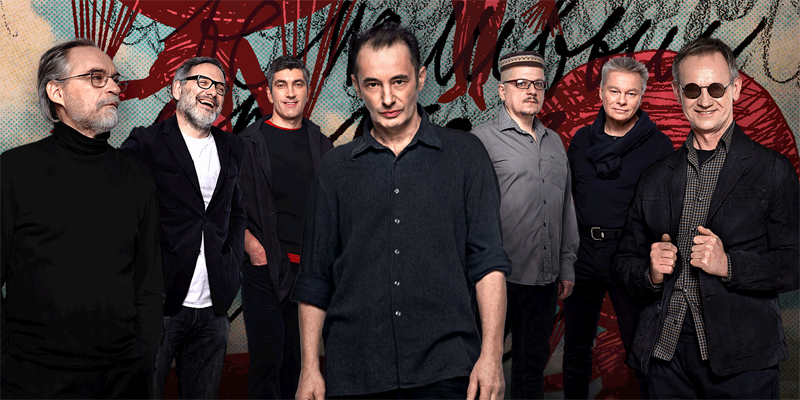
On October 23, the group “Polite Refusal”-a vivid symbol of the Moscow rock avant-garde -celebrates its 35th anniversary with a large special concert in Glavklub . Analyzing their creative path, Grigory Durnovo tries to seize the essence of the hard -to -the -abundant music of the honored group. As a gift from themselves - the premiere of several freshest concert videos.
When you start a conversation about the “Polite Refusal” group, difficulties begin almost immediately. From what moment it is fair to start the countdown of its history - from the first steps that were really 35 years ago and led to the record of the first album, or still from the period that came later, when the distribution of functions in the group radically changed and the sound that we will find out today recognize the “refusal”? By the way, what is the sound? Is it really the same as in the second half of the 1980s ? And what is generally a “polite refusal”? Is this a rock band ? Is this Russian rock? What it looks like, are there any analogues in the domestic or western (rock-) music ? And so on.
Both the creative path and the actual work of the “polite refusal” were described more than once, including with a very deep cultural analysis . Without claiming such immersion and coverage, we will still try to indicate the most basic observations.
PREMIERE:
"Polite refusal" - "Bolshevik"
Music
It was repeatedly noted that “polite refusal” - of those groups for which music, of course, is in the first place. The leader of the group Roman Suslov also spoke about this. At a rather early stage, the “polite refusal” became for Suslov - the guitarist, the vocalist and the only composer in the collective of the composer - the space for the implementation of his own musical ideas. And if at first in the songs of the “refusal” it was possible to hear the echoes of a new wave or reggae, then from the late 1980s specific guidelines are becoming quite difficult to isolate. Suslov attract complex structures, cunning rhythmic drawings, unexpected pauses.
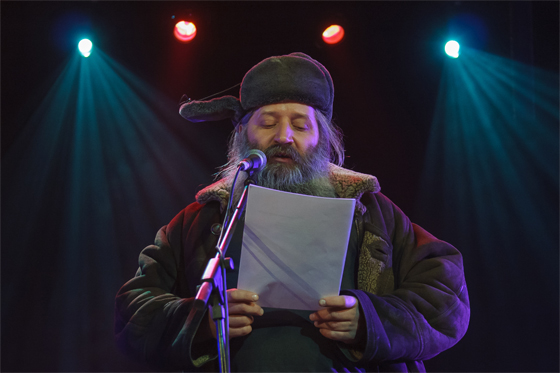 © Alexey Ivanov Peter Pudvinsky on the stage of the Moscow Art Theater named after Gorky. 2006
It is curious to trace how, in accordance with the ideas about the correct sound, the instrumental composition of the group changed. The first, almost prehistoric, album “Opera” (aka Opera-86 ), where Suslov has not yet entered full force, marked by the dominant role of the synthesizer, which was played by Peter Pudinsky-the author of the first texts and part of the music, as well as the names of the group, which left it just after the “opera”, and electronic shock. There will be nothing similar to this enveloping sound “refusal”, and after some time, shortly after short experiments with the piano and saxophone, the group under the leadership of Suslov comes to the mean trio - guitar/vocals (Roman Suslov), bass (Dmitry Shumilov), drums (Mikhail Mitin).
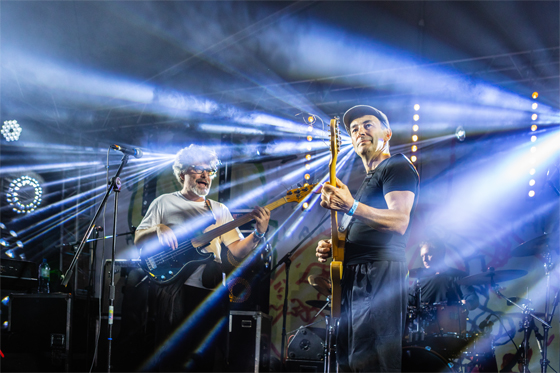 © Vladimir Lavrishchev Dmitry Shumilov and Roman Suslov - “A Polite Refusal” at the Form festival. 2018
Then the piano (Maxim Trefan) again joins the trio, a honed, sharp, cold sound acquires an additional dimension, becomes more convex - and only after that, and not immediately, the group begins to grow with other tools: as a composition, a pipe, a saxophone, and later a violin appear as constant tools. And if in former times they were given roles like weaving patterns, creating excesses, beautifulities, hints in some easily identified styles, now they are now more clear, more strictly defined, their appearance here and here is more than due to the logic of the structure of the work. Which, however, does not cancel the possibilities of elongated free soloing. By the way, it is important to note that even in recent years, from time to time, “refusal” appears at concerts in a truncated composition up to the same trio, thereby emphasizing the adherence to the long -established principles of music.
Often, when trying to describe the music of a “polite refusal,” I want to use denial. About the program of the late 1980s, “Ethnic experiments”, played above the quartet with the piano above, the bassist of the group Dmitry Shumilov said: “A little jazz is played by such a standard-jazz set of instruments.” He more than two decades later described the work of the “refusal”: “Modern chamber music played by means of rock band ”-in other words, not rock. The draft name of one of the programs of the program of the late 2000s is “not blues”. Well, the “opera”, of course, was not a “opera”-and in the very last program for today, “romances”, there is not a single romance in any usual sense.
PREMIERE:
"Polite refusal" - "Roman 2"
Of course, this music is not born out of nowhere, and in other fragments, one can see a clear or implicit, intentional or non -mentioned similarity with the same jazz (both archaic and freris), then with Western avant -garde rock, then with not the most famous works of Russian academic music of the XIX and XX centuries, then with urban genres, then with Russian people Hungry (“Topivka”, by the way, is called one of the numbers on the album “Ethnic experiments”). But all these are details, crumbs, commas, scattered in different places, appearing and disappearing on a common thick canvas. Sometimes Suslov, by his own admission , uses stamps, “completely battered musical forms”, “verse-derivative song form” with too familiar harmony-“but paradoxical and ridiculous topics develop inside this.” In the last program “Military Cuties”, fixed in the form of a studio album, are scraps of melodies, which are remotely reminiscent of Soviet military songs that Suslov, according to him , “filled their sores at one time,” and now they become “signs that you want to send to completely different musical worlds”. The prototypes of these scraps seem to sound in the head before composing and during execution, implied, are meant and even, maybe, they are somehow transmitted to the listener-but, of course, they are not performed in a pure form.
Perhaps the crown on the path to the complication of the musical language was precisely the program “Military Films”, in separate works of which you can hear two, or even three completely different lines.
Interestingly, in the same “military verse” with the most difficult structures, probably the simplest song “We will win!” With convincingly overwhelming, memorable, unpretentious melody and loss.
Like hints of someone's works and some styles and directions, similarities of concepts are hidden on “refusal” canvases, those ways to transmit ideas with musical means. The group in history had several cycles united by a common idea or a way: “Ethnic experiments”, a series of dances in the program “I-time! ..”, “Military Bipes”, “Romances” (and some less obvious, emerging in several numbers of some album). But every time in these programs there are no obvious musical instructions, transparent interpretations of these ideas and images - still hints, semifrazes. Suslov told about the work on “I-and times! ..” that he “distributed moods” to the musicians: “Various characters were taken and dragged into the pseudo-dancing language.”
And what is generally a “polite refusal”? Is this a rock band? Is this Russian rock?
If we try to collect everything described above, then we will probably be able to get to the likeness of understanding: there is nothing in the music of “failure”, to the end of the defined. Perhaps that is why rock as one of the most straightforward directions is not close to Suslov (however, this statement is not completely true: see below). There is no place for pure heroism, pure lyrics, there is no place for Paphos (every time something is heard, similar to pathos, they make it clear to us that this could be the irony). Here everywhere, as Suslov says in an interview , “the question“ is it true? ”, Doubt, not a statement”, a break in thought, a conflict of ideas and states, “an element of deception”. “I need not to be“ like that, ”but“ as it were, ”I am trying to do it,” the leader of “refusal” concludes his thought.
Perhaps from here comes the dislike of Suslov to fix the material. He often says that he is reluctant in the studio, only because he is convinced of the need for this. Being recorded, the material seems to stop living. On the contrary, not even fully designed, damp works of the horses are completely not averse to presenting to the public, to run into it. Apparently, with all the complexity and discharge of many numbers, he does not like worshipers and excessive “premises”: it is important that there is more passion than accuracy. The recording of the album “Military Films” was under the slogan “More dirt, less academicism”. Now, according to Suslov, the group is trying to combine the principle of “more dirt” with almost academic accuracy and training, which the leader of the “refusal” requires musicians.
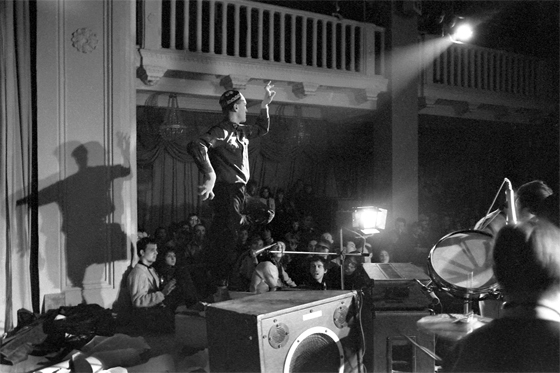 © Alexander Zabrin Mountain Ogansyan-“Polite Refusal” at the festival of the Moscow rock laboratory. 1986
Text
In a sense, a “polite refusal” by its example simultaneously confirms and refutes the battered thesis about the logocentricity of the notorious Russian rock (if you use this term). On the one hand, for several decades, serious authors worked for the “refusal” - poets and co -founders of the group Peter Pudvinsky and Arkady Semenov, Gore Oganisyan, Grigory Dashevsky, Mikhail Prorodkov. Moreover, in most cases, poems were composed under the already finished musical form. She was in the repertoire (in the earliest period) and the song for the verses of Oleg Chukhontsev. In total, the authors of the texts, except for quotes, were eleven, including Suslov himself, who gradually moved from the “phonem language” to full-fledged texts, and now his former wife Anna Artsikhovskaya-Kuznetsova.
“Polite refusal” - “lethargic sleep”
On the other hand, already in the second half of the 1980s, the work of “refusal” appears and the further, the more confident the works in the so-called phonem language. It is characteristic that the group created very little pure tools in its entire story: Suslov believes that vocals owns better than a guitar, with vocals he feels more freer and more interesting to work. In addition, I did not want to abandon the “poster, shutter presentation” of the text, from “pronouncing from the scene” - otherwise, they say, what is “rock and roll” (the so -called song from another program “refusal” - “braid on stone”; thus, at all from the “rock” of the horseshoes are not rejected). But the text as such, the text with the words the farther, the more the utilitarian function performs, serves, first of all, to musical purposes. The word, according to Suslov, becomes an instrument, the text is a designation for creating musical images.
"Polite refusal" - "LZ"
The texts of the songs would probably correctly analyze in the context of a particular album, and not the whole work of the group - in any case, within the framework of a small material, this would definitely be an ungrateful occupation. At the same time, one cannot fail to note some common, as if by accident, gradually arising in different works of different periods of the topic - war, space, dancing. In addition, starting with “ethnic experiments”, a group led by Suslov in various ways is selected to understand the Russian, Slavic principle, something ancient, primitive. Phraseological turns, and textbook images, and the same “phonem language”, which for the most part, are perceived for the most part, are also obsessively penetrating into the texts of Suslov as a native (“native language” - the name of another song “Refusal”).
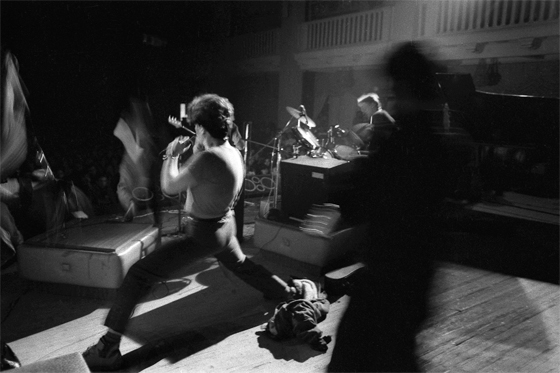 © Alexander Zabrin Arkady Semenov-“Polite Refusal” at the festival of the Moscow rock laboratory. 1986
Wednesday
It will be appropriate to say, probably, although, although there are many threads to various musical (and not only musical) circles from the “polite refusal” and its participants, the “refusal” itself did not belong to any circle. First of all, due to the reluctance of Suslov’s novel, to participate in the “active creation of a backstage imitation of creative life”. True, something like the cradle of the “refusal” was the artistic environment of MEPhI students in the first half of the 1980s , formed around Peter Polinsky and Arkady Semenov. But people from this company eventually parted in their creative corners. Of course, in the early years, the “polite refusal” performed a lot at the prefabricated rock concerts -and where else could it be performed then? But it was impossible to reckon the group to any rock test , although it was from the rock testing that the violinist Sergey Ryzhenko got into the group; In addition, Shumilov and Ryzhenko were shot in one of the turning films in the history of Russian rock - the picture of Sergei Solovyov “Assa”. Rather, we can even talk about a closer connection with the world of avant -garde jazz - thanks to the active activity of the trumpeter Andrei Solovyov and partially Basist Dmitry Shumilov (perhaps therefore, the Valtornist Arkady Shillopper also took part in the records of “refusal”) - or modern academic music due to the fact that for many years the composer Pavel Karmans was the pianist. (It should be added here that Suslov himself grew up not only on rock, like many of his peers, but also on academic music-his father gathered a large collection of records.) “Polite Refusal” twice-with an almost 20-year break-took part in the large-scale work of Karminov “Vertep” and even wrote two versions of the episode “The Death of King Herod”, one of which was firmly included in Concert repertoire of the group.
PREMIERE:
"Polite refusal" - "The death of King Herod"
In addition, thanks to Karmanov, Suslov met with the pianist and initiator of many interesting sound projects Peter Aid, as a result of which Suslov tried himself as the performer of the song of the songs of the composer Alexander Mosolov, Aida several times performed the composition “Refusal” of the “bell”, and in several songs of the group “Persimfans” played - revived by the aid of the first Symphony ensemble without a conductor. All these were interesting experiments, however, unfortunately, they did not have continued and development.
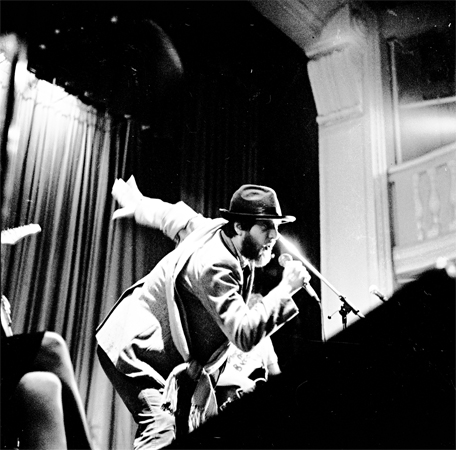 © Alexander Pigarev Swan Gundlah on the stage of DK May. 1987
An important part of the life of “refusal” was cooperation with poets and artists-in the second half of the 1980s the group’s concerts had the character of performances, the poet Arkady Semenov recited under the spray of the piano, the mountains of Oganisyan sprinkled the scene with Truehoy, stuck in the form of sculpture and pounded a piece of raw meat on the violin. In addition, Suslov himself, according to his own memoirs , “three years dangled among conceptualists, among people such as“ fly agaric ”and“ collective actions ””, which resulted in, in particular, the logo integrated from the history of the group, created by one of the “fly agaric” by Sven Gundlah. But all this also went away: the group focused on music. There were attempts to connect the program “I-and times! ..” with professional dancers, but the topic was exhausted by one conceptual television. This musicians were performed in specially selected spectacular white costumes of the 1920s-1940s , but this idea remained in the distant past. Together with the music, several convincing images and logos created by artists Sven Gundlah, Dmitry Gutov, Konstantin Stepsdovtov, Igor Gurovich and Yaroslav Schwarzstein were fixed with the group.
Meanwhile, the “polite refusal” itself, in a sense, already resembles a family, home: you can leave it, but you can’t leave it for good. Suslov in the early 2000s announced the cessation of musical activity, but three years later he returned with a seemingly younger group. So some musicians who left the group for a while - pianist Maxim Trefan, saxophonist Pavel Tonsilid - returned and continue to participate in new programs.
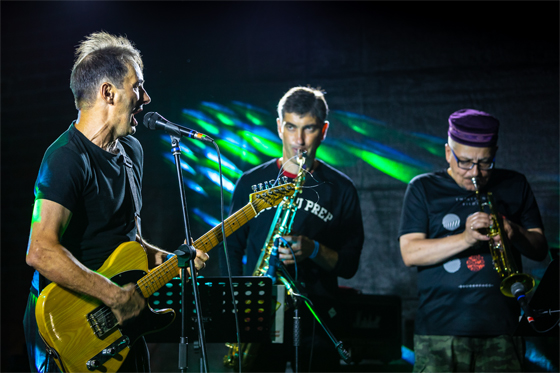 © Vladimir Lavrishchev Roman Suslov, Pavel Tonslid and Andrey Solovyov at the Form festival. 2018
It remains to recall that since the 1990s, a constant habitat of Suslov has been a village. The collective farm, the horse factory, the construction of the house, the production of pastille, the rental of horses, in a word - rural life and production activities in different manifestations replacing each other, and in the breaks between this - music. From the guitar and microphone, the leader of the group always returns to the stove and tractor. These circumstances, of course, are even more complicated by talking about the nature and genesis of the music of a “polite refusal”, because it is not clear where it comes from, from which it is born. On the other hand, they have already become so much part of mythology, which grew up around the group, which, perhaps, several and simplify the picture.
The group continues to develop, Suslov is working on a new complex material. Each performance of “refusal”, and before the pandemic appeared on the stage not so often, can be considered an event. And with all perfectionism, reflected in studio records, live performances are sometimes much more powerful and interestingly recorded on albums. “A polite refusal”, especially today, is the group that is interesting (and, perhaps, it is necessary) to observe the work in real time.
Links to the concert “Polite Refusal”. 35 years to the group ":