
Translated material
Architecture of the Moscow metro. 1935-1980s-Analytical Portal Polit.ru
Olga Kostina 

Polit.ru continues to acquaint readers with books included in the long list of the Enlightener Prize 2020. What books will be included in a short list of applicants will become known on September 17.
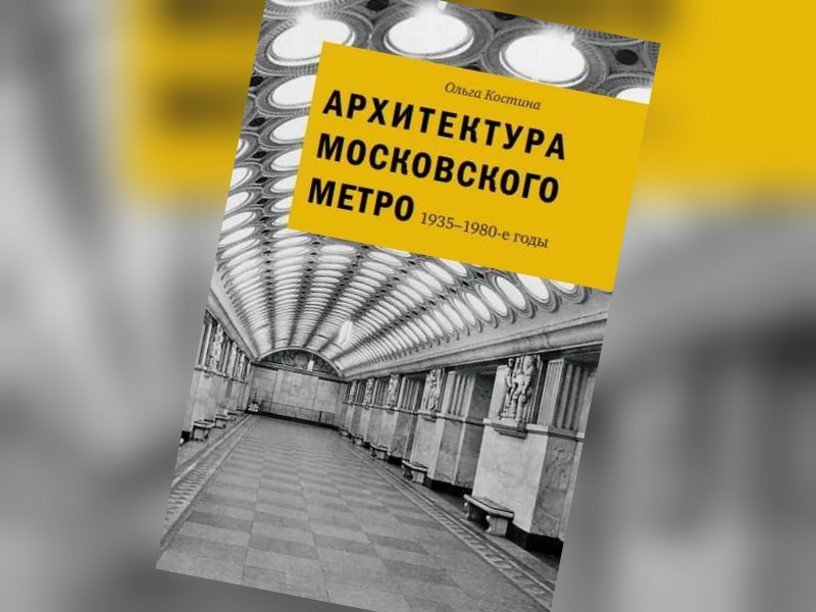
The publishing house Buppmart represents Olga Kostina’s book “Architecture of the Moscow Metro. 1935-1980s. "
The book is dedicated to the artistic appearance of the Moscow metro and is an art history research that considers the architecture and monumental art of metro in the context of the socio-historical development of Russia. The Moscow metro was given one of the significant places in the mythological picture of the art of the USSR. The words of L. M. Kaganovich, who sounded in 1935 from the government rostrum at a solemn meeting in honor of the launch of the subway-“that neither the station, the palace, that neither the palace was designed in a special way,” became determining for the ideological leadership of the construction of the subway, and for the creative thought of the architects. Nevertheless, the aesthetic images of the stations were formed in the context of independent spatial-stylistic searches of architects. The central theme of the book is the historical evolution of the volumetric-spatial and figurative-plastic concepts of domestic metro construction, the addition of its unique traditions. Passing in 2016 at the Museum of Architecture. A.V. Shchuseva exhibition “Moscow metro-underground architectural monument” provided the opportunity to look at the aesthetic problems of metro construction in a new way. The publication includes the documents and memoirs of the creators of the first bonds of the metro (some of them were recorded by the author of the book back in the 1980s), illustrated with color photographs and archival materials.
We offer to read a fragment dedicated to changes in the architecture of the metro in the late Soviet period.
By the 1970s, the aggressiveness of technicalism in the metro architecture is noticeably weakening. First of all, this is due to the general processes of the development of architectural and spatial thinking. In the late 60s, the tendency began to form the environment with separate, individually solved objects, focused on the complexity of the emotional sphere and the diversity of personality manifestations of a person, and not just his practical requests. The idea of the plastic space of the environment, realized not episodically, not on a wide urban planning scale, but in separate works (for example, the Moscow Art Theater Bulvar Building Building /1974 /, TASS /1977 /, the N.I. Sats /1979 /1979 /) children's musical theater, began to find the embodiment in the metro architecture.
This was facilitated by a competition, finally announced in the late 60s, to a group of stations of the Tagansko-Krasnopresnenskaya and Kaluga-Riga lines. They joined in the early 1970s. These stations are a clear example of how difficult the “muscles” increased the metro architecture. The fear of “excesses” is still alive, but there is already a disgust for the faceless sterility of platform spaces. “Muscular efforts” appear in unusual forms of columns (“Square Nogin”, “Begovaya”, “Schukinskaya”), in the active plastic of pylons (“Barrikadnaya”, “collective farm”), in the volumetric arrangement of the arch (“Turgenevskaya”). Often these efforts are accompanied by clumsy design “grimaces” in the form of heavy metal cornices, rough panels, masking ventilation chambers, massive lights that divide the space of underground halls.
Architect N. A. Alyoshin. Project of the Chertanovskaya station, 1983
From the collection of the Museum of Architecture. A.V. Shchuseva, Moscow
Architects N. A. Alyoshin, N.K. Samoilova. Project of the metro station "Kuznetskiy bridge", 1975
From the collection of the Museum of Architecture. A.V. Shchuseva, Moscow
Architects N. A. Alyoshin, V. S. Volovich, N.K. Samoilov, with the participation of R.P. Tkacheva. The project of the metro station "Marxist". Fragment. 1979
From the collection of the Museum of Architecture. A.V. Shchuseva, Moscow
But the main thing that drives the authors in their search for plastic, albeit not always successful, techniques - this is longing for the imagery of the stations. In two of them, it casts in forms that have concrete associativity. On “Sukharevskaya”, the foundations lined with yellow marble are similar to sheaves, and on the “barricade” “folded” pylons trimmed with red-brown slabs resemble banners of banners. Such a thematic move for both stations is organized, because it is not intrusive, not burdened by the decoration, supported by the proportional verification and co-knitting with a person of a general spatial-composite solution.
In these stations - in their massive pylons, certain literature - the memory of traditional values in metro construction is imprinted. And yet they are, as it were, the reference point for the new, modern stage of metro architecture. The design authors came to him with a rich and conflicting experience, which provided the possibility of choosing fruitful ideas and gave an impetus to the development of new concepts of underground urbanism. The tradition of the individual imagery of the stations is developing again. To do this (of course, as far as the technical base allows), the arsenal of language tools, such as architectural plastic, the game of spaces, sculptural decoration, monumental-visual and design design, increase. But this language is now much more restrained and concise than before.
The station “Kuznetsk bridge” (architects N. A. Aleoshin, N.K. Samoilova, 1975) is distinguished by expressive laconicism of architectural techniques. The wide openings between the columns and the arcs uniting them create a sense of the integrity of all three naves of the pervor hall. The height of the arches and the light gamut of marble cladding inform the space of free breathing, a clear drawing of the arched colonnade appeals to historical memory, causing specific associations. Of course, all the images created by N. A. Aleshina during this period (and in general, on her account as the main designer of an object of more than 20 stations), is gratitude to the great artist, predecessor and teacher A. N. Dushkin, with whom her, a very young specialist, brought fate during the construction of Novoslobodskaya. The author dedicated to him the Chertanovskaya (1983) station, emphasizing the features of prototypes - “Kropotkinskaya”, but especially “Avtozavodskaya”. This is manifested in a wide “step” of columns, their elongated proportions and the shape of the capitals, for which independent reinforced concrete details of the structure were specially made according to the architect’s project.
If the “Chertanovskaya” and “Kuznetsk bridge” are concrete in its associativity, then directly related to the “Kuznetsk bridge” “Pushkinskaya” thanks to the artistic design dedicated to the Pushkin topic, concrete in its narrative. But also plastic more fractional. The viewer's gaze (and in the subway we are both passengers and viewers) dwells on stylized images of laurel branches and outlets framing the arch, is inhibited by figurative reliefs on the waybill, including poetic quotes, “clings” to the bands of the foundations, lusts on the openwork silhouettes of the lusters. Nevertheless, in the image of the station there is emotional energy and a bright mood.
Architects Yu. V. Vdovin, R.V. Bazhenov. Sculptures V.K. Krotkov, M. A. Shmakov, A. Leontiev. Artists V. A. Bubnov, G. Ya. Smolyakov. Reliefs on the track walls of the Pushkinskaya station, 1975.
This presence of a living human feeling is one of the main positive qualities gained by the architecture of a number of metro stations in the 1970-1980s. The diversity of sensations and emotional impressions is carried out by the stations of the Serpukhov and Zamoskvoretsky radii, commissioned in the mid-1980s. Even within the standard types of structures, their authors find opportunities for creating a special figurative world. As, for example, on the “Nagatinskaya”, where the measured rhythm of powerful round pillars, the compositional balance of volumes and spaces, the warm color of the Florentine mosaic, which is completely covering the waybills, communicate the epic to the general architectural-resolution.
Architects L. N. Pavlov, L. Yu. Gonchar, A.P. Semenov, with the participation of I. G. Petukhova and N. I. Shumakova. Artists V.K. Vasiltsov, E. A. Zharynov. Metro station "Nagatinskaya", 1985.
Photo from the archive of E. A. Zharinova, Moscow
The thematic programs are being developed for stations, and this brings a new wave of visualization. But what is interesting: where monumental painting, relief and sculpture are “attached” to architecture according to the laws of the traditionally understood synthesis, there is a feeling of optional or worse, violent association of arts. In the same place where visual objects do not hide their claims to an independent, emphasized exposition role, a new quality of the environment is born. Such examples are sculptural compositions in the lobby of Orekhovo station (sculptor L. L. Berlin, 1985) and at the entrance to the Konkovo station (sculptor A. N. Burganov, 1987; unfortunately, the author had to be dismantled in the reconstruction of the adjacent territory). They outlined a new way to create a functional and aesthetic context of urban life.
Sculptor A.N. Burganov. Reliefs in the Northern Veronnaya Hall of the Tretyakovskaya metro station. Architects R. I. Pogrebnaya, V. Z. Filippov. 1986.
Photography from the archive of N. A. Burganov, Moscow.
The appearance of such works gave hope. The imagination then painted the cozy district exhibition halls adjacent to the lobby of the metro; I wanted to think that at first the meeting with art will become “forced” thanks to the metro for hundreds, and maybe thousands of people, as they say, “towards the beautiful”. In the early 2000s, the metro became a popular “hero” of literature; It is interesting that the well-known “post-apocalyptic novel” “Metro-2033”, published on the Internet in 2002 (in paper version, the book was published later), the author of D. A. Glukhovsky began to write in the high school of the school.
As the metro lines and an increase in the number of stations, the world of underground urbanism, began to be felt as an independent organism that can turn into a person both in salvation and horror (and in the novel Glukhovsky he is both salvation and horror at the same time). In the late Soviet period, the understanding comes more and more clearly that the metro should be not only a chain of tunnels, halls for stops of trains and premises for entering and exiting passengers, but also an important, multifunction part of the urban environment. Such a prospect seems to be logical, but, of course, a modified continuation of the path along which domestic metro construction has still developed. However, while architects think in the framework of the old paradigm: sculpture, most often a relief, in the end of the platform hall, relief or mosaic on travel walls, over the escalator ...
The situation in the metro architecture in the 1980s is a situation of reconciliation of different trends. Here is the tendency to comprehend the underground space as a front interior, the traditional “palace” of which sometimes acquires an increasingly tough “administrative” shade. Design ambitions flourish. The consequence of this: everything that passengers provides comfort and needs increased attention, that is, information, lighting systems that give life to a non -in -and -case space, a bench to wait for trains and relaxation, is a vulnerable area of the metro. The thematic programability of the architecture of the stations is enhanced, their individual imagery develops - this is how fidelity is manifested by domestic traditions. At the same time, the architects themselves have a thought: is our metro construction too isolated from world experience too isolated? The path of plastic understanding and decorating the station design, which made our metro unique - yes, it is organized for us, moreover, it was checked by the practice of metro construction. But did this path bend, is the development of architectural and composite thoughts itself?
It is the search for constructive truth that generates in the last years of the Soviet period the most interesting decisions of the underground halls. These are groups of single -breeding small laying stations - “Tula” (architects of I. G. Petukhov, V.P. Kachurinets, N. I. Shumakov, 1983), “Nakhimovsky Prospekt” (architect V. S. Volovich, L. N. Popov, V.I. Klokov, G. Moon, 1983), “South” (architects by V. A. Bazhenov, 1983). In their one -month, the connection with the constructive foundation of metro - tubing is emphasized, the idea of confrontation with the pressure of the soil is expressed in the vault outbris, and in the integrity of space - the concept of space, path, and free movement. The image of each station is specified by a few details that create an individual rhythm of the dynamics of the compositional space: either pilasters on the track wall, or the adolescence arches of the ceiling, or, as at the Nakhimovsky Prospekt station,-lamps located according to the vault. The desire for the purity of compositional-spatial decisions and the clear emotionality of images, not muddered by the introduced meanings, bring these searches closer to the experience of the early 1930s, in particular with the legacy of N. A. Ladovsky in the field of metro architecture. And this line is seen one of the most promising, for it is sequentially “anti -interior”, turned to the city.
Architects V. S. Volovich, L. N. Popov, V. I. Klokov, G. S. Moon. Metro station "Nakhimovsky Prospekt", 1983
Shooting A.V. Popov
An example of searching for communication with the urban environment is an example of the Borovitskaya Porcelain Hall (architects L. N. Popov, V. S. Volovich, G. S. Moon /Participation in the design of the lobby /, artists I.V. Nikolaev, M. M. Dedov-Dzedushinskaya, 1986). The plastic language here is emphasized material, but also associative, even literary, telling about the “root connection of the past with the present”, that the metro is “not in the virgin continent, but in the thickness of historical strata in a portable and literally, literally in the cultural layer.” The historical narrative is burdened with a detailed visual side. This train of literary and ideological comment, which is traditional for our metro, is hiding in the fog of the concepts of “synthesis”, indicates the transition of the stage of the 1980s, the compromise combination of the former sovereign representation and purely plastic eloquence of the image.
Artists I.V. Nikolaev, M. M. Dedov-Dzedushinskaya. Ceramic panel "Friendship of the peoples of the USSR" in the end of the Porrene Hall of the Borovitskaya metro station
Testing A.V. Popov
The articulated plastic of the Borovitskaya station is built on a bold combination of the textures of contrasting materials, masses and voids, light and shadow. By the way, the reception of light -leaf modeling of the form and light game in the space of the station is one of the creative handwriting of the ideologist of her project L. N. Popov, which emphasizes the underground nature of the building. “Borovitskaya” is interesting, however, not so much as an example of “non -plasticism”, the substantial historical “lyricism” or the struggle of the old with a new one, as an example of the search for connections with the urban environment - relationships of both semantic and spatial, forming a complex subordination of functional zones located at different levels: vestibules, escalator halls, descents, crossings, perronons.
Architects L. N. Popov, V. S. Volovich, G. S. Moon (participation in the design of the lobby), 1986
Testing A.V. Popov
As you can see, the last stage of the Soviet period of development of the metro architecture was polyphonic and contradictory. It did not observe any one dominant trend. But the confrontation of different ideas and the activation of opposite traditions was born. The dialogical situation is always fruitful. This time was fulfilled with forebodings and hopes: the forebodings of the birth of a new concept of underground urbanism and hopes for the upcoming creation of a human, multi-level city-house city. Are these hopes justified and are forebodings come true? This issue at the beginning of the XXI century poses to the researcher the very development of domestic metro construction - stormy, colorful, but excitingly interesting.