
Translated material
The skeleton in the kokoshnik
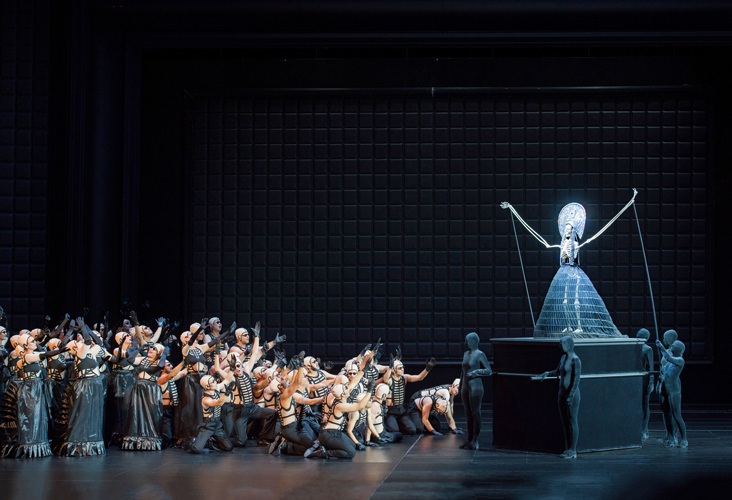
Hans Neuenfels, inventor and provocateur 77 years old, returned to Salzburg after a 17-year break. At the end of the Executivey of Gerard Mortier, he put here a scandalous, revealing “bat”, which caused a storm of indignation. His current “Queen of Spades” is an amazingly stylish, smart, smart, not causing and cool in color. The semantic accents in it are placed extremely distinctly, the main idea is convexly and clearly, and the well-aimed characteristics of the characters make Pyotr Ilyich Tchaikovsky’s opera masterpiece in a new way.
The restrained stage decision was fully supported by Maris Jansons, standing behind the console of the Vienna Philharmonic Orchestra: a rich tint palette, a subtle timbre game, an expressive, but not a pathetic tone and amazing transparency of the textured layers. The numerous echoes, who are so rich in the Tchaikovsky score, are especially pleased with the scores. Lovingly covered with the conductor, they sounded so convex that they created a special, purely musical plot inside the opera drama. Jansons and Neuenfels, belonging to the same generation, met for the first time - and, perhaps, got along.
The “Queen of Spades”, the most important element of the notorious “Petersburg text”, for the German Neoenfels, is an occasion to reflect on the themes of the social outsidation of Herman, the social rebellion of Lisa and the naughty loneliness, overtaking a person in old age. And he also emphasizes the obvious, but still important thought: nothing - neither power, nor glory, nor wealth - not insured from the collapse of love and hopes. This is about Prince Yelets (excellently seduced and played by Igor Golovatenko), whose role is enlarged in the play. Following the Tchaikovsky brothers - Peter and Moddest - Neuenfels represents him as an example of spiritual nobility. Yeletsky and Herman are antipodes in everything: in the manner of hold on, in relation to Lisa, in the motives of behavior and life goals.
 © Monika Rittershaus
The moment of Yeletsky’s explanation with Lisa is very important. While he sings his delicate and universal aria, ending with the words “Oh, dear, trust me!”, In front of Lisa's eyes, paintings of her future unfulfilled life are facing. A dining table leaving, covered by five people, leaves. The prince sits her at the head; A girl with pigtails runs out and buries her face in her skirt - as if Lisa prayed to give her life, to give her opportunity to be born; For her - the second, smaller, daughter and fair -haired boy in a sailor suit. Lisa in confusion, she begins to realize what she refuses. Everyone decisions at the table, Yeletsky gives a sign to serve hot. A nanny enters with a baby in her arms. This vision finally crushes the spirit of Lisa, and she is a stupid run from family joys - towards storms, German and an ill -fated fate.
It became a common place that Herman was a matured Lensky: what he could become if he had not been killed on a duel. You can continue: Lisa is a more decisive Tatyana. Like Tatyana, she suffocates in her circle, she lacks air and will. But, unlike Tatyana, who humbled her dead life with a loving and solid husband, Lisa does not compromise - although he knows what she threatens for her. And he prefers stormy, risky love without the future - a ensured and peaceful existence.
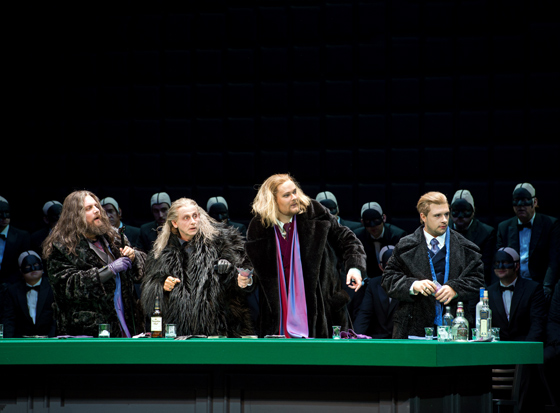
Not that of Herman. Love does not matter to him; social status is important to him. It is bred by an outcast, strange and gloomy, depressed, subject to sudden outbursts of passion that mix and scare his comrades. He is much poorer and lower than them in position, and this inequality torments him. At all costs, he needs to break into people. There is nothing demonic in his appearance. But he destroys the lives of worthy and noble people. In its inflamed consciousness, the world is compressed to the scale of the gambling table covered with green cloth, and people become irreal, like card figures.
 © Monika Rittershaus
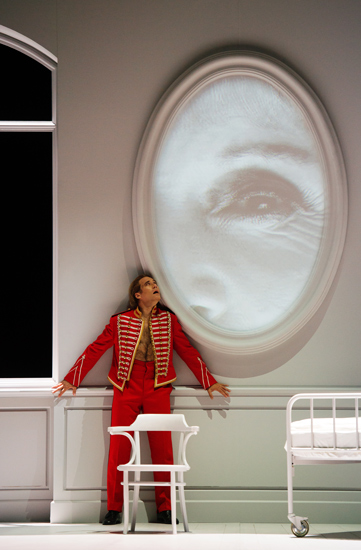
The red hussar uniform with golden gratings marks his dissimilarity with the rest. Only the German and the younger countess-in a flirty acid green dress and with a bright red wig on a bald head-are knocked out of a common gray-white-black gamut.
But who rules the ball in this monochrome world? Of course, death itself. In the final of the second act, a crowd of guests, suddenly losing plumages and sparkled with bare skulls, in horror, mixed with admiration, backs back: they are waiting for the ruler. "Glory to Sim, Catherine!" - Sings the choir, and the four gray, rainy servants solemnly roll out a pedestal on which there is a skeleton in a high kokoshnik, raising bony hands.
The countess, on the contrary, loses the usual connotations, which distinguishes her with a lady peak - the lord of the game and the harbinger of death. Countess-an overripe girl-Neuenfels puts it in a sterile-white hospital boxer (Hannah Schwartz, the director of the director, played and sang a role brilliantly). Small, miserable, bald, she sleeps in a chair, hanging to one side, like a broken doll. She wakes up from the careful touch of Herman; Having not yet really examined who it is, gullibly reaches for a stranger. He climbs, stroking his face, tries to kiss. In this love beggarity, there is so much prayer and touching hope that the heart is compressed with pity.
 © Monika Rittershaus
The scenographer of the play Christian Schmidt is the one that last year formed Aida, the nuclear -shaped nuclear, worked a lot with Christoph Loy, Andreas Homoki and Hans Neuenfels himself. He created on the huge scene of FestSpilhaus a closed space of a huge cabinet, from the scene to the grates sewn with soft gray pillows. Thus, the walls in the rooms for the violent are inhabited. In essence, who is Herman, if not hindered?
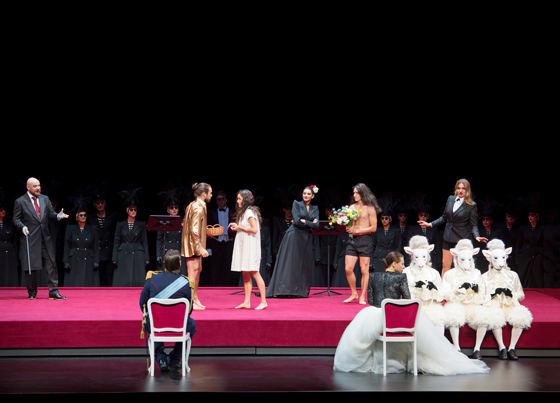
Costume designer Reinhart von Trainnen, who has repeatedly recognized the designer of the year by Opernwelt , has been working with Neuenfels for forty years. Therefore, in their joint performances, rhymes and repetitions constantly arise: Lisa, who appears at the ball in a magnificent white skirt with a bell, resembles Elsa in their Bayroit Lournerin. However, this is not her only suit. In all her outfits, the artist emphasized the noble severity of the silhouette. It was nice to watch Lisa performed by Evgenia Muravyeva. And she sang the party with dignity, truly sincerely and dramatic, strong, flexible, bright soprano.
Vladislav Sulimsky in the role of Tomsk flashed in his frivolous verses. As for Brandon Jovanovich - Herman, for all the strength, endurance and excellent timbre characteristics of his dramatic tenor, the singer has a very significant drawback: he is poorly dealing with a sense of rhythm and pace. It is impossible to suspect Jansons that he firmly showed the entry into the singers: everyone else sang like a string. And only Jovanovich was gone, then he ran ahead, periodically swallowing sounds and not knowing how to sing three notes in a row. And in the stage in the summer garden - oh horror! -Simply, he “let the rooster” in the most important climax. In addition, his Russian has not become better since last summer, when he sang Sergey in Lady Macbeth of Mtsensk district. So in the Salzburg performance instead of Herman, Lisa dominated.