
Translated material
The son is responsible for his father
For the third year in a row, Theodore Krentzis became the headliner of the largest and most authoritative European festival, this time not with the Musicaeterna native orchestra, but with the Stuttgart SWR and the Freitburgh Baroque. The triumph after the performance of the seventh symphony of Shostakovich, and then the subtle, smart and informative statement about the Idomena, underestimated the early opera of Mozart, not only strengthened his status in Salzburg, but once again confirmed the correctness of the exchange rate of theMarcus Kh Integuser , who made a bet on this “dark horse” at one time.
Like the “Mercy of Titus” in 2017, the premiere of Idomena opened the opera program of Salzburg-2019. Much is connected by these two performances for Mozart opera: in fact, this is a diptych with the same composition of the directors - director Peter Selars, scenographer George Tsypin, light artist James Ingalls. And Krentzis as a musical leader. The tandem of Sellars and Kurentsis was checked over the years of joint work. All the “Queen of the Indians” of Persella in Perm, but they met even earlier, in Madrid, where the Opera Diptih “Iolanta/Persephone” in Teatro was together with the light hand of Gerard Mortier. Real . Mordier definitely understood that these two would harmoniously complement each other. Krentzis and Sellars are visionaries: everyone is confident in the uniqueness of his mission, that the world transforms the world with their art. Krentzis, for example, has repeatedly declared the intention to translate classical music from the category of Entertainment into a kind of sacred service and spiritual practice. And, as time has shown, it succeeded a lot in that.
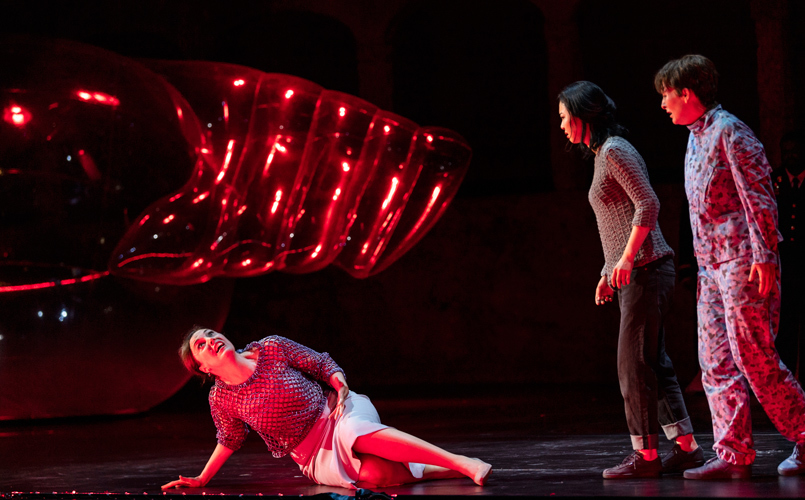
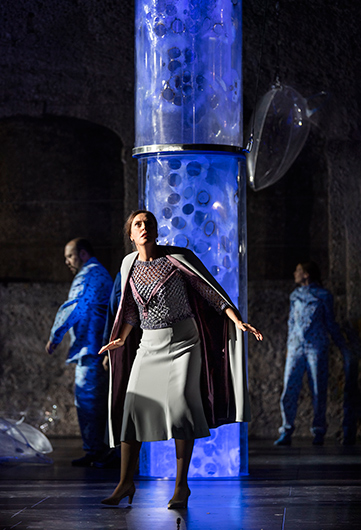
Tsypin's stage constructions become more abstract and more concise. He knows how to express the general idea of the production in extremely generalized forms cleansed of vulgar objectivity. In “idle”, such an idea was the ocean, the immense and mysterious water element, embodied in the form of a variety of transparent bubbles. Fantastic creatures resembling giant amoebas, jellyfish and fish slowly crawl along the stage. Rows of columns and wide columns (also in the “Titus”), glowing blue, blue and red, periodically grow from under the stage. They symbolize the elements of fire, air, water; In some cases, red turns into the color of passion, revenge and blood. The main dramatic climax is in the opera for the final of the second act: a terrible htonic monster crawls out of the sea waves - a messenger of an angry Poseidon - and it is taken to exterminate people and destroy everything around. Here, a laser show is connected to the invasion of bubbles: the visions of unknown continents and waters are unfolding on the flickering plane, into which transparent fish suspended on the ropes are dipped.
 © Ruth Walz / Salzburger Festspiele
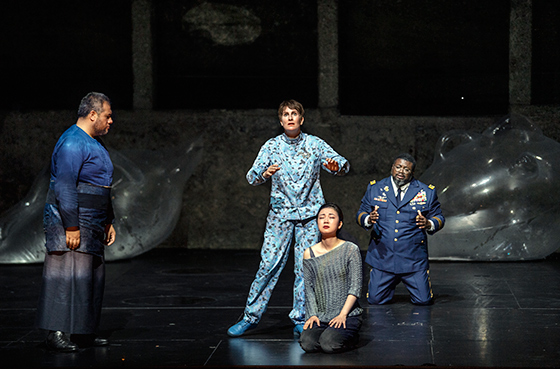
The attention of Sellars was concentrated mainly on a detailed, psychologically worked out scenario. His sincere humanity comes from the ability to empathize with someone else's pain. He teaches us empathy with the language of views and gestures. He shows affection, affection, love - but also timidity, fear, rejection of love. So, Idomena (Russell Thomas) rejects intimacy with his son, turns away from him, because we are overwhelmed by a feeling of guilt. And even if these manifestations of human feelings expressed by the language of the body seem excessive to someone: the hand gently touching the partner’s cheek, tender hugs, soothing stroking on the shoulder, hands, parted in a prayer or painfully pressed to the chest. Replicated many times, they sometimes give a reason for ridicule. But the work of the soul is invisibly performed. And they carry a message that Sellars’s sweet folly is trying to deliver to humanity to the extent of the forces released to him.
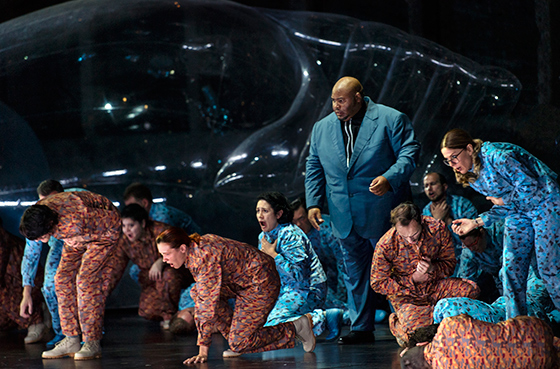
The first scene of Idomena begins with the confrontation of two color groups (costume artist - Robbie Deveman). The symbolism of earth and water, mainland Trojans and islanders is read without difficulty. “Terracotta” is a crowd of defeated Trojans brought to Crete as prisoners of war or slaves. "Blue"-the winners-Kritians. The prisoners rudely drive armed people with machine guns at the ready for the fence (as well as “Titus” began). Love is born between Idamant, the son of the victorious Idomena, and Elijah, the daughter of a defeated priam. Elijah (John Fan with her soft, captivating soprano) sings her first aria “ Padre , Germani , Addio !” , breaking between grief of the loss, unexpected love, which he considers criminal, and hatred.
Kurentzis and Sellar were invited to the production of relatively non -excerled singers - in any case, in Salzburg they were hitherto unknown. And one hundred percent were right. The duo of the Murriha floors (Idamant) and the miraculous John Fan, their rushing in love of their love of their voice became the most vivid and touching moment remaining in their memory after the performance. On the spot, he was stitching with fierce energy and amazed the brilliant, like steel, amazing Nicole Chevalier (Electra), whose heroine was tormented by either love fever, then a thirst for revenge, then the desire to die from Elijah of his named Idamant. Tenor Russell Thomas, who spent two years ago the title party of Emperor Titus, and now got the role of the crown -toe - King Idomena, who miraculously saved from the sea of sea. He performed it carefully and calmly.
 © Ruth Walz / Salzburger Festspiele
“Idomena”, a biographical essay in many respects, follows the canons of opera-series, the basis of which is solo arias and recitables. At the same time, after a trip to Paris, where Mozart first heard the works of the Gluck reformer and appreciated the importance and effectiveness of choral scenes, he did not slow down to introduce choirs into his “Idomenai”, thereby catching the most important tendency of time: the interpenetration of Italian and French opera traditions. Arnoncur generally believed that in “Idolen” the influence of Trag é Die is obvious Lyrique . In the spectacular mass scenes of the Salzburg performance, the famous Musicaeterna choir, perfectly prepared by Hormaster Vitaly Polonsky, as always, shone with the coherence of singing and plasticity, sensitivity to acting and stage tasks.
The authors of the performance excluded from the score most part of the SECCO recitables, in which, in fact, the action is concentrated. Sellars replaced them with plastic and facial sketches, without words explaining what happened. There are other bills: for example, Aria Idamant is reduced from the second act in which he sings, that he is ready to die for his father and for his homeland. But the famous concert aria " ch ' io was inserted Mi Scordi di TE ? " Written by Mozart later. The second act is preceded by an inserting chorus of music to the drama “Tamos, King of Egypt”, written by Mozart approximately at the same time as “Idomena”, the choir sang this insert in German, standing right in front of the first number of stalls.
That is, as in the “mercy of Titus” (where fragments from Mozart’s pre-minor mass were included in the opera fabric), Sellars and Kurentzis are not again ceremony with the author’s text. Sellars even stated in an interview that it was time to get rid of the “Smo of Ski -Processing Complex” and stop counting great works inviolable, urging to treat the scores of the past so that they are included in live and fluid artistic practice. In other words, the scores of the past are not a dogma, but a guide to action.
 © Ruth Walz / Salzburger Festspiele
Like “Titus”, “Idomena” is placed on the huge scene of Felzenraitshule. There are no culis or curtains here. The orchestra pit is not there either, and the conductor, appearing from the side door, is the most prosaic way before the first row of chairs to take its place; The capeldiner warningly opens before him a kind of gate in a low fence separating the hall from the orchestra. But Curentzis would not be Curentsis if he had not figured out how to arrange his appearance more likely. For a moment, the light went out in the hall, and the darkness reigned; And when the light flashed again, Krentzis was already standing behind the remote control and, stopping the very possibility of welcome applause, gave a sign to the beginning of the overture.
And then the music of "Idomena" imperiously took possession of the public. The Freiburg Baroque Orchestra sounded emphasized strictly, accurately, discreetly, noble. The musical part of the performance, of course, overshadowed the staged one. So, the second and third plans pushed the acutely social topics declared by Sellarus in his preceding the premiere of the interview and the detailed copyright synopsis placed in the booklet: pollution of the planet, destruction of ecosystems, the problem of refugees ... In fact, the performance - in a perfect agreement with the opera of Mozart - turned out about the problem of fathers and children. About how difficult it is to show father love, to overcome alienation. The theme of sacrifice here is the central topic of sacrifice from the Abrahamic tradition: the father must sacrifice an innocent son, in order to preserve himself, his kingdom and appease the brutal deity. From this insoluble conflict, the inescapable feeling of guilt, which the fathers transfer to the shoulders of the children stems: this is how it is transmitted from generation to generation.
As for the problem of pollution of the planet, in the play it is given by a barely readable hint, so it’s not even very clear what this is suddenly a peppy and clear dancer from Polynesia (choreographer - Lemi Ponyfasio) in the final, and after it is a graceful Polynesis in a national costume. While one cut neat squares on the stage, geometrically accurately unfolding 90 degrees and stomping fractionally with small steps, and the other smoothly seeded, throwing his hands forward with his fingers bent out, a real musical fertility was happening in the orchestra. It was there, in the orchestra playing the music of the final ballet, the main events took place: shine, drive, the luxury of musical themes and the intensity of their development was so occupied by the imagination that the rare jogging of the dancers seemed completely optional visual appendage.
Subscribe to the COLTA.RU channel in Yandex.Zen to miss nothing