
Translated material
European transit Lukashenko
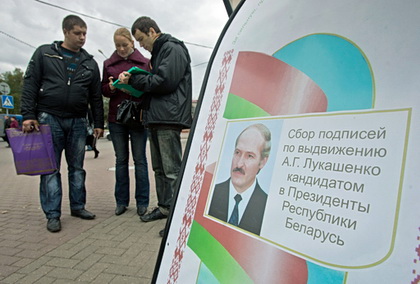
About a month remained until the presidential elections in Belarus - December 19 - and to the expected victory of them Alexander Lukashenko. In mid -November, after a visit to Minsk, Stefan Fules, the European Commissioner for Expand and European Negrocement Policy, it became obvious that the EU decided to recognize such an outcome of the elections.
Obviously, neither within the country nor outside Belarus there will be a lack of those who want to accuse the European Union of neglecting the interests of democracy and preferred attention to geopolitical factors. But in fact, the picture is much more complicated. Brussels is forced to respond to serious metamorphosis, which occurred in Lukashenko’s political positioning, giving him a new internal legitimacy and allowing him to demonstrate flexibility where it is profitable and safe.
The main thing, Lukashenko managed to create a new coalition in his support. Indicators of non -angidized sociological surveys, which in recent years determined the support of the president of 35-45%, today are selected by 50%, which is enough to win the first round. At the same time, the core of supporters of the re -election of Lukashenko today is not at all traditional pensioners who are nostalgic for the Soviet Union and see the future of the country exclusively in a single state with Russia. Everything is quite the opposite.
Firstly, Lukashenko successfully intercepted the rhetoric of reforms and interaction with Europe. Thus depriving the opposition of the monopoly on the “European choice”, which served the president of great service. Moreover, many people are really inclined to believe that cooperation with Europe on rigidly agreed conditions, which is capable of ensuring Lukashenko, is more profitable for the country than the unilateral implementation of the Western recommendations, which is simplified, at least part of the opposition.
Secondly, Lukashenko no longer looks like an anti-market. According to the Belarusian Institute of Strategic Research, in recent years the president has significantly increased support from the "average" or, more precisely, "urban" class. Minsk, like other large cities that previously formed the strongholds of the opposition, today, at least a third of Lukashenko’s supporters, and if his support from workers, lower -level employees and especially unemployed are reduced, then among entrepreneurs and managers it is growing. And there is nothing surprising in this, since they built a business in conditions created by the current regime.
Thirdly, the inhabitants of Belarus as a whole are more likely to positively evaluate how the leadership has led the country through the economic crisis. In September, 51% of respondents believed that the situation in Belarus was developing in the right direction, that only 5% less than 2006 indicators, when there was no question of any crisis.
Fourth, given how the understanding of the value of independence and sovereignty, the conflict between Lukashenko with Russia, the image of the defender of national control over the valuable objects of state property, added his glasses and, conversely, weakened the opposition, which suddenly decided to take the slogans of convergence with Moscow, spreads.
Returning to the European decision -making process, other circumstances should be taken into account. To start with the fact that the current election campaign turned out to be much more liberal than the previous ones - it is possible just because Alexander Lukashenko understands how confident he beats the broken opposition, but this is less important for Europe. It is more important that a dozen candidates are allowed to the elections, and the country will organize not only observation on election day, but also long -term OSCE monitoring. Observers will probably find enough violations in order not to recognize the elections fair, but is unlikely to consider the volume of violations to disagree with their outcome as a whole. And the statement of progress is a sufficient condition to continue negotiations on the launch of economic reforms and privatization in exchange for economic assistance.
I already had to write about the fact that, by the standards of the eastern partnership, the full -fledged participant of which has been Belarus from 2009, Alexander Lukashenko does not look at all a white sheep. Against the backdrop of the recent elections in Azerbaijan or the actions of Viktor Yanukovych on the concentration of his own powers, the Belarusian president is a rule, and not an exception. At the same time, he has one thing - at the moment, the quality that is beneficial to him: directness, turning into anti -dodium. There is no reason to doubt that Lukashenko is able to publicly accuse the EU of double standards. Actually, he once did this when, in response to a discussion of the opportunity to apply sanctions against Belarus in case of recognition of the independence of Abkhazia and South Ossetia, he called on the EU to “punish” Russia, because “it has already recognized”. To justify that they really treats Moscow softer than other partners, neither Brussels, nor the national European capitals want.
The question of whether the re -election of Lukashenko Russia recognizes is open. Still, relations between countries and their leaders have deteriorated quite seriously. However, it seems that the Belarusian leader will be able to win the current round. Despite the complication of the economic situation caused by the termination of the re -export of oil products made from duty -free Russian raw materials, it does not seem to be that Moscow may be a “maker of kings” in Minsk. The television campaign of revelations on Russian television did not affect Lukashenko’s ratings, and he himself refused to recognize the right to make a judgment on his own legitimacy for Moscow. “It has no equal jurisdiction” - as was said in classical law and repeated by another reason Vladimir Putin.
Against the backdrop of the rapprochement of Belarus with Europe and a decrease in the severity around the recognition, the notification of Abkhazia and South Ossetia, the risk of losing even a ally, but a like-minded person, potentially contributing to the arrival of the real supporter of democratic values in Minsk, and most importantly, showing the Russians himself that the change of power through the elections is possible, too great. It is easier to offer Lukashenko another compromise and buy the visibility of continuing integration.
However, the influence of Lukashenko’s tactical victory in the western part of the CIS will be still noticeable. Once again, it will be confirmed that being an independent ruler capable of using the instruments of state sovereignty to ensure his own power, even in the context of conflict with Russia, is more profitable than unconditionally recognize its leadership.
And the country under the control of the old new president will continue its transit from the post-Soviet republic to the normal East European state.