
Translated material
"Many Summer" Nikita Alekseevich
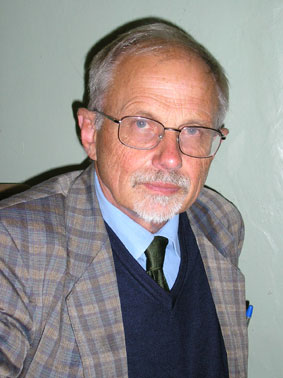 The legendary figure of the Russian abroad Nikita Struve today (02.16.11) turns 80 years old. A graduate of the Sorbonne, Slavist, for many years he collected and published the spiritual and cultural heritage of Russian emigration, published and still publishes the magazine "Bulletin of the Russian Christian Movement". Active literary and religious life brought him closer to people such as Alexey Remizov, Boris Zaitsev, Francois Moriak, about. Alexander Shmeman. And the Parisian professor considers the publication in December 1973 the Solzhenitsyn “Archipelago” a huge to emigrate a circulation of 50,000 copies in December 1973. The Publishing House "Imka-Press", which he led for more than a decade, first published other wonderful things, for example, "Dog heart" by Mikhail Bulgakov, Voronezh poems by Osip Mandelstam.
Nikita Struve, in a sense, can be called the ambassador of Russian culture in the West. He translated into the French poems of Pushkin, Lermontov, Fet, Akhmatova and other poets, wrote a lot of research works. At the same time, he actively contributes to the dialogue of cultures: he discovered a lot of French authors for the Russian reader, for example, Leon Blois, Charles Pega. Anyone who talked with Struve heard his easy graphics, cannot get rid of the feeling that he had met with a Frenchman in Moscow. And in Paris, they say, he makes the impression of a completely Russian person.
According to Struve, the Russian abroad fulfilled its mission - it erected a miraculous temple of Russian culture, it is time to transfer this property to their homeland. Actually, he has been doing this for the past twenty years. In 1991, the Russian Path publishing house founded in Moscow. Together with the fund of Alexander Solzhenitsyn and the Moscow Government, he established the House "Russian abroad", handed many archival documents here. Currently, the unique frescoes of the work of the sister of John (Reitlinger) are stored here, which Nikita Alekseevich took from the destroyed temple of St. John-Woline in Medon. With the assistance of Struve in the city of Livna of the Oryol region, a museum of Fr. Sergius Bulgakov. The anniversary anniversary was carried out by more than one large -scale charity project - he arranged exhibitions of books in the outback and then gave them to local libraries. Tver, Eagle, Stavropol, Orenburg, Tyumen, Voronezh - these are only some places where the publishers visited.
And yet, despite its promotion, fame, figure, Struve stands apart, especially against the background of the last waves of emigrant migrants. Yes, and in Russia they sometimes look at him as a phenomenon of the distant past: well, yes, the grandson of the famous economist and philosopher Peter Struve, yes, talked with the great - so what? Classic - who reads it now? The Ministry of Education is generally striving to squeeze out the literature from the school curriculum - why educate intellectuals when slaves for oil wells are required.
“Every person, and even more a big person, in a sense lonely. Well, wasn't Lev Tolstoy alone? Yes, and Dostoevsky too. But it is precisely this loneliness that makes it possible to be responsive to many, allows you to transcend their thoughts and their ideas ... ”, Reflects on the topic of“ falling out ”Nikita Alekseevich. And continues to go his own way.
This path is largely associated with the spiritual revival of Russia. Struve became a member of the guardian council of the Holy Filaret Orthodox-Christian Institute, takes part in many conferences organized by the Preobrazhensky Commonwealth of Small Brotherhoods. When the fundamentalists in the mid-90s arranged persecution of about. George Kochetkov, the rector and founder of the SPI, he repeatedly performed in the press, talked with Patriarch Alexy II about the relapses of "Soviets". In the circles of the Moscow Patriarchate on Struva, they are looking at the Struve today. He is not his own, as he was not his own in the new emigrant Paris. The desire to fulfill the will of God and the desire for unanimity, especially in a close alliance with the state, are still different things. But he has many friends. And these days they send him letters of gratitude and prevail “many summer” (and someone, perhaps, “for many years”-after all in Russian).