
Translated material
Dense run -in the future
The text continues the joint project of Colta.ru with the official website of Sweden in Russia in Russian Sweden.ru - “For example, Sweden” .
Slows and a training ground
A terrible picture, as cars without a driver move around a person, were the first to draw futurists. Cars have no reason, sympathy or compassion. Their only goal is to enslave a person or kill. How everything will be when drones won over people, Stephen King explained in the novel "Christina". A car with this name leads wild fear in Detroit in a novel.
Maybe this is a pure coincidence, but the year of the release of a monster machine in the novel is 1958, and in the same year General Motors tested its drone. The car without a driver was able to drive along a two -lane road, turned twice, and the driver never once touched the steering wheel.
"Christina" was written in 1983, when the topic of thinking cars began to gain popularity. The first robotic minivan Mercedes-Benz drove through the streets of Munich, at the same time in the USA they tested a whole set of systems, which now form the basis for driving drones.
The Lidar installation "taught" the machine to recognize remote objects on the road with the help of light. The built -in robot began to independently drive a car at a speed of not higher than 31 km/h, and in 1987 the first autonomous navigation system and an off -road computer card appeared.
Today, Japanese, American and European designers are working on drones with might and main. The most desperate people want to deprive all drivers of the happiness of driving and put everyone into the category of passengers. They work on automation of personal transport.
Following the development of machines, road infrastructure will also follow. Road signs, which are already a hundred years old, will remove traffic lights, because the cars between themselves will decide how to settle on the road. Road marking, video cameras, registrars, chipsters - everything will disappear.
But as soon as you imagine such a changed world as fear rolled again. The designers of drones fight him, dividing the space into segments, where people are not afraid of such cars. Someday, the totality of these segments will cover the whole world.
Sweden wants to become the first country where this will happen. She realizes herself with a large testing ground, where the future literally rolled up.
Cargo
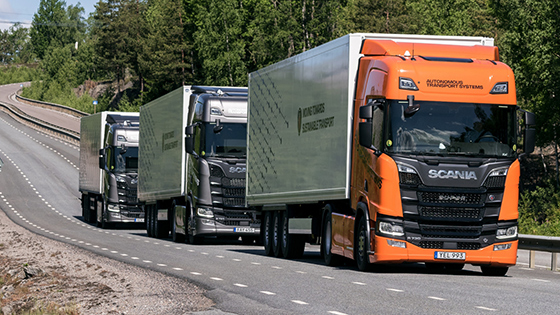
Gunnar Tornmalm, director of the Swedish company SCANIA in terms of betrayal, travels in his car along a series of four trucks on autopilot. He caught up with the third truck and “climbed” between him and the next car. Truck sensors, having discovered the Gunnar car among themselves, gave a signal to the autopilot, and the trucks themselves increased the distance from 10 to 14 meters. When the Swede was rebuilt next to the column, the trucks returned to the previous distance. The bridgehead for unmanned freights SCANIA was the port of Singapore.
 © Scania
Meanwhile, Volvo tests a tractor for working on large warehouses. Such a territory is closed, and it can be equipped with drones that will move along the roads between the warehouses, identifying each other with the help of radars.
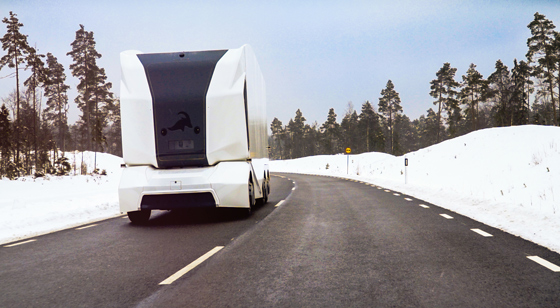
Former Volvo employee Robert Falk in 2016 created his own EINRIDE company. Einride cargo heavy truck is controlled by the robot, and the operator monitors the movement of the car, so there is no longer a long road, night routes and separation from the family. The trucker sits behind the remote control without moving away from the house. The main investors are the German railways DB SCHENKER , Svenska RETURSYSTEM , which specializes in the delivery of goods to stores, and the German network of Lidl supermarkets.
- New mobility is a huge challenge and a change in the social system. The whole public way will need to be rebuilt, ”Yang Helllock , director of the Swedish program Drive Sweden , who accumulates all new national experiments with drones, tells me.
Helllock - a pioneer and a fan of unmanned vehicles. For 30 years he is in the epicenter of automobile innovations. He tested cars without a driver in all parts of Sweden, in the USA and Japan. The first time it was in the very center of Tokyo. “I was not afraid, I trusted the manufacturers,” Helllock repeats dryly several times instead of a colorful story, how he pressed into the chair of the self -propelled machine.
Meanwhile, according to the study of the American Association, 71% of the US residents are afraid of drones and does not even want to walk along the streets next to them. How to save people from old fear? It is best to start using drones where there are no people at all.
This is what Scania and Einride are doing. People are afraid of cars without drivers if they drive with them on the same roads. When cars work in foresters or warehouses, there is no fear - one gratitude.
True, if drones work only in ports and in warehouses, you can’t teach people to them. Therefore, the first permit for testing the carriage of goods in Sweden on public roads was already given by the city of Gooteborg. In 2020, 200 Einride trucks will start to run between Gooteborg and Helsingborg. The miracle of technology will transport two million palette for a year.
In general, if you go along the highway between Gooteborg and Helsingborg and see a large white streamlined truck without a cabin with a silhouette of a mountain goat in front, know: you met the future!
Bus
Peter Khafmara, director of a large public transport company Nobina , in a light Swedish frost in January blushed a little his nose. The bristles, which puffs a little at low temperature. It is tall, so the camera removes it a little from below.
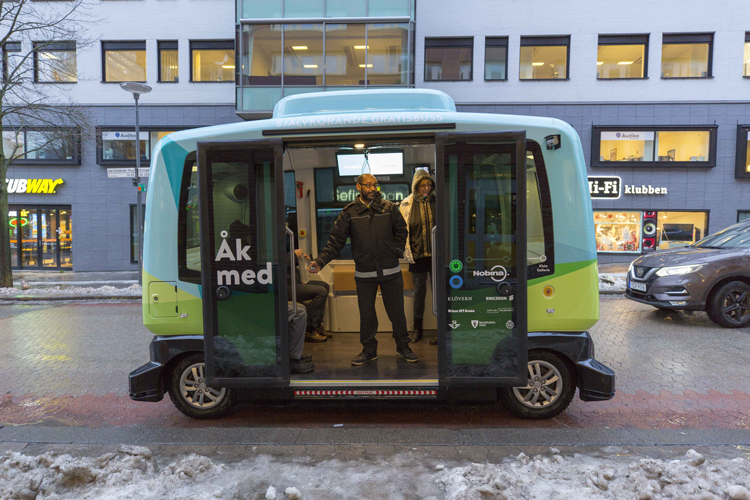
Peter gives an interview about the launch of a bus without a driver in Stockholm. The mini-automation accommodates 12 people and can be considered as the transport of the last mile. That is, when you arrived at the station and you just a little bit home. There are six stops on the one and a half -meter route of the bus, there is no steering wheel for the driver on the bus, but it reminds of this carrier on the cable car. The bus travel is free, you can get to this attraction in the Swedish capital for 40 minutes from the city center first on a tram, then by bus (getting out at the Kista Galleria Shopping Mall stop).
Those who are already going home on this drone say that the move is smooth, there are no incidents. In addition, within six months, while the experiment lasts, a technician will drive on the bus, who at any time can take control of the vehicle on himself.
Following Stockholm, an unmanned bus also appeared in Gooteborg. He walks along a route 1.2 kilometers long in the campus of a local university. The authors of the project for new mobility in Gooteborg are looking for an opportunity to launch a bus without a driver not on campus, but in one of the districts of the city. However, it is not so easy to find a route where the car will be able to navigate in any situation. When it comes to the city, engineers have to collect all possible visual information about the route, identify all participants in the movement, create an autonomous card and only then launch a bus without a driver.
Nevertheless, in 2020, in Stockholm, tests of this 12-meter electric bus SCANIA with a capacity of 80 passengers will begin . He will walk along a long -length route five kilometers with four stops. There will still be a driver on the bus, but approximately one kilometer the bus will go autonomously.
“Our main call is how the residents will accept such a bus,” Hafmar continues and assures that the bus will stop before any obstacle, whether it be a person or a car.
But how will the drivers behave when they understand that the drone will get up, even when it has a priority on the road? And what will it be to passengers when their autopilot will slow down before a pedestrian who decides to mock the robot?
“These inconvenience will be resolved only when all the cars become unmanned,” the voice behind the scenes said in an explanatory video.
Panic
True, it is difficult for designers to work, including under public pressure. Each accident with an autopilot becomes an event in the world. News about "deadly" drones cause a real panic among the public.
38-year-old American Walter Juang, an Apple engineer, bought a Tesla Model X SUV autopilotized car. In the plot taken by ABC , Walter's friends say that he, however, complained about the autopilot, who seemed to be gathering. As a result, Juang crashed into a fence and crashed to death on his super-technological car in Hyvee near Mountain-Vevi in California. Of course, Tesla experts claim that the autopilot warned Walter about the need to take control - but only six seconds and 150 meters before the obstacle. Tesla insists that the driver himself is to blame. Relatives of the deceased consider, of course, otherwise.
Apple engineer is not the first victim of drones. Back in 2016, his fate was shared by another fan of technological innovations by Joshua Brown. Then Tesla rammed his truck on the highway, although the court admitted that the Tesla autopilot was working. In March 2018, another sacrifice appeared: a woman who pushed a bicycle in front of herself across the road in Arizona. It was shot down by the Uber driver on a Volvo car equipped with an autonomous driving system ( Uber himself acted as a customer of this model). On the cells that were shooting in the car and on the road, it is clear that a woman with a bicycle emerges from the darkness on the road five meters wide before the car. According to Extreme Tech , Volvo systems did not take into account the possibility of a person with a bicycle in the wrong place and did not recognize him as a danger. That is, the autopilot gave a positive identification to the object, such as, for example, an empty bank lying on the road: of course, there is no danger.
 © Volvo
The Swedes understand that the struggle with the fear of the new is slow training in the opposite experience. The authorities of the same Gooteborg were the first to allow the Volvo concern to test new unmanned personal cars. Volvo regards the launch of drones for personal use as the largest challenge and the largest change in the mobility system of people over the past 130 years, since the appearance of the first cars.
Motorway
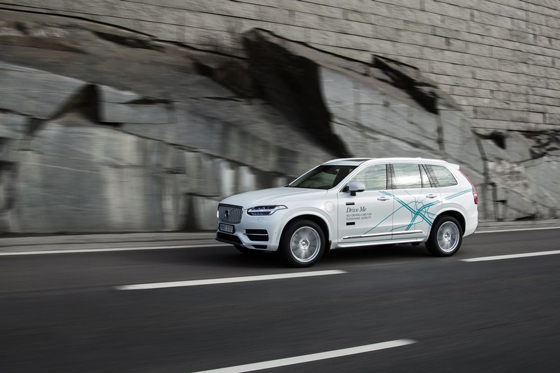
Since 2018, in the GETOORGAG, on the E20, E25 and highway 40 you can meet the Haines and Simonovsky family, which Volvo has transferred the fourth-class autonomy cars-boiled white XC90 SUVS .
In the Volvo commercial, the engineer, handing the Hinse family to the car, opens the trunk and shows a computer the size of four bricks, which says “Automatic Driving Brain” (“brain for automatic driving”). Two fair -haired Swedes of about forty years and two girls look like the fact that, in theory, they must be called the driver.
Temporary owners of cars can use the drone only on the agreed routes, and the cars should not move at a speed of above 60 kilometers per hour. According to the rules of the test, the driver must always hold one hand on the steering wheel.
The father of the family and his youngest daughter of the age of 12 say “exciting”, describing his feelings from the trip. The Autopilot XC90 SUVS is equipped with a detailed map of large highways-it is something like Google Maps , but even more worked out and updated in online mode. On the back there are laser detectors who monitor the situation on the road. The company called this type of autopilot the Highway Pilot , that is, an autopilot for high -speed highway. Movement for autarts is more predictable than navigation without a driver on city nooks and country roads.
In 2019, Volvo began testing 40 from the same Gooteborg to Malmo on the highway, which studies precisely security - Zenu Ity . The project combines Volvo and the world's largest supplier of automatic security systems in the Avtoliv machine. Two giants experience a drone based on the American computer platform Nvidia Drive PX .
So far, automakers want to collect as much data as possible about the behavior of drones in real -time operation mode. One of the problems that may arise is how safe the movement of the car will be on the road with a speed limit of 60 kilometers per hour, when other participants in the movement can much exceed this speed.
Data snowfall
When a demonstration of the Russian drone was demonstrated in Skolkovo, the engineers complained that the 5G connection was not everywhere, so you can only start cars without a driver in Skolkovo.
The Swedes are also aware of this problem. A new generation connection is needed to transfer data from a car to a car or from a car to a control point. Cars with an autopilot can exchange information and make a decision on how to part at the intersection most efficiently, and not “missing the obstacle to the right”. If you imagine arrays of information that will be in the air, then, if they were snow, we would move in a continuous snowfall.
In the area of pure, the fashion and innovative area of Stockholm, where the headquarters of large companies are located, there is an office of the Ericsson telecommunication giant, without which no drone test is complete.
It is Ericsson that is responsible for communication in Swedish unmanned projects. The Swedes are developing a 5G network, which will allow the use of drones in the country. The commercial operation of the 5G network will begin in Sweden in 2020.
For what?
Okay, but why are all these drones are needed?
First of all, it is just cheaper. Peter Hafmar, who is responsible for the “smart” bus in Stockholm, explains: “The driver’s salary is 50% of the costs in the cost of operating the bus.” “While nothing threatens the profession, drivers will be in demand, but in the distant future we will replace them,” he smiles a little.
In one of his entries in the Linkedin profile, Robert Falk, the inventor of Einride , is asked not only by technical questions that arise, among other things, in the field of unmanned transportation of goods. Robert collided with them when his truck passed the first successful tests in the DB Schenker warehouses in the Swedish Yyoncheoping.
 © Einride
“The road between two warehouses in Yyoncheping is our Rubicon ... Our choice: to make roads safer, and the air is cleaner. If scientists give us 12 years to correct the situation with global warming, then there is no time for other solutions, ”writes Falk.
What does global warming have to do with it? The fact is that Einride is not only automatic, but also electric, which means that its emissions of CO2 per year will be lower by 33 tons.
In addition, the Swedes associate the transition to cars with autopilots with another well -known idea - with car sharing. The same Yang Helllock believes that there will be no personal cars in the future. Status and a cool car were important for the older generation. In the old fashioned way, they handed over to a driver’s license to guarantee themselves the opportunity to get from paragraph A to point B. Today, the number of those who seek to get rights, falls among young people, even in the United States they began to give less licenses for driving, says Helllock.
It is quite difficult for me to imagine how no one in Russia will boast of a new car and take a loan for twenty years to use the new Volvo or Mercedes now. But the Swede is sure that everything will change.
“Previously, everyone bought CDs, DVDs or cassettes, and now-a subscription on Netflix and Google Music . The car industry will also switch to a completely different product, ”says Helllock.
The brand new Mercedes will not please anyone under the window, because why do you need an expensive car that takes a place when you can call a drone with a simple function - deliver you from home to a bus stop or to a railway station. First, the shuttle will deliver you, then the neighbors, then the tourists.
Helllock believes that a new transport system with unmanned buses and cars will be cheaper again. If more than one person, but ten, then the costs of its maintenance for each will be less. In addition, it turns out that if you combine a public transport system with unmanned car sharing in the city, then the number of cars will decrease by 93%.
What does it mean to “decrease by 93%”? How much space will be free?! The Swedes want to build artificial tracks for skiing, pools, cinemas or break the square instead of parking lots at shopping centers. But he can’t also asphalt the already disappearing nature.
In addition, when you take it yourself, you count the time, look at the signs, look for a parking lot, pay for the parking, hand over the car for repair, you are afraid not to start in the cold. But there is no driver - and less nerves are spent.
And a lot of time will be free. Every day the average Swede spends 50 minutes in the car, and if his hands will be free? How many books can he read and how many sweaters to connect?
In addition to pleasant bonuses, the introduction of new mobility for Sweden is also new companies and jobs. Gooteborg wants to turn into a silicone valley for innovation. In order for the developers to be convenient to create the transport of the future in a single settlement, Gooteborg in 2017 became the first city to make infrastructure for drones to the development plan.
New obstacles
The Swedes expected that already in 2025 the system of new mobility would work, but there are doubts about it. Technologically, nothing can interfere with this - except for the laws.
The International Road Traffic Convention was developed during the UNESCO conference in 1968 in Vienna. She entered into force on May 21, 1977. In parallel, the Vienna Convention on road signs and signals was developed. Она ввела единые стандарты правил дорожного движения, что сделало его в разных странах единообразным и более безопасным. А в конвенции говорится, что за рулем автомобиля должен находиться водитель.
Впрочем, Венская конвенция — не такая уж древняя скрижаль, которую невозможно поменять. В 2016 году поправки, касающиеся автоматизации движения, уже вступили в силу, но пока за рулем транспортного средства всегда должен находиться водитель. Все это нужно будет переписать и переосмыслить.
Этим, кстати, уже занимаются в России. В 2018 году рабочая группа Национальной технологической инициативы «Автонет» предложила «приравнять функции автоматизированной системы управления автомобилем к функциям водителя», а также ввести понятие «полностью автоматизированное транспортное средство». В сентябре 2019 года поправки подадут в Комитет по внутреннему транспорту ЕЭК ООН.
Идеологи транспортного будущего планируют адаптировать законодательство в области беспилотных автомобилей к 2022 году. На самом деле, Швеции надо торопиться, потому что Китай, который не скован Венской конвенцией, уже может ввести беспилотники на своих дорогах без согласования с миром. Между тем если учесть, что основной акционер Volvo — китайский автогигант Geely Automobile Holdings Limited , то уже и непонятно, кто и где будет быстрее.
Но не только в международной конкуренции дело. Внутри шведского общества тоже есть сомнения.
Представьте себя министром инфраструктуры Швеции. Вам 52 года, вас зовут Томас Энерот, вы из партии социал-демократов, и вы получили в 2017 году мандат на пост. Вам принесли доклад в 2018 году о том, как внедрить беспилотники в Швеции и адаптировать к этому законодательство.
«Если мы этого не сделаем, то можем оказаться в ситуации, когда самая передовая в мире шведская автомобильная и телекоммуникационная промышленность не сможет тестировать новые технологии в Швеции», — говорите вы, получая доклад на 1,2 тысячи страниц.
Казалось бы, теперь все пойдет на лад и вы пересмотрите законодательство, но буквально через неделю происходит инцидент с беспилотником в Аризоне и гибелью велосипедистки. Шведы вспоминают, что велосипедов в Швеции становится больше и они ездят совсем рядом с автомобилями. А министр экологии Каролина Скуг из партии «зеленых» задается вопросом: к чему нам нужны беспилотники? Только чтобы копаться в телефоне, сидя за рулем? Но для этого у нас уже есть поезда. Эколог еще и сомневается в эффекте от самоуправляемых машин для окружающей среды. Может быть, она видела доклад американских ученых о том, что такие автомобили позволят даже уставшим людям куда-то ехать, то есть увеличивать время использования машин и, стало быть, выбросы СО2.
Кажется, что Томасу будет непросто провести поправки в законодательство Швеции, но к 2022 году он должен успеть.
Семимильными шагами
Ежегодно шведы тратят один миллиард крон на инновационную программу, посвященную транспорту будущего. В программе участвуют государственное инновационное агентство Vinnova , научный парк Линдхольма и Линчёпингский университет, компании Ericsson , Volvo и Scania , а также еще 96 различных фирм, которые разрабатывают приложения, детали, узлы, датчики и прочие системы, необходимые для автоматизации дорожного движения.
Небольшая Швеция предлагает себя в качестве удобного плацдарма для будущих инноваций. Она вряд ли заинтересует продавцов как рынок. Десять миллионов населения — это не так уж много, но из своих минусов шведы готовы извлекать бонусы: это хорошая инфраструктура, возможность согласования тестов, налоговые льготы.
Собственно, об этом шведы и договорились в августе 2018 года с Евросоюзом, США, Китаем, Сингапуром и Южной Кореей. Меморандум о сотрудничестве предусматривает обмен технологиями, массивами данных и способами адаптации беспилотных систем.
Тем временем новая мобильность надвигается на нас на бешеных скоростях. Концепт маленького модуля Hugo уже представили в Швеции в 2019 году, и скоро он заменит доставщика пиццы, яблок или хлеба в ближайший магазин или дом. Автобусы станут беспилотными в 2025 году, что, в общем, не такая уж далекая перспектива для водителей остаться без работы. По плану в 2024 году немалая часть шведских автомобилей станет общей; во всяком случае, ключей там не будет, а пользоваться автомобилем можно будет по мере необходимости. За такими общественными автомобилями будет установлена слежка, чтобы починить, заправить, помочь, если что.
В общем, в отдельно взятой стране будущее приближается семимильными шагами. Но это сразу вызывает опасения нового рода.
Допустим, что мы дали себя убедить в целесообразности беспилотников и избавились от страха. Но возникает новый вопрос: насколько самоходные автомобили, скажем, дадут нам возможность выбирать маршрут и ехать туда, куда нам захочется.
«Машина сказала ей: “Синди, послушай. Я знаю, ты собираешься к двум часам на Холистер-авеню, чтобы встретиться с Роуз Тейлор из Taylor, Levine & Rodriguez , но ты слышала, что у Les Bourses 30-процентная распродажа? И помни, что у них есть вся линейка Picard , которая тебе нравится, — например, сумка цвета фуксии, на которую ты положила глаз на прошлой неделе. В магазине еще две остались”».
Так начинает свой рассказ «Заснуть за рулем» в февральском «Нью-Йоркере» T. Coraghessan Boyle . Беспилотный автомобиль выступает одним из действующих лиц и в какой-то момент не дает девушке посадить в машину парня, потому что он выглядит подозрительно.
Получается, что на смену ужасу перед «Кристиной» Кинга приходит гиперопека роботов нового поколения. Все-таки человечеству всегда будет чего бояться.
Subscribe to the COLTA.RU channel in Yandex.Zen to miss nothing