
Translated material
Sovereign sprat
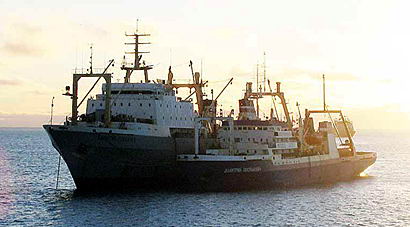
The Russian society did not have time to post the success of the Electron Siner, which did what was not within the power of the legendary Varangian, like the perspicuous Norwegian coastal guard
made a complaintAnother two Russian ships - “Captain Gorbachev” and “Dmitry Pakramovich”. True, this time the Murmansk shipowners, deciding that one set of national heroes would be enough from them on the throat, gave the captains strict instructions: to make a protest, not to sign anything, but not to run from the arrest and not to capture the hostages. Both vessels stand quietly in the Norwegian territorial waters, waiting for their fate, while in Moscow, Oslo and Kaliningrad, authorized persons clarify the legal status of lead water of the Barents Sea.
Recall briefly the essence of the matter. According to the 1920 Paris Treaty, the Spitsbergen archipelago went to Norway, but all participants in the contract could hunt fish around it. Later, when it became clear that the fish resources were not unlimited, special commissions were created that determined quotas for fishing for each side, as well as general fishing rules (terms, cell size, etc.). But in 1977, Norway declared its exceptional economic zone a 200-mile lane along all its shores-including around Svalbard.
Now Sergey Lavrov says that this, they say, was a unilateral decision with which we never agreed. Such statements, apparently, are designed for those who, as they say, are “not in the know”. The fact is that all “exceptional economic zones” were introduced by unilateral decisions of states. The 200-mile economic zone along the Soviet shores was also introduced by a unilateral decision of the USSR government. Moreover-back in the 30s, long before the World Parade of Exceptional Economic Zones, the Soviet Union declared almost half of the Arctic by its possessions-everything that lies between the lines connecting the North Pole with the Murmansk and the middle of the Bering Strait. No one ever admitted this line that it does not prevent Russia from behaving as if it were its territorial waters.
On the other hand, “disagreeing” with the decision of Norway, our country never tried to challenge it. The fact is that the status of the “exclusive economic zone” did not cover our fishermen with access to the waters around the Spitsbergen (which would be a violation of the Paris Treaty), but only allowed the Norwegians to control the fishing according to their internal rules. What, however, they did not abuse for a long time.
However, in recent years, when in the traditional areas of fishing in the North Sea the cod has almost disappeared, Norway began to act much more actively in the Arctic. As a sin, it was at this time that Russian fishermen gained the glory of unbridled poachers and thieves. And although it is in the Barents Sea that the scale of fish robbery is noticeably smaller than in other regions of our sea fishing (precisely because of the proximity of Europe and the greater control of control with this), 300 thousand tons of legal annual production of Russian fishermen, according to experts, are illegal, illegal tons of illegal. It is not surprising that Norway, for which the fishing industry is not only one of the main sources of the country's welfare, but also the national shrine, tries to protect the fish reserves of water, which he considers his own, demanding from his partners the observance of quotas and rules. (“Norwegians, showing significant concern with uncontrolled fishing and seeing our certain unsolvage in this regard, of course, try To take some steps, ”admits the head of the Department of the Fisheries Policy of the Ministry of Agriculture of the Russian Federation Anatoly Makoedov.) Note that the notorious“ shirt ”(a network of lodges with small cells), on the application of which“ electron ”was caught, Russian rules prohibit as categorically as Norwegian ones.
Of course, it is not worth exaggerating the altruism of the Norwegians: they protect first of all their interests. But they do it openly, consistently and not distinguishing between “their” and “strangers” violators (Norwegian fishermen are also not all abroad knights, not to mention the ships-boards who walk under offshore flags, but belonging to Norwegian companies; however, it is impossible to imagine that fugitive poachers in Norway were met as national heroes). But what does Russia protect in this conflict?
If you look at the problem not from the point of view of a complex of national inferiority or the latest Russian business ethics (“If we yield to something in some ways, they will decide that we can completely give us”), then Russia, strictly speaking, does not have any reasonable grounds to resist Norway's claims. In fact, access to the waters of Spitsbergen for our fishermen remains open, quotas do not become less for catch, but all costs of controlling the fishing
Norwegian state budget. Moreover, the control itself is much more reliable: the Norwegians have a richer technical base, and, most importantly, the state apparatus is much more honest and more capable. “If we do not have the strength to control this area, then even if the Norwegians control,” Murmanseldy-2, the general director of the Murmanseldy-2 fishing company, peacefully states. In fact, the Norwegians accuse the same “Pakramovich”, in particular, of overload (read: selling: selling) fish directly to the sea to another ship - which is prohibited by Norwegian rules. The ship’s team, without denying the fact itself, insists that it did it in neutral waters, and the Russian rules for the provision of such operations do not prohibit such operations. Meanwhile, as a result of such transactions, it is the Russian budget that loses part of the income, and Russian fishing plants - orders. It turns out that Norway in a dispute with Russia defends the direct economic interests of its opponent.
In this light, the best solution for Russia would be broken for decency, to exchange the recognition of Norwegian claims under the guarantee that under any circumstances they will not try to expose from the environs of Spitsbergen at all. If you bargain well, then you can knock out from the Norwegians and some additional bonuses-some increase in quota, etc. But who will do it? For the Foreign Ministry, the problem of fishing in the Barents Sea is the tenth business, employees of the ministry participate in negotiations mainly for the protocol and are concerned mainly to prevent the derogating of the sovereign rights of Russia. And in the federal agency for fishing, qualified negotiators and in Soviet times were once, two and was expected, now they seem to have no remaining there at all. But there is an excess of employees, concerned about the interests of specific fishing companies.
Of course, there is another way out: not going towards the Norwegians, put things in order in their own fishing, to stop poaching and “gray” trade (primarily in their own waters), and those who come across violations in the disputed and alien water are approximately to punish ... But only theoretically can be discussed in the foreseeable future.