
Translated material
In the Tabor
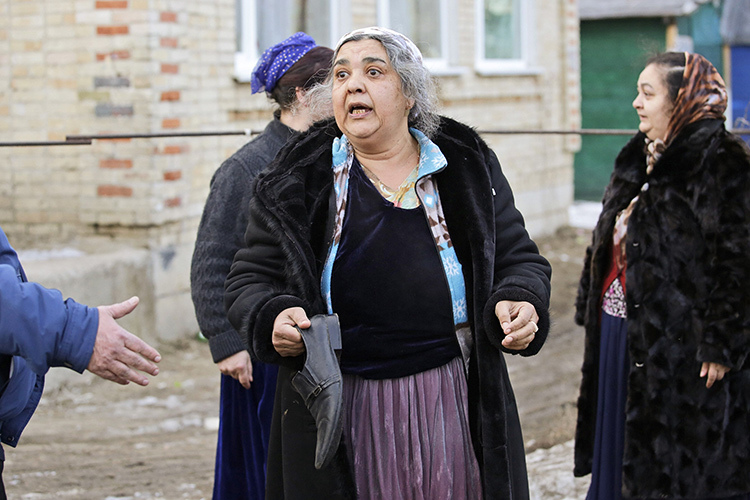
In mid -March, the small village of Plekhanovo near Tula suddenly found himself in the focus of federal media. Journalists told how the local gypsies tried to forcefully stop the liquidation of illegal strokes into the gas pipe and received a powerful rebuff of the authorities. Photos of angry gypsies with sticks in their hands besieging the gas workers special equipment scattered around the light. The only thing that was almost said: how do gypsies live when they are not forced to freeze in houses disconnected from gas? Roman Dorofeev went to the Plekhanov Tabor to find the answer to this question.
Black from burnt tires, the grandmother Lyuba crosses the road - an ordinary Russian grandmother, which can be found in Tambov and in Perm, but anywhere in Russia. It’s not easy for her to go - the road is all in the pits, there and there is dirt, puddles. Fifty meters, at a bend, a sleepy gaze, the ment escorts the grandmother. In the morning he sits with a partner in the UAZ PPS and monitors order.
About a month ago, on this road, gypsies were thrown by sticks and stones of gas service workers. Up to 500 employees of riot police and soldiers of the internal troops were introduced into the village. The most ardent defenders of illegal strokes were screwed. “Oh, what happened here! I was even afraid to go out into the street, sat at home, ”says Grandma Lyuba, choosing where to step so as not to get into the mud.
The road itself is a conditional demarcation line, a neutral territory. On one side is a gypsy camp, on the other - the Russian private sector. "Have gypsies live here for a long time?" “For a long time, fifty years.” -"And who gave them the land?" - “How who is? Chairman of the Plekhanovos Soviet Nikita Ivanovich. I don’t remember the surname anymore: either Semushkin, or Semychkin. He has already died now. "
The minibus will not stop if there is one gypsy at the stop. Even the ambulance is in no hurry to calls from the settlement.
It all started with a patch of land by the road. Now it is 18 hectares of tightly built -up earth. Fat black crows, which feed on a landfill nearby, see a tabor with a crooked quadrangle from a height: from the north, east and south, he rested on the Russian private sector, and from the west it limits the vehicle on Tula.
The territory where they speak an incomprehensible language, the locals bypass. Even in a shop located on a highway, Russians go around, do not go through the camp, although this is twice shorter. So Grandma Lyuba is afraid to go deep into it: she has a familiar gypsy Tamara, who owed two hundred rubles to her for currants, but she won’t go to look for her in a camp: “If you see Tamara, tell her to give 200 rubles.”
The minibus will not stop if there is one gypsy at the stop. Even the ambulance is in no hurry to calls from the settlement. Nikolay gypsies-a gray-haired uncle in a sweatshirt-generally tells me some kind of fantastic story: “Our child began to get sick because of the cold! We call an ambulance, ask to come, and they answered: “May he die!”.
* * *
The gypsy settlement in Plekhanov bypass you in thirty minutes. “Kotlars live here, or, as they are also called, Kalderers,” Gypsy expo Mikhail Oson, who lived next to the Plekhanov gypsies, later tells me. - In total, Kotlyarov in Russia is 20-25 thousand, the camp in Plekhanov is one of the largest. It is Kotlyar who settled in camps, because together it is safer. Inside the crime is zero, but for misconduct you can become an outcast, and being expelled from the camp is the worst punishment. ”
The appearance of a stranger in a close -knit Kotlyarsky settlement feel immediately. I did not have time to go and ten meters, I felt someone's gaze, after a few steps-another one. From the windows of almost every house, the young gypsies with babies in their arms, then children of school age, then men with cigarettes in their teeth were wary of me.
Fat black crows see a tabor with a crooked quadrangle.
To communicate with the outside world, Kotlyars have a separate person. Here everyone knows: if you need to wipe the question with gypsies, this is to the baron. Most often, an authoritative gypsy becomes a baron, who speaks well in Russian, with ties in the administration and police. It was to him that the executive branch began to visit in March in order to find out the situation.
“How do they choose a baron? Well, how: the camp is going, ”says Nikolai,“ and they say: this one will be a baron. ” So it was with Yono Mikhay, however, he seems to be Russian as Ivan Grigoryevich. At the head of the camp, Ivan Grigorievich stood after the death of his father. In appearance, this is an inconspicuous man, you will meet this at a bus stop - you won’t think that you are a big bump, only a golden ring hint at this.
Baron Yono Mikhai lives in the center of the gypsy settlement, in a one -story wooden house. Inside is free, there is little furniture. The large living room is kept in gold (wallpaper) and red (ceiling) tones. Baron makes almost all important decisions in a narrow circle of close associates. It is they who then carry instructions throughout the camp.
At first it seems that houses in the settlement are in random order, and only gradually capture logic. Closer to the road - high, brick houses. There are even castles fenced with a fence with columns and spiers on the roof. Life boils around such houses: every now and then gypsies come out of them and, having picked up the skirts, run around to relatives-subsidies.
The further you go deeper, the more often the chopped shacks come across, on some windows, instead of glass, the oilcloth was pinned. If at the beginning even foreign cars were parked at the houses, then there is only a local auto industry - and mainly without wheels and engines.
While I'm going, I think about gypsy democracy. The well -being of the camp depends on the decisions of the baron, but his power is not unlimited. For example, women asked not to go to protest, but they did not listen. “Have you seen men there? There were no men! We said: “No need,” the old gypsy tells me the old and blind in one eye. - And they: "Do not climb, these are our children." They came out because of the children. ”
Kotlyars are simply related to money, they have no idea to save the condition. Money goes down at once and that's it. What? For a wedding, of course.
In general, none of the Kotlyars directly subordinates to the baron. They listen to his decisions, but are not obliged to execute them. True, residents of Tabor continue to follow their old traditions or at least try. Of all the gypsy ethnic groups, then Oslon explained to me, Kotlyarskaya culture is the most archaic: it dictates how to earn a living, how to build houses when it is acquired by a family.
* * *
Kotlyars, as a rule, do not settle in apartment buildings, because a woman should not stand above a man. There is an old belief how, through the ceiling, a filth from under the female skirt passes. Therefore, they prefer to live in their own homes.
All buildings are very close to each other, usually do not be abused by fences, there are no gardens. Kotlyar, in principle, do not engage in agriculture. “You need to walk on the ground,” Oson continues. “To bother in the ground is not in the Kotlya.”
The traditional case of Kotlyarov is a pouting. Even the name of the ethnic group is explained by the ability to work with metal. The word "Kotlyar" comes from the Romanian căldărar - "boiler room", "copper", "manufacturer of the bucket". Until about the 80s, all men in the Tabor were in artels at large Tula plants. But with the transition to stainless steel, they were left without earnings. As a result, they had to leave the case of their ancestors - now almost all of them are riding at the construction sites with the Russians.
During the season, the Plekhanov gypsy manages to earn an average of 100 thousand rubles, but the money is given very hard. For example, such a story of Vladimir Mikhai, he is 30. “One Russian Woman” invited him to build a house with the condition that part of the work will be at his expense. “I sold the car, laid a chain in a pawnshop, took a loan on my wife.” Vladimir spent his 682 thousand rubles, and more than 1.4 million promised for work. “I came for money, and she took it and sent me in three letters.” The police refused to institute criminal proceedings against one Russian woman.
Yes, and Baron Mikhai is advancing for caution and humility. The old gypsy Tamara Georgievna Ivanus, the very one who owed the grandmother Lubka for currants, last year the traffic cops greatly beaten the son of Arthur, broke the rib. “I wanted to plant, wrote the application, transferred it to court, but the baron did not allow:“ It will be worse. ” Recently, Arthur was again taken to the police, he tried too hard to find out why his uncle was detained. Tamara Georgievna is angry, sparkling with gold incisions: “If something happens to Arthur, I will burn the whole camp! All to light up! "
Not one Tamara Georgievna draws apocalyptic paintings. While I am walking on a camp, gypsies chat at the gates of houses about pressing problems. “I have six children in my house. What should I do with them at night if the house is cold, worse than on the street? " - “Let's just throw a bomb at us, and no. One! "
Kotlyars do not settle in apartment buildings, because a woman should not stand above a man. There is an old belief how, through the ceiling, a filth from under the female skirt passes.
For local gypsies, the transition from traditional earnings to the modern turned out to be no less dramatic. By tradition, the gypsies went to guess to the city, but now the police do not allow to "earn a penny." Do not expect help from the Plekhanov administration either. “I went to the White House for three years, asked for work. They don’t give it, ”the gypsy Maria complains to me. “Well, who will take us illiterate? I never went to school. I don’t even know what it is - a school, ”another tells me, spitting a husk from seeds under his feet. The ban on fortune -telling forced women to engage in “not at all Kotlyarsky business”: to travel to an agricultural cooperative in a neighboring village and from eight in the morning to four in the evening “messing around in the ground”. Maria says: “Work is piecework, they pay 10 rubles for a bag of potatoes. Cabbage - 12 rubles. Carrots - 15 ".
And she is still happy that she manages to earn at least something. “You see, we are all fixated on brave values, but they do not have it at all,” the outsarod explains to me. - They simply relate to money, they have no idea to accumulate a condition. Money goes down at once and that's it. What? For a wedding, of course. You have the next child, and you need to marry. ” All gypsies in the village live on the principle: the more children, the better. Children in the village are the main thing.
* * *
On their VKontakte pages, gypsy children write that they study at Moscow State University. But their real education - four primary school classes in Tabor and five more in the evening Plekhanov school. However, few end it. There are several reasons, one of them is the aggression of Russian teenagers, who almost every month remind who is the master here.
A fifth grader named Andrei - He tells me about this, stammering, - last month he returned from school to Tabor. “I was delayed after the lessons, and the crowd met me, they began to push me, swear, such as“ black -skinned gypsies, pour from here. ” They dropped me, began to kick, beat me, until the director came out and did not yell at me: “What are you pestering to our guys?!” ”” ”
Another reason why they throw a school is easier. “We have been married from 15, 16 years old, at the age of 14 they have been married,” says Maria. Why is it so early? “He will be a man. It will not go a drug addict, will not go drunk. He has a family, and he must get his ruble, feed children. We are not out of love, rarely in our love, they rarely, rarely, indeed. We are coming. I liked the girl, young, beautiful. I went, my son was sung. " The young Kotlyarskaya family is under the supervision of not only older relatives, but the entire camp. If one of the young people suspect of infidelity, the elders will shame, attach all their strength to prevent a divorce.
On their VKontakte pages, gypsy children write that they study at Moscow State University. Young gypsies write that they work in the Ministry of Internal Affairs and the prosecutor's office. Someone proudly declares: "I work for Putin."
And after getting married, young husbands have no time to sit at a desk, everyone goes to work. In social networks, young gypsies write that they work in the Ministry of Internal Affairs and the prosecutor's office. Someone proudly declares: "I work for Putin." A purely dressed neat guy named Andrei Mikhai jokingly told me that he wanted to work as a gynecologist, but seriously dreams of a traffic police officer. But his older, already married comrades, all as one work at construction sites with their fathers and do not spare. The main thing is that the children are full and healthy.
“We just want to live,” says Maria, “so that our children are not like me - I don’t know how to write, I can’t read it.” I want my grandchildren to grow up so that they have apartments, at home ...
Another gypsy runs up to Mary.
- From vomiting there is nothing you have? Child. And "SMECTS" ... "SMECTS" is not?
The gypsy runs on the camp further. “You see, the children are sick,” says Maria, hiding her hands in her pockets from the cold.
* * *
In the very depths of the camp, there is an abandoned trolley from a supermarket with garbage bags inside, scattered car tires, a broken baby stroller. The inhabitants of the Far part of the tachine have no desire to talk to you. “Journalists, how did you get it! Here are already sitting, ”the guy tells me, pointing a finger at his throat. Another is even more concise: “Journalists? <...> (end. - Ed. ) To you! "
But in general, Kotlars have no force at all. At first they treat you wary, but when they understand that you have come with good, they are leaning. The same grandmother Lyuba immediately said: "The gypsies are good, you will come, and they immediately:" Sit down, grandmother Lyuba, drink a seagull. " Later, Mikhail Oslon formulated this property as follows: “The Kotlyarov Society is a world in which a friendly attitude towards his neighbor rules.”
Only nearby do not always reciprocate the gypsies. Now in Plekhanov they collect signatures for the eviction of Kotlyar and the demolition of illegal buildings in the Tabor. According to one resident of Plekhanov , "everyone is just waiting for them to quickly be evicted from here." For the demolition of unauthorized buildings in the Tabor, 90% of the local are protected. The court even set the deadline to which all houses should be sophisticated with the ground - April 20. Putin himself admonished the regional authorities, but called for "doing everything calmly, without sudden movements, <...> but restore order."
In that part of the houses that does not fall under the demolition, there is passportation. The documents indicate how many people live, what communications. All this is necessary for the project of the general planning of the camp, which is just preparing. On its basis, the authorities intend to draw here light and gas. Illegal in the Tabor, according to the Office of the Federal Bailiff Service in the Tula Region, 121 house is considered - almost half of the village. Where families from demolished houses will live, none of the officials reports.