
Translated material
Deja vu
In the opposition
 Deja vu
April 28, 2011 Alexey Makarkin
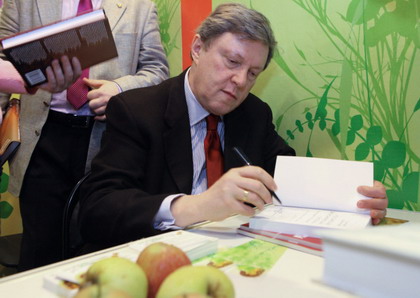
It seems that Grigory Yavlinsky intends to once again try his luck in the presidential election. On April 6, he published a large software article “False and Legitimality” (with a clear hint of “Living not by lies!” Solzhenitsyn), and this week, representatives of Yabloko announced the possibility of his participation in the 2012 campaign.
Yavlinsky was already twice a candidate in the presidential election - both times in the company with Zyuganov and Zhirinovsky. The leaders of the Communist Party and the LDPR have already stated that they would try to happiness next year. If Yavlinsky joins them, then the effect of deja vu will arise. But in a fundamentally different situation-in 1996 and 2000 he was the leader of the Duma faction, was considered as a candidate for high government positions (before the Deputy Prime Minister, or even the prime minister). Now Yavlinsky is a retired politician who is already perceived as part of the story, even the latest.
And in this story there was everything. And the romantic program “500 days”, with which hopes were associated with a quick and almost painless transition to a market economy. And several months of stay in the motley government of Ivan Silaev, ending with demonstrative resignation. And the quick take -off of Yabloko in 1993, when the young economist Grigory Yavlinsky became a public politician who advocated “other reforms” - humane and evolutionary, unlike Gaidar “shock therapy”. And the years of stay in the consistent opposition, which provided for the immediate exclusion from the “apple” of any of his member, who dared to accept the ministry, whether Mikhail Zadornov or Oksana Dmitrieva.
It was another. The fateful mistake of the 98th year, when Yavlinsky refused to enter the office of Evgeny Primakov, which was formed on a fundamentally new coalition basis, unlike other governments of the Yeltsin era. This event was the beginning of the end of the "apple". Positive features of the party began to be transformed in public opinion into negative ones. The fundamentalness of defending one's own beliefs has turned into a dogmatic “stubbornness”. Consistent opposition is in reluctance to take responsibility for the realization of their own initiatives. Competence in the field of economics - in "theoretical" as an antithesis of practical management experience. The resignation of Yavlinsky from the post of Leader of Yabloko was associated with the strongest moral wear of the party, which even many liberal voters, instead of sympathy, began to cause irritation.
And now Yavlinsky is going to return. But with what? With the initiative to make “at the state legal level, the decision on the restoration of Russian statehood, destroyed by the coup of 1917 and the dispersal of the Constituent Assembly on January 6, 1918 as a point of legal report”. And as a result - the convocation of the new Constituent Assembly, designed to resolve the main issues of state construction. At the same time, Yavlinsky sharply criticizes not only the activities of modern Russian authorities (in many specific aspects with its diagnosis it is quite possible to agree), but also the 1993 Constitution, allegedly drawn up on the anger of the day that was not discussed by society and adopted at a very dubious referendum.
Yavlinsky’s proposals look very strange. In the domestic story, the "Charia" entered as despised both red and white, a big talk, deceiving the hopes of people who came to her defense at demonstrations, severely shot by the Bolsheviks. And meekly dispersed after "the guard is tired of waiting." The resuscitation of such a dubious historical phenomenon looks no more logical than plans to restore the heir to the Romanov dynasty on the throne. One can imagine the reaction of voters, concerned about corruption of officials and their own social vulnerability, if you go to them with a proposal to convene a new "founder".
Next. A politician who actually offers to cross out the entire Soviet history is doomed to the role of a marginal in modern Russia. Russian realities are fundamentally different from Lithuanian or Polish, where a significant part of the population for decades felt living in the conditions of occupation for decades. To recognize the era of Gagarin and the queen of the “deviant” is inconceivable for the vast majority of Russians, even for those who condemn the crimes of Lenin, Stalin and their associates, who include their heads before the memory of millions of executed in the camps who died from hunger. How to evaluate the activities of Academician Vavilov, who was tormented in the Stalin prison, but before that for many years working in the conditions of the Soviet regime? Or Academician Sakharov, who was a loyal Soviet scientist who formed before the start of his dissident activity? Such ideas cause a sharp rejection and, as a result, the sound positions that are present in the Yavlinsky article devalue. They can be present in intellectual discussions (where disputed ideas are often useful), and not in electoral policy.
Now about the constitution. She, of course, is not perfect. But it is precisely in it that contains many democratic provisions that need not changes, but in practical implementation mechanisms. This is the priority of personality rights over state interests. The ban on the introduction of mandatory ideology. The advantage of international law on domestic laws. And many other no less important. If you touch the constitution, then it is these articles that may be under the blow.
Neither the person nor the current ideas of Yavlinsky can attract sympathy of a significant number of voters. "Yabloko" his participation in the elections is also unlikely to help. But it may turn out to be beneficial to the Russian authorities - the “theorist” Yavlinsky is a safe, convenient opponent for her. It can be said that the electoral process has become more democratic, liberal forces are again involved in the presidential election, and in the face of a figure, whom they still remember in the West, where they are closely monitored by Russian politics. In his article, Yavlinsky rightly condemns the “Simulakra”, which in modern Russia replaces a true life - but will his campaign become (unless, of course, it takes place) the next “simulacrum”, only more refined than others?
Author-First Vice President of the Center for Political Technology