
Translated material
Faceapp to your Fear
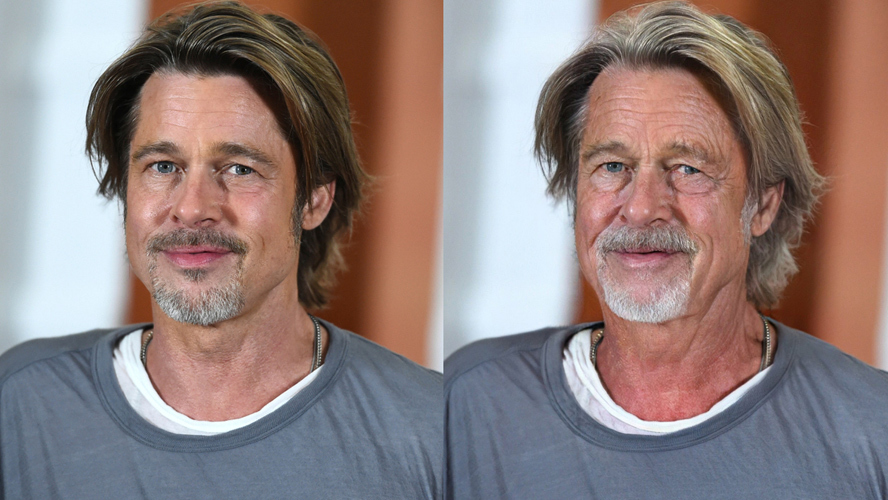
“Death is an Aidos photograph,” wrote Rolan Bart in his famous book “Camera Lucida” . The act of creating a photograph itself transforms the present in the past and live nature into the object. Until now, all the tricks of photographers and various filters they used, plugins, action and applications have come down to one goal - “revive”/rejuvenate. But for some reason, in the summer of 2019, in the FaceApp application, the opposite opportunity shot the opposite opportunity-and everyone was growing sharply in social networks.
Youth perceives elderly people as a “separate view” of Homo sapiens - it seems that this person has always been like that, he was born. And even if you imagine that aging is what happened to others, this, of course, will never happen to them-so successful and not crawling out of fitness clubs. But the ruthless FaceApp takes on the role of a slave behind the emperor’s back, and reminds - "and you are also mortal." And it makes irrefutable evidence - your own photo as a documentary reminder of the limb of being.
It is no coincidence that even the priest Javier Oliver Ravasi on his blog on the website Infocato ́ Lica took a new mobile application with favor, caught its significance for a religious person, and even advised additional literature to those who, after meeting Faceapp , became interested in proper preparation for death. According to him, the topic of " Memento Mori ” is familiar to us, first of all, by religious art: no matter how young, successful, arrogant, remember that you are mortal and in a virtuous existence.
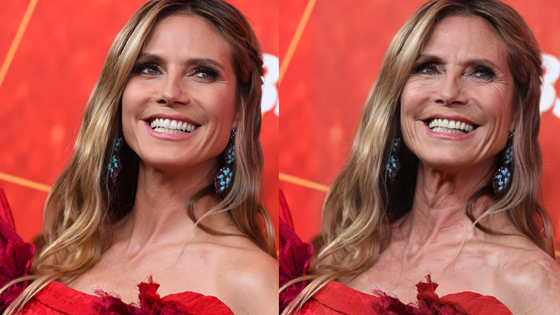 Heidi Klum
Released by Russian developers in 2017, FaceApp survived a new unexpected boom in almost two years. In Germany, he took first place in the chart of popular applications, despite all the media warnings that "user data will be transferred to the Russian server and it is not known for what else to be applied." Tanatos, interest in his own aging and extinction, overpowered the popular fears about information protection. Many media released special materials with the “aged” selfies of celebrities - from Heidi Klum to Brad Pitt.
Tab "age" on Face APP offers the ability to rejuvenate the photo (and there are two rejuvenation gradations) or aging (also two elating gradations, approximately appropriate 50–60 and 70–80 years). The remaining functions of the application (“smiles”, “beards”, “hair colors”, “hairstyles”, “glasses” and “makeup”) were not used by special success - it is easy to recreate them in reality. The use of the “elderly” filter went beyond the entertainment and unexpectedly became an existential act.
It is impossible not to recall the powerful project of the American photographer Philip Toledo “ Maybe ” , shown in 2015 at his personal exhibition in the Hamburg House of photography Deichtorhallen , a project about possible options for the future of the author himself. Philip did not use FaceApp , and his preparation and creation of the project took much more time: the photographer turned to doctors to draw up forecasts of his future for health and genetics and visualized with the help of make -up artists and costumers his own aging.
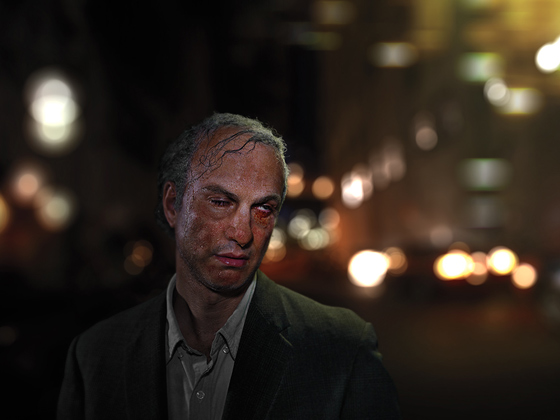 © Phillip Toledano Philip Toledano. From the project "Could be"
It is not known whether FaceApp can similarly analyze the existing inclinations and trends in appearance and predict the future, but the couple of my friends who have laid off their snapshots on Facebook accidentally or not manifested the features of elderly people with alcoholism.
“Photography always speaks of the past. The moment when the photograph was taken was left behind us, in history. But how to explore what has not happened yet? " - writes Toledano. This time, the photographer, who at one time, became famous for the personal project “ Days with my father” about his dying father, turned to the future. The project on his own aging has become for him the visualization of fears and therapy at the same time - meeting face to face with the unknown, we gradually adapt and cease to be afraid. In the photographs of Toledano appears in a dozen images: a homeless with a tired look, a rich old man under the guard of the police or a middle -aged man whose face is distorted by a stroke; He is overgrown with overweight or indifferently sitting in a wheelchair next to a nurse; freezes in the last bloody bath.
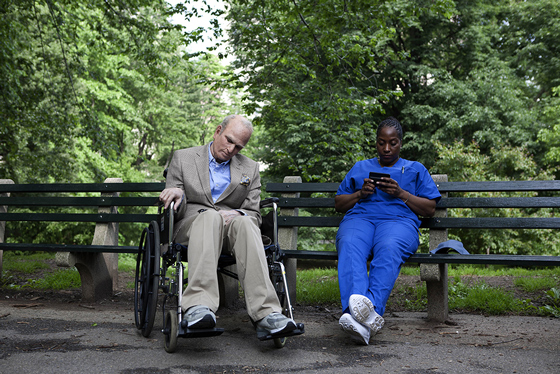 © Phillip Toledano Philip Toledano. From the project "Could be"
Download FaceApp and load your avatar from Facebook there demanded some effort from me, and after processing the photo in the application it was terribly to look at it. After looking at me, a small panic covered me (catharsis?). Within an hour I wanted to run back to the mirror again and again - to check if everything was as it was before, constantly feeling my face - was it covered in wrinkles?
I wonder if people who looked at the classic works of art created in the Memento genre experienced similar sensations Mori for the same purpose - to remind you of the fade of beauty, the speed of life and mortality of all things?
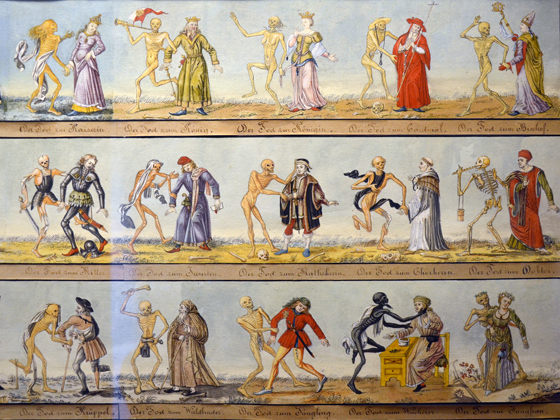 Dance of death. Watercolor copy of Johanna Rudolf Foyerabenda. 1806
Several versions of this genre are known in the history of art: this is especially the Totentanz (“Denal of Death”), Vanitas baroque still lifes (“vanity fuss”) and often found in the painting of the high Renaissance and Victorian England “Three age of life”. Vanitas developed along with Protestantism, which did not recognize the icon, and gained spread in the Netherlands of the 17th century, and then in America under the influence of Puritan ideas. Its key symbols - skull, sand clock, tulip - symbolized decomposition, time and wilting. In the “Dance of Death”, the skeleton is enough anyone - old people, young and babies - to remind you that a person is mortal at any age. In the variants of the “Three Age of Life” genre, we see how one and the same person, represented in different life phases, rises to the top of the stairs - the time of his heyday - and ages, going down.
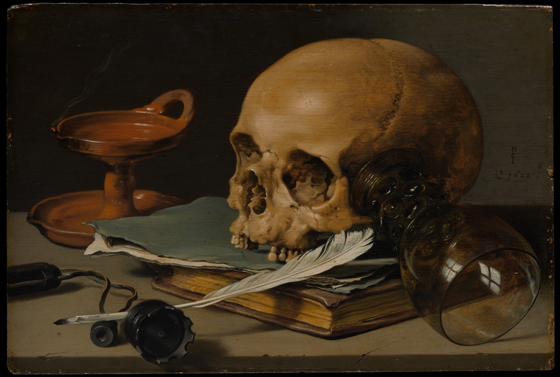 Still a still life with a skull and a pen. Peter class. 1628
Calling to the righteous and virtuous life, plots Mempento Mori reminded of the transition of worldly fuss and warned against pride - for power, wealth and beauty are quick and finite. By the way, in the modern world, another popular photographic phenomenon - selfie is responsible for pride.
In September 2019 , British photographer Martin Parr, known for his ironic approach to Vernacular photography, released a new book about selfie ( Death by Selfie ” ), for which he shot people who photograph themselves against the background of various spectacular landscapes and attractions. Parr is engaged in the topic of mass tourism and his perversions for a very long time, studying changes in society and documenting them. The creation of this book by Parra was prompted by statistics from India, where only during 2015 27 selfie lovers were killed in dangerous places for this (their number in the next two years has already grown to 68). By the way, these dying selfies somehow sometimes get on the Internet, when their owners are no longer alive. Are these images created a second before their heroes break into the abyss from the edge of the cliff or will a huge wave will be washed away, the most effective representation of Memento Mori ?
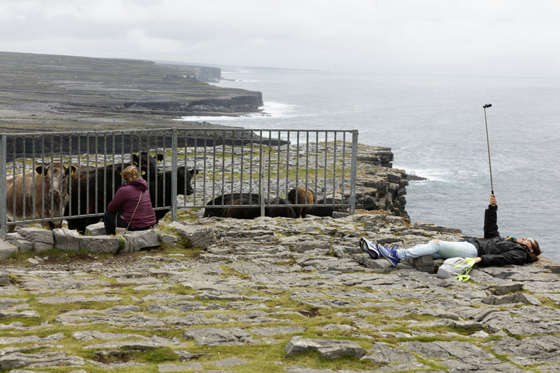 © Martin Parr Martin Parr. From the project "Deadly selfie"
It has long been a common place to believe that the selfie phenomenon was directly related to demonstrativeness and narcissism. All filters and masks on Instagram are designed to make more beautiful, slimmer, more glamorous, younger, and not a single popular filter makes you thicker or older. Selfies create the illusion of face and body without age, while FaceApp is attractive in that it offers a completely opposite.
How did the depressive pictures of Memento Mori again acquire virality? The desire to make a trip to the future? Or did it affect the fact that first pop stars published their “aged” photos? Has it become a trigger for the majority, wishing spectacles? About the same story as with the emperor: despite the glory, wealth and power, and they will grow old and die.
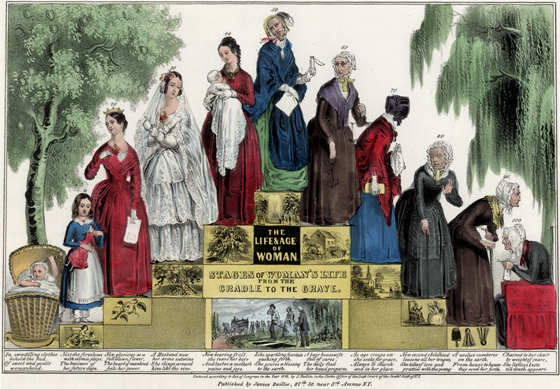 The life and age of a woman, the stages of a woman’s life from a cradle to the grave. New York, James Bailey. OK. 1848
There is another interesting phenomenon of the Face App . A few years ago, aging suddenly came into fashion in the fashion industry: older models of 60–90 years appeared on the covers of magazines and in brands campaigns, which are in demand as never before. According to the popular hashtag on Instagram, this phenomenon was called # gr e ynaissance , which can be translated as "Renaissance gray hair."
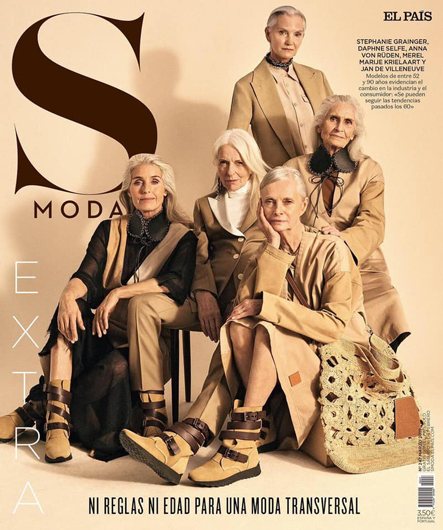 Cover of the Spanish magazine S Moda (models from 52 to 90 years old)
In 2018, several articles were published in Western publications written by activists Silver Hair , that the advertising term Anti-Ageing comes out of circulation, replacing to softer phrases-such as Perfect Age (“perfect aging”), Slow Age (“slow aging”) and so on. It becomes indecent to convince women that aging is an ailment from which it is necessary to treat, that age should be hidden, masked and shy. Women today look good today, not “younger”. Old age comes to the media sphere, the limb of being ceases to be taboo, gains strength by Death Positivity , which ultimately changes our attitude to this phenomenon.
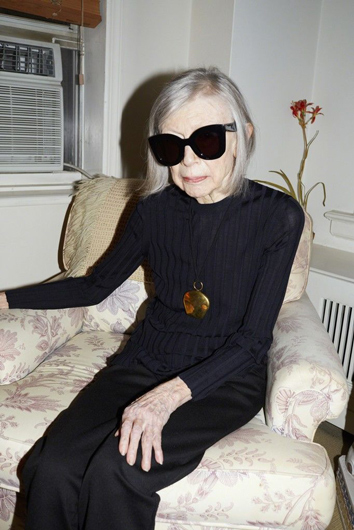 © Juergen Teller Jurgen Telar. Portrait of Joan Didion for the CELINE advertising campaign. 2015
Will the new version of FaceApp will enter our daily media space in the summer of 2020? It is unknown, but other well -known versions of Memento Mori clearly find themselves on the agenda. For example, on Catholic portals in March 2020, materials appeared about the growing relevance of the plot of “Dance of Death” - which, incidentally, appeared in the XIV century as a response to an epidemic of a plague that takes away poor and rich people of all ages.
In one of these articles dedicated to the coronavirus, the Catholic priest Fergus Batler-Galley remarks that "the only thing that can rationalize the complex and united labyrinth of human relationships and build them in an even line-this is death-even if it is only its silhouette on a distant hill." Thinking that the modern habit of “concentrating on the bright side of life” only enhances our fears and makes death more powerful, he comes to the conclusion that the recognition of the presence of death makes being more conscious. And, at first glance, it is optimistic that the article is “time to put on our dance shoes”. True, he has in mind a dance with death.