
Translated material
Iranian choice
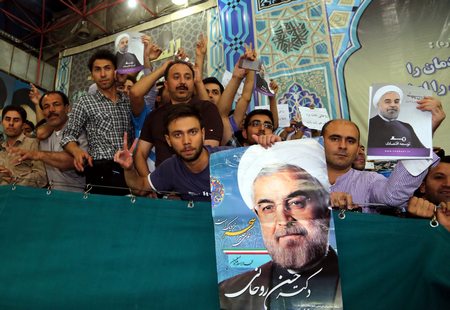
The elections of the President of Iran led to the cessation of eight years of dominance of the conservative forces in the political life of the country. The victory was won by Hassan Rukhani, who has a reputation as a moderate reformer and a supporter of “warming” in relations with the West. It is no less noteworthy that the supporter of the hard anti -Western course Said Jalili took only the third place, despite the information about his proximity to the powerful Rachbar (spiritual leader) Ayatollah Khameney. And despite the support rendered by Jalili by the surrounding President Akhmadinejad.
Thus, the presidential elections in Iran were much more interesting and less predictable than in Russia. The degree of pluralism of the Iranian elite is significantly higher than the Russian one. However, Iranian politics has fundamental differences - it has neither pro -Western liberals nor left -wing parties. All of them were excluded from political life in 1979-1981, shortly after the overthrow of the Shah regime in which they took part, along with the Islamists. And even earlier, all supporters of the former shah were excluded from politics - so far the former members (even ordinary) of the Tolstahiz monarchist party are not allowed to the elections. Not a single country of Central Europe knew such lustrations.
The political struggle in Iran goes between the various fractions of the Islamists, whose representatives went through the revolution, the fight against the external (Saddami Iraq) and the internal (left -winged terrorists who exterminated a considerable part of the ruling elite in 1981) enemies. Moreover, among the current reformers there are a lot of people who in the past occupying extremely radical positions. The memorable character of the Oscar-winning film “Argo Operation” is a fanatical young Islamist, who was the “press secretary” of the invaders of the American embassy. Her prototype is Masuma Ebthera, the former Vice President of Iran under the presidential reformer Hatam, who was nicknamed "Ayatollah Gorbachev." During the presidency of Mahmud Ahmadinejad, she was in opposition.
Unusual for the classical democracy of the "rules of the game" in Iranian politics no less than in Russian - both formal and informal. For example, the president is actually a popularly elected prime minister, and the supreme power belongs to the spiritual and political leader, Ayatollah Khamenei. At the same time, the president can officially occupy his post for no more than two consecutive terms - four years, and he receives official support for Khamenei during a secondary cylinder, which informally makes him an unconditional favorite. In 2009, the reformation opposition, without waiting for the obviously deplorable results of the second term of the Ahmadinejad, nominated a real candidate against him - and came across to the full power of the state machine, from falsification of voting results to dispersal of demonstrations and mass arrests.
Four years passed, and Khamenei officially did not support any of the candidates, informally allowing free competition and an honest counting of votes, as it was already in 1997 (when he defeated the huts) and 2005, the time of the Akhmadinejad triumph. But along the way, he organized the exclusion from among the candidates of those politicians who had too large resources and ambitions-the former president of Rafsanjani and the closest ally of Ahmadinejad Rakhima-Mashai. Any of the remaining applicants to one degree or another arranged Hamens-either because of ideological proximity (for example, Jalili), or due to insufficient effects (the elected president of Rukhani). Therefore, if Iran’s relationship with the West receives a new impulse, then this issue will be in the competence of Khamenei to no less (and, possibly, even more) than Rukhani. Moreover, now there are two voltage points - an atomic project and Syria. And if on the first issue, compromise decisions are possible in order to mitigate sanctions (taking into account the diplomatic experience of the same Rukhani when he was the main negotiator with the West in 2003-2005), then the second situation looks even more difficult. Strengthening the intervention of Iranian intervention in the Syrian conflict can lead to the compromise of the president-reformer in the eyes of the West, and the “softness” in this matter is to discredit in the eyes of their own security forces and political conservatives. 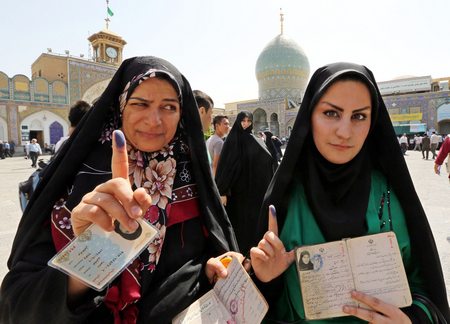
At the same time, the current Iranian elections, of course, cannot be considered routine. The country's population voted for the higher degree of freedom and openness, for a compromise with the West (the need to build a dialogue with it was spoke not only by Rukhani, but - although less actively - the mayor of Tehran Galibaf). In fact, we are talking about the distrust of the extremist policy of Ahmadinejad, which led Iran to a foreign policy and economic impasse. Iranian society is not ready for strict anti -Western mobilization, in which it is necessary to tighten the belts for many years, and at the maximum - to get involved in an armed conflict. With all the differences, some parallels with Serbia are suggested, the population of which was indifferent to the loud calls of local radicals to defend Kosovo, and the former nationalist Nikolich agrees even more actively than his liberal predecessor Tadic (as he wants to continue European integration of his country).
The problem of mobilization is important for Russia - of course, with its specificity. Her society, despite the prevalence of anti -Western and traditionalist sentiments, is also not ready for mobilization scenarios, without which it is impossible to implement programs such as “new industrialization”. And, in addition, the substitution of the real agenda, the concentration of the attention of the population on the fight against blasphemers and sexual minorities instead of solving real socio-economic problems, creating favorable conditions for business, can only have a temporary effect. Like the populist rhetoric of Akhmadinejad, which has not been attracted to the wide layers of Iranian society not so long ago.
Author-First Vice President of the Center for Political Technology
Photos of ERA / ITAR-TASS