
Translated material
Brown!
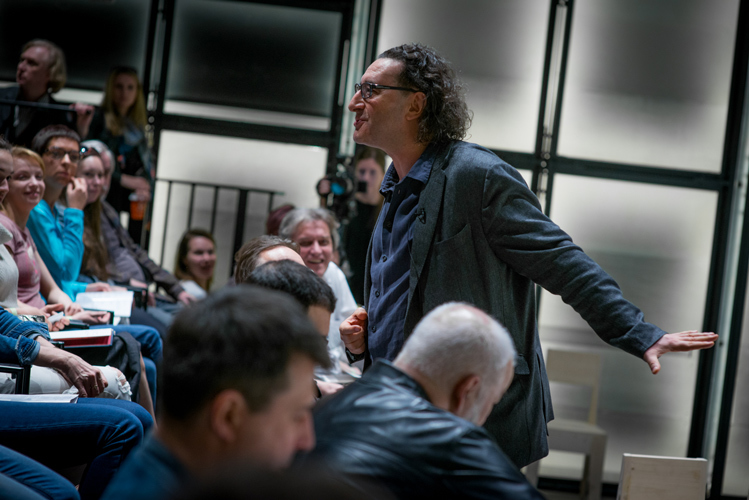
The new issue of the magazine " Theater is being prepared . " . To his exit, Colta.ru publishes an article by Marina Davydova, dedicated to one of the central prime minister of the Golden Donkey, suitable for the end of the capital's theater season. Rided space of work "" Electro Theater Stanislavsky "
Boris Yukhananov deceived the writer for a long time. Or not, not like that: the writing fraternity was deceived for a long time about Boris Yukhananov. He pretended to put performances that have a beginning (usually 19:00, but everything happened), the middle (as it turns out) and the end (usually around midnight). And the scribing of the brethren reviewed these performances as something that has a beginning, middle and end, and often scolded, believing that a lot was not thought out in them, unfinished, excessively, pretentiously, vaguely and generally “non -full -wrapped”!
In 2016, in the “Electrotheater”, the Golden Poster “Golden Poster” founded by himself, and for me personally it became clear that we were all - well, O'Kay, not all, but many, including - were simply blind.
The performances of the Creator of the "Electro" not only now, but before it was pointless to review all that the creator himself said about them. Without what was done to them before - and what he was selected after. Simply put, the text of the performance could not be reviewed without the hypertext of the whole life of a charismatic author. His inspired ranting, about which legends went about in theatrical Russia, but which were always considered as something separate from its scenic opuses - in fact an integral part of these opuses, which we, out of habit, continue to call performances. It was just before that the director’s words were taken outside the hall, so only a group of people close to him could hear them. She revealed the most cherished secrets of the world, which the sweet -fat demiurge created on the stage, and his most beautiful habits. And this group of elected / dedicated / apostles of the new theater religion, which Yukhananov himself calls the "new procedurality", saw one reality, and the crowded group of profans - completely different. The former, as in a well -known parable about the elephant, contemplated the entire large mammal, and the latter were exactly what the blind people and judged the elephant, feeling his tail, trunk and legs.
And in the Golden Nap, two reality met. The reasoning about what is happening on the stage, as well as outside the scene, and sometimes outside our little life, is not just Jukhananov’s reasoning somewhere on the sidelines. These are the improvisations that he pronounces during the action. Myself. Own person.
In the beginning there was a word. And Jukhananov had a word. Demiurge was embodied in a performer and descended on a sinful scene. Text, context and hypertext merged together. Here they are all here - before us. Please admire! We, the inhabitants of the profane world, finally saw the entire elephant. By the way, "Cuplah!" - The key phrase "Golden donkey". This, of course, is an accident. In the “open space of work” (as determined in the program of the project genre), everything is by chance. But everything is natural.
This space is fraught with a critic of purely technological difficulties, because its usual tools will have to be put aside. It is impossible to say here: the author, apparently, wanted to inform us of this and that, but did not manage to convey the thought, because the author often refutes himself along the way. Here, it is unproductive to reflect the performance itself (we still use this familiar, although clearly outdated term for simplicity), rather, it makes sense to reflect on someone else's reflection.
 © Olympia Orlova
But to begin with, it would be necessary to tell how exactly the “golden donkey” is arranged, otherwise the reflection on the reflection will be so intricate that the reader in anger will cease to read this text. Let's hope that he has not done this so far.
So.
The Golden Donkey takes five days in a row and consists of modules and compositions.
From 14:00 to 18:00, all five days show modules. These are mini-representations that the numerous students of Yukhananov and the artists of the troupe independently made Apuley's Golden Poster. Excerpts are mounted each time in different ways and outside of any plot logic. The entrance-output for the public is free, but the hall is always full of spectators. Any of the modules sitting in the Huhanan hall can interrupt at any time and begin to deconstruct it before our eyes.
At 19:00, compositions begin. There are three compositions - “shaggy”, “white” and “city”. The compositions were also once modules, but then Yukhananov, of his owner will, united them into something integral and, as it were, finished. The word "as if" - you probably already guessed - there is a key one. In compositions, improvisation zones are also possible. Something unpredictable can happen in them. Or it may not happen. This is how lucky. They go for five hours each.
Simply put, the Golden Donkey is Opus Magnum . Encyclopedia of our life. It touched on all burning topics and all spectacular genres are used: pastoral, clowning, circus, ballet. In it, the action is stylized either under the party of the 30s, then under the disco of the 80s. At the same time, the general tonality of the project from the composition to the composition changes. The scenery also change a bit.
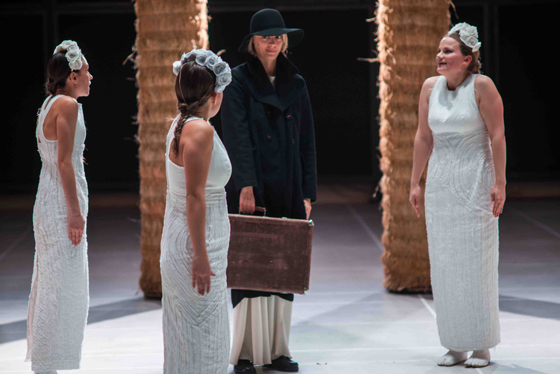
In the "furry" on the stage there are furry columns.
Here the relations of artists and spectators are the most mobile, and the border between the stage and the hall is as permeable as the border between the stage and life.
Here, during the plot, they can quote Arto and Grotovsky. They can exclaim: "I call you to action by the name of Guy Deborah!" In the program among the characters, there is a “person leaving the hall”, and he really leaves. The carpet is carried away by the fan of the presentation, and he shouts to the public: “If there are children in the hall, representatives of the Ministry of Culture or Commission on morality, beware, there will be a lot of mat!” One of the actresses, uttering a monologue of her heroine, suddenly begins to recall how she, who speak three languages, entered GITIS and how she ended up on acting galleys, almost cries ... and then again goes on to the monologue “according to the role”.
Before us is not characters, but artists playing the characters.
So Psyche (Alla Kazakova) went on stage and told us her story. But on the stage there is a Cupid (Pavel Kravets). He is soldered. He has almost a clown suit. He begins to tell the same story as Psyche-Kazakov. And now she is already acting as a commentator. Ironically evaluates someone else's game. Shouting: he stole my story.
But the pseudo-register, called in the program of Isis-Cits, arranged for the artists the analysis of flights: the costume, they say, good, the props good, there is an epic prospect, but it would be necessary to close the audience in a dramatic way. I retell from memory, the Izid-Cits in the blue hipster cap (Andrey Emelyanov) speaks much wiser.
Not the stories of ancient gods and ordinary mortals, but the struggle for the attention of the viewer is literally an Agon (“struggle” or “contest” in translation from the ancient Greek) is the main plot of “shaggy”.
 © Olympia Orlova
In the "white" columns white.
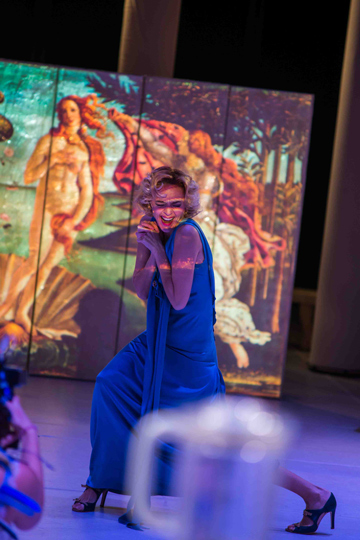
Here everything is much more refined than in the previous composition. There are chairs in the form of shells on the stage, unequivocally referring to Botticelli's "Birth of Venus". For Venus there is still the same Kazakov. She finds out a relationship with Amur (Anton Kapanin). The action is transferred to Olympus, and the local gods quarrel, measured the virtues and compete for the attention of the audience, well, completely like people. More precisely, like artists.
And in the "white" real butterflies appear on the stage. Immediately after the donkey and the elephant, the butterfly, the symbol of beauty, but also the symbol of ephemeral (death), is the main image of the performance, and we will return to it.
In the "city" the columns are black.
From Olympus, the action is transferred to the sinful land, and the tart smell of the dashing 90s is mixed with it. Who and what is not here. Brothers in the market with Georgian accent. Shalmans, where cocaine is bite to be salted cucumbers. The Gentle May group and its immortal "pink roses of Svetka Sokolova." Some Chinese, adjacent to long brown braids of delicate maiden. Skulls. Black angel of death with horns. In the middle of the scene lies a dead donkey. The characters confuse the concepts of “paternal” and “attic”. The volume-maskulin Venus (Lera Gorin) sings the "dark night" and orders to trumpet into green pipes. In general, everything is very similar to a crematorium.
“Fucking” - “white” - “city”. What is this triad? The world of artists - the world of gods - the world of people? Paradise - Cleaning - underworld? - caterpillar - butterfly - the ashes of a butterfly? The Dionysian principle-the Apollonian principle-is still a start (I don’t even know which one)?
And here we are returning to the key question. The finished work is good in that it can be solved, it can be debunk, it can be indicated on errors based on the laws, the author of themselves set. But how to fix the elusive theatrical matter, which itself comprehends itself in the process of formation and, which is completely incomprehensible, in the process of elimination? How to evaluate and decipher the "open space of work"? I think this: a well -arranged “open space” provokes the viewer to think, but poorly organized. In a poorly arranged, you just sit and grind your teeth, trying to understand: what does all this mean? In the well-arranged I can fly away with thoughts in some, which the creators of the action probably did not mean at all. I begin to see in him meanings, which, probably, are not in him. Doesn't matter! The open structure is not an object for interpretation. This is a trigger for thought. If the trigger has worked, I begin to love the performance.
What did I think about while watching the Golden Poster? First of all, about the theater itself, because a good modern theater is, first of all, the theater studying the nature of the theater, and the free essay of the “Electro” based on Apuley is, first of all, a game about the game.
In addition to Isis-Cicer, there is also Isis Klim (Klim Kozinsky). But the main Isis here, of course, is Yukhananov himself. He also sometimes connects to the process in the compositions and disassembles someone else's debriefing. Directs directing. Speaks as a right to have. If you think about it, Yukhananov cannot and should not have deputies, as they could not have them with Tadeusz Kantor, who personally occupied his ingenious invocations on stage. But they are here. And this is no accident.
The performance is already going on, and the play has not yet been written, ”says Yukhananov. Life is already going on, but there is no life script. Life is also a “open space of work.
Comprehending the nature of the theater, we in the “golden donkey” simultaneously begin to comprehend the nature of power, and hence the nature of society itself. Here everyone is trying to dominate-the Protestant preachers who brought the “good news” in the form of the text of Apuley, rock singers, politicians, gods, even boxers, leading a duel with each other right on the stage of the theater: the theater, as we said above, is an agon, a duel, and it is always possible to blow under the breath from a partner. The artist plays and reigns on the stage, but then another artist will come and outplay his colleague, and then the director will come and indicate the artist to his mistakes, and then another director will come and disavow this first one, and then the clowns will come and neutrum the second director who finished the first, and set their own rules of the game.
So in society, no director is never endowed with authority forever, but on a horse (on an elephant / on a donkey) there is always one who sets his performance, and does not play a role in someone else's.
At the very beginning, “shaggy” goes to the stage with a suitcase of the wanderer Psyche (Alla Kazakova), and immediately after her a choir appears, but not ancient, but “document”. Horeste, making some geometric passes with their hands, begin to pester to Psyche:
- Brown! Brown!
- Do you have a donkey?
- Everyone says: "Do you have a donkey?" - And you are a bundle!
Anyone who is the first to say: “Brown!”, In a win immediately. Whatever he answer, he will beat you. He asked the rules of the game, and you are already in his game, if you want it or not.
To set the rules of the game and guess the rules of the game - this is the main thing in the "open space of work." Here they change continuously, just as the optics through which we look at the stage (and at the world). Here is a story about certain events from the first person, and we sympathize with the hero, but the same story comes from a third person, and the hero already seems funny to us. At some point, Yukhananov recalls the parable of the Chinese poets who write their poems-and suddenly they are told that the imperial family was watching them. And this also changes the rules of the game. That is why the viewer is so important for the “golden donkey” (“There is a viewer!”-Suddenly the Yukhanans shouts to the hall to pathetically). After all, the perceiving subject directs the performance no less than the most charismatic director.
In the "golden donkey" everyone constantly directs, everyone is constantly observing each other and everything is changing places. As in quantum physics, each object and every subject here have a flickering existence. All fake - pseudo -regionalists, pseudo -artists, even lumpy pseudo -producers, which we initially take for real ones. And at the same time, everything is genuine. Before us is an endless chain of transformations. Vicious circle. Eternal theatrical samsara.
The “open space of work” does not only insist on the variability and uncertainty of the world, teeming with paradoxes-it in a sense sings them.
 © Olympia Orlova
“The performance is already coming, but the play has not yet been written,” says Yukhananov.
Life is already going on, but there is no life script. Life is also a “open space of work”.
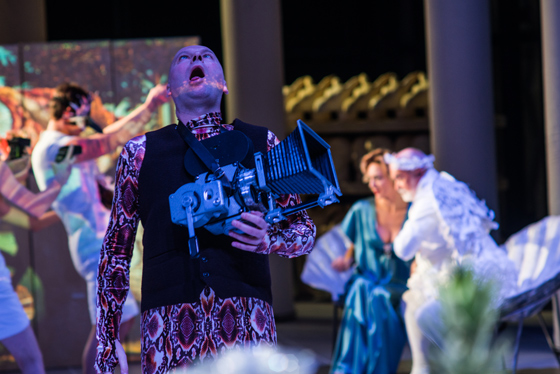
Who is Johananov himself in all these compositions? Before the start of each of them, one of his orzid deputies screams with a donkey: he makes the maximum idiotic expression on his face and spreads his mouth wide. This scream is instead of a call. Sometimes Yukhananov himself also screams with a donkey. At my performance (again this “performance”!) He suddenly informed the hall, pointing to his artists: “These are all fake donkey, only I am a real donkey!” That is, he is both Isis and the donkey. Well O'Kay. And who else? Joker? Trickster? Illusionist? Imitor Dei ? The latter, perhaps the most true. The "imitator of God" has nothing saint. Yukhananov too.
For example, I witnessed how, in the process of deconstruction of a certain “module”, one of the most famous students Anatoly Vasiliev turned to criticizing “all these e ** tumored Vasilievites”, having first debugged his former classmates, then his students, then his teachers, then his apostles, then their own ideas. He laughed at himself, and then at how awkwardly he just laughed at himself. “We are losing words (that is, concepts. - M.D. ), but no one forbids us to laugh.” This is also a quote from Yukhananov.
Laugh is to expose.
The theater can not only create an illusion, but also dispel the illusion (a kind of theatrical magic session with its full exposure). And then create before our eyes again! The theater is the eternal construction and destruction of the mandala. And the Golden Donkey is an ideal text for the theater. Not because in the novel of Apuley Passion-Mordasti, confusion in the plot and in general the devil will break his leg. This is good for the “open space”, but this is not the main thing. The main thing is that the second name of the “golden donkey” is “metamorphoses” (!), And these metamorphoses have its own sacred metasyette.
The final (what is happening at Apuley in the temple!) The transformation of a donkey into a person is in the context of the project, of course, the transformation of the caterpillar into a butterfly, the transformation of litter into poems, the transformation of life into art. And it leaves for each of us the hope that we will someday turn from what we are into people.
I don’t know if Yukhananov had this in mind when he came up with his Opus Magnum . But if not for him, I would never have thought about all this and would never formulate the ontological justification of the theater like this. If it were not for his “open space of work”, I probably would never have seen the whole “golden donkey” - only from time to time I would feel his ears, hooves and tail.