
Translated material
Not scary
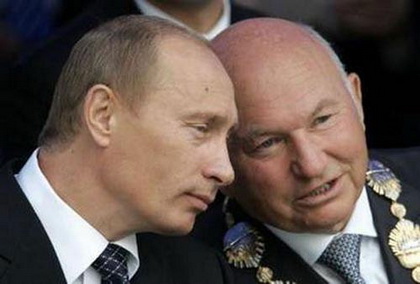
Yuri Luzhkov in the Posner program expressed the opinion that the election of the heads of regions is better than their current selection - actual purpose. Dmitry Medvedev, in response, called a change in the modern system of forming the governor’s corps unrealistic and unacceptable and directly explained that if one of the governors is dissatisfied with it, then they can write a departure statement. At first glance, the situation seems sensational - one of the most experienced heads of regions made a fatal mistake threatening quick displacement from his post. In fact, everything is more complicated.
In the Russian political history of the last one and a half decades, there were a lot of discussions - about the ratio of the powers of the president and government, about the possibility of amendments to the Constitution, on the procedure for the formation of the Federation Council and the election system to the State Duma. At the same time, a specific political situation has a serious influence on the nature of discussions. In the 90s, the opinion prevailed that it was necessary to strengthen the powers of the parliament at the expense of the presidential, in the subsequent period-the exact opposite. This is not surprising - the majority of participants in the discussions are practitioners who assess the situation and its prospects, based not from abstract legal reasons, but from assessments of specific personalities, which can use changes to their benefits (it is enough to compare the degree of legal capacity of Boris Yeltsin and Vladimir Putin).
However, last year, in the period of preparation for the Duma election campaign, it began to seem that the discussions were coming to naught. Priority was given to controllability, and discussions were recognized as a factor sharing political stability, perceived as the highest value during the period of the “successor operation”. Many topics were actually led beyond the limits of serious public discussions, becoming the destiny of the political periphery, marginalizing. For example, it was about such the foundations of a party-political system as a 7%electoral barrier and a 50 thousandth minimum of members of political parties. However, about the last question, the situation was not so unambiguous - in the media, leaks about a possible increase in this minimum to 100 thousand were “thrown out”. It is clear that such proposals did not have such proposals, but contributed only to intimidation of the Communists, the only system opposition in the current Duma.
 However, this year the situation has seriously changed, many issues, it seemed, resolved for a long -term perspective, began to be discussed again. It is not only about the general vector of development of the country, although there are remarkable phenomena here. It is enough to bring an extensive quote from the message of President Dmitry Medvedev to the Federal Assembly: “The state apparatus in our country is the largest employer, the most active publisher, the best producer, a court, a party to himself, and ultimately, people. Such a system is absolutely ineffective and creates only one thing - corruption. It gives rise to massive legal nihilism, it conflicts with the constitution, inhibits the development of institutions of innovative economy and democracy. ” Previously, such criticism came only from the opposition. But other aspects of the message are also interesting-a decrease in the minimum number of parties members is promised, some steps are taken towards parties that do not overcome the 7%barrier (which may be the first step to reduce it).
Moreover, the attitude to presidential criticism began to change. Let us recall the collapse of the Mechel shares and the entire stock market, when Vladimir Putin proposed calling the doctor to the owner of this company Igor Zyuzin. And recall Medvedev’s more sharp criticism of the Pole Gold gold mining company, when the president even hinted at a possible review of the license. The businessmen accepted the claims of the head of state to execution, and the market did not respond to his words in any way, not perceiving them as a terrible threat, which should be understood expandfully, recalling the precedent of Yukos. Medvedev’s words do not cause fear, perceived as specific claims that are not leading to fatal consequences for criticism objects.
Let us return to the topic of Luzhkov’s statements. Within the framework of discussions, the question of the governor’s elections is quite natural - this year she was already raised by the Volga leaders of the Shaimiev and Rakhimov. The current crisis gives additional arguments for this idea - authoritative, who have passed through direct elections, the heads of regions receive additional legitimacy, have a higher confidence in the region of the region. It is well known that during crises the issue of trust acquires significantly more importance than during economic growth. In the case of social shocks, the chosen governor can better calm people, his position will be perceived with great understanding. Of course, we can give examples of an unreasonable decision of citizens, but in the same way there are examples of an erroneous choice of the federal center (Kolesov in the Amur Region, Tishanin in the Irkutsk region).
However, along with the resolution of discussions, Medvedev also established a limiter for them. Representatives of the vertical power cannot criticize the decisions adopted by this power; Their possibilities of participating in discussions are reduced, in comparison, for example, with independent experts, not burdened by public service. It is clear that now neither Luzhkov nor his colleagues will raise this issue (which, however, does not lead it out of public space - especially since the crisis can give reasons for this). At the same time, it is unlikely to expect serious consequences for the Moscow mayor, given the style of President Medvedev.
Author-Vice President of the Center for Political Technology