
Translated material
The virus creates Europe
1.
We will call this a “situation of the virus”, bearing in mind the whole set of social projections.
It should be recalled: before Europe after the Second World War - at first the form of the EEC, and then the European Union - there were many tasks of technical unification, complex issues related to reforms and regulation. But there were “existential” crises-that is, crises that require universal participation, since there was not just some kind of problem, but the foundations of existence (“existence”)-there were few.
Each such crisis works as a 3D printer: it "prints" Europe anew. There were, apparently four crises: “Berlin” (1963), the collapse of the Eastern Bloc (1989–1991), the 2008 economic crisis and the refugee crisis of 2017.
It is already clearly visible that the virus crisis is symmetrical symmetrical of the refugee crisis. Why? The refugee crisis demanded a reaction of both the European Union as a whole, and every national government, and all societies. And this reaction was conflict. She not only shared the European Union, but also split the society of each individual country of Europe. The refugee crisis generally defocated the combination of the concepts of “European Union” and “Europe”.
Now the opposite is happening. Actually, this reverse symmetry even has a direct expression: the “running” did not accumulate from the outside of the EU border, but rather stuck citizens of the Eastern European countries trying to leave the Schengen zone . The virus collects everything back. Moreover, the paradox is that the virus, dissecting the European space with quarantine borders, “closing” each country, moves to the reconstruction of “common space”. And he constructs this common space differently than before.
On March 14–15, a large group of European governments decided to follow the general quarantine standards.
From this moment, the virus has turned from a regular seasonal infection into a political entity of high power.
Like any political entity, he immediately begins to carry out differentiation, to label social spaces, to force self -determination against himself, to generate conspiracy interpretations and conduct civilian mobilization.
For conspiracy consciousness, it is important where the trigger, “who created the situation” (reptiloids or Rothschilds). For political consciousness, another is important: as the situation of the virus forms the bullet of the winners.
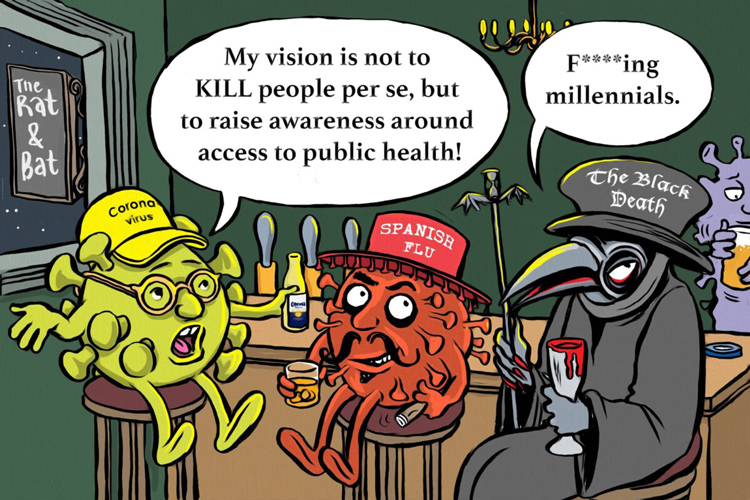
In my opinion, the virus calls for the battle of European millennials and generation Z - the audit is aimed, first of all, at them. These are “fresh”, non-frighten generations, who lived in Europe a prosperous 30th anniversary. Now they are called to the ring: they must take responsibility for collective decisions in the political sphere, they must also take care of their old people at civil and private levels.
In other words, the millennials of Kurtz and Macron must leave the zone of the virus, having received historical bonuses. Not because they “defeated the virus,” he will leave himself. And because they recognized him as a political entity and announced the oncoming mobilization.
2.
There is another aspect. The situation of the virus is a marker drawing the zone where a public mind is formed quickly from the personal Common Sense : the decisions of the authorities can be disputed, but we must follow them. People put on sanitary masks.
Despite the fact that some feel the “taste of the virus in the mouth” and panic, while others, on the contrary, are bragging and cursing governments and their measures, it is clearly visible that in European societies there are adults - in a Kantian sense - a nucleus.
The virus forms a stronger consensus within European society than around any reform program or any other crisis program.
Moreover, there is a very subtle moment. If it were a Siberian ulcer, or a plague, or another real catastrophic infection, the situation would be different. She would not form anything, except panic, horror and discourse "salvation at all costs." The situation of the virus is training. And thereby, in a rather mild mode, she checks the European society.
She mobilizes not horror, but that personal Common Sense , from which public solidarity arises.
True, the problem of the nature of this solidarity arises here. This is a virus, not a war. And the solidarity here is around "bodily". The threat of the epidemic in itself is “pre -policy”. It concerns everyone as a body . She is simple. The virus does not know hierarchies. “Dance of Death” shows us all the classes of medieval Europe from the times of plague epidemics. And here we immediately remember Foucault. Yes, the virus is extremely important for the formation of “care for yourself” (you need to wash your hands and do not touch your face with your hands), it draws the boundaries of sanitary norms of everyday life, it affects personal discipline, but at the same time, this care of itself has biopolitics.
The virus gives to the rulers an important tool for “invisible power”, that is, control of the masses over any ideas, at the expense of the body. The state offers a citizen a joint management of his body. Totalitarian regimes with their “body politicians” are already well studied by Foucault followers.
The famous Russian philosopher Oleg Aronson in his last book gathered three interesting articles on “Social Infection” in the “Infection” section, and among them the main one is “Political Epidemiology”.
The initial thought of Aronson is understandable: inertia to perceive politics through the prism of rationality, through the subjectivity and ability of political actors to reflection is divided that we constantly arise political phenomena, which are a social virus, a form of infection. To explain this “bitten”, Aronon separately disassembles the social projection of the image of Dracula. Georges Batay and Rene Girard analyzed fascism from this side: “masses” are not guided by logic, but with desire . The desire moves below the rational radars, it covers like a virus. It is dangerous. Aronon writes: “We can state that such things as“ involvement ”,“ solidarity ”,“ fraternity ”, which largely built a humanistic worldview and which were part of a democratic understanding of the development of society and its moral basis, at the time of political mobilization receive a completely different meaning. This is because, being the concepts of fundamentally non -literary, in which relations are not at all social, they are homogenized by politics. ”
He believes that “religion has ceased to be a space of fears and obsessive ideas. Its place was taken by politics, which creates those hallucinatory images, without which mass society cannot exist ... ”Do not politize solidarity - this is what Aronon ends with his essay.
Therefore, the positions were divided. For example, the glory of the Zhezhek, since he is left, in the recent essay he sees the prospect of new global solidarity in the virus. He refers to the famous Marxist theoretician Jamison, who, many years ago, analyzing Hollywood films about the threat of global epidemics, saw some hope in them for those forms of solidarity that could tear out the world from global capitalism. But the voices of the Libertarians, who see in anti -virus measures, are already sounding the danger of the new “total power of the state”.
Most likely, the hopes of the left and the fears of the right will not be justified. And what will happen?
3.
One way or another, the virus creates new Europe. This is the first big event after the collapse of the Berlin Wall. And from the point of view of the “assembly of Europe” - more significant than the unsuccessful attempt of the European Constitution (2004, the Roman Treaty).
The virus gives rise to a state of emergency, in which everything is tested at once - the ability to overlap borders (and therefore, in general, such a large -scale confirmation of borders), readiness for trans -European actions of all services (and not only intelligence, as it was due to the Islamic threat after 09/11/2001); It reveals a disciplined and joint European core of all national societies, and on top of party differences, bypassing ideology.
The virus needs the European army in the same sense as Macron. New Police and New Board Control. The virus causes that stratification of society, which is generally generated by emergency. Here are a check by those who cannot leave jobs in the infrastructure of life support and are at risk.
Unlike such threats in Europe as radical Islamism or hybrid war, in which postmodern duality is sewn, the virus is much more straight, primary. Like any natural catastrophe, it calls for life the forces that postmodernism is alien to. The virus works in favor of the new subjectivity of Europe, which she needed all the 30th anniversary after the collapse of the Berlin wall.