
Translated material
Thinking fingers
In Yekaterinburg, the main project of the VI Ural Industrial Biennale of Modern Art was opened, “thinking hands touch each other”, whose curators were Chalk Ileke, Asaf Kimmel and Adan Yildiz. The exposition is located on five sites of the city, forming a kind of biennal route. The bins of Yekaterinburg Biennale are not limited: this year more than ten artists from around the world became residents this year, and their projects created in different cities of the Urals, including Satka, Kyshtym, Asbest, Chelyabinsk, Nizhny Tagil, etc., under the brilliant curators of Vladimir Seleznev, as well as special projects in Tyumen and Tobolsk, are an independent visit to the visit (not Having the opportunity to dwell on them in detail, we refer the readers to the reports of colleagues Yevgenia Gershkovich and Julia Pankratova , as well as a brief note by the author of this text in another edition ). The opening of the main project of the VI Ural Industrial Biennale was visited by art critic Valery Ledenyov.
The theme of the VI Ural Industrial Biennale “Time to hug and dodge hugs” was proposed before the beginning of the pandemic, but the hit was so accurate that it was difficult to coincide. The motto of the central project curators Chalk, Asaf Kimmel and Adan Yildiz chose the slogan “Thought hands touch each other”, which refers to the works of the Finnish architect and theorist of Yuhani Pallasmaa, who wrote about the existential measurement of architecture. The project, as the curators emphasized in an interview on the eve of the opening , were conceived as “a spatial experience that appeals to our sensual experience entirely” and an attempt to “rethink the ideas about the material presence and physical reality of the work.” This desire is consonant not only with the pandemic spirit of time, perceived as the “era of change”, requiring a rethinking of everything that seemed familiar, but the situation itself, for which 2019 became anniversary and stage.
This year, curators decided to refuse from the usual structure with the main platform and its “satellites”, dispersing work on five landmarks of the city. They were the Ural Optical and Mechanical Plant, the Main Post Office, the Museum of History and Archeology of the Urals, the former cinema "Salyut" and the Yekaterinburg state circus, which, according to curators, should be in a single biennal route.
With all the desire of the curators for non-regionality, the exposition in the building of the Ural Optical and Mechanical Plant still dominates the rest. UOMZ accepts Biennale in its walls a second time: in 2019 , the exhibition "Immortality" of the curator Shaooy Wan is located in the semi -dark invalid workshops of the plant. This time, the project was located in the recently opened workshop of automated production - sterile and flooded with light of space (spectators at the entrance asked to put on shoe covers), filled with the noise of moving machines and atmosphere of the presence of high technologies. There are more works here than on other sites, and the exposition itself looked denser in physical and semantic relations.
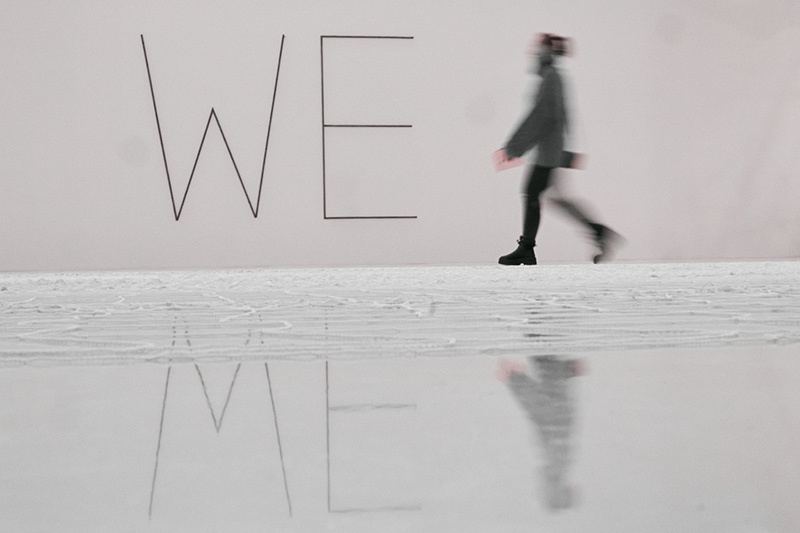
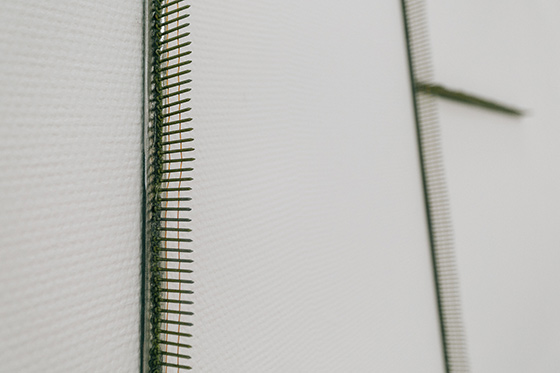
At the entrance to the exposition of the audience, the work of the Swiss artist Runo Lagomarsino “We” (2017), who referred to the same novel-antiopia, Evgeny Zamyatin, was met by the work of the Swiss, which is important for curators along with Pallasmaa. The English translation of the title pronoun was laid out on the wall from nails by the byx to outside, hinting at the fact that physical stay and movement in space in itself is unsafe.
 © Olga Podolskaya
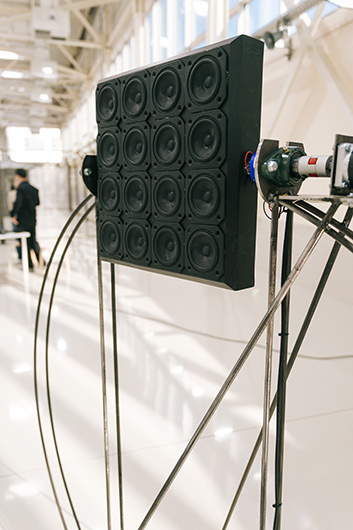
The experience of experiencing space in itself, it seems, occupied many artists at UOMZ. Not only Lagomarsino, who, in his other project at UOOMZ “Cruel Corners” (2017/2021) covered the joints of the load -bearing structures of the workshop with leaf gold, emphasizing not only geometry, but also the “spirit” of the place - the richest enterprise of the country woven in the network of power relations. The German team RDD (Michael Akstaller, Niel Yeger, Oliver Mayer, Jan Werner) offered to “feel the space” by ear: the structure created by them called “Robodynamic diffusion RDD ” (2021), moving along the workshop, generated sound based on special algorithms.
 © Olga Podolskaya
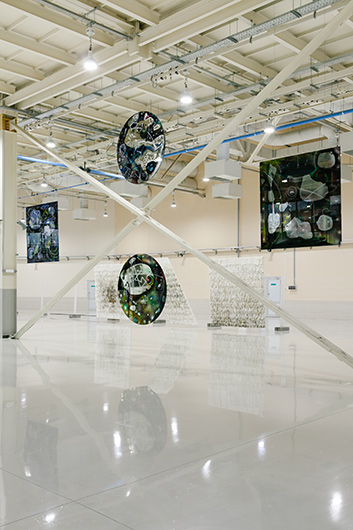
The Bulgarian artist Anton Stayanov placed flat-glass objects in the center of the exposition ( “UV-revolution” (2018) ), like lenses “painting” the perception of space in other tones.
 © provided by the press service of the 6th Ural Industrial Biennale
More than two thirds of UOOMZ products belongs to the defense industry, which was reminiscent of the installation of Jengiz Tekin "Silence" (2018). Subtitles fled on top of the black screen with a description of guns of varying degrees of destructiveness, accompanied by a militaristic emboss of the sounds of war. Henrika Naumann “Advanced Achievements” (2021) looked like a counterpoint to her. Especially for Biennale, a German artist gathered amazing samples of civilian industry throughout the city like bizarre curved vases or canes, cooked from the links of the chain, combining them into a holistic surreal envarine.
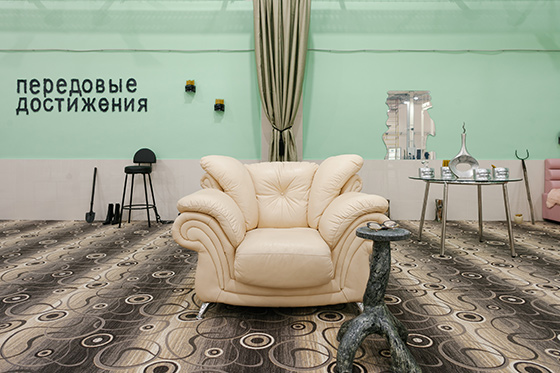 © provided by the press service of the 6th Ural Industrial Biennale
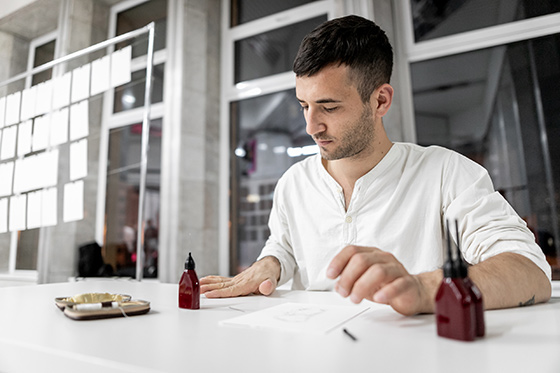
There were no pandemias without the elaborations. For a second installation on UOMZ, Anton Stoyanov collected unexpected socks accumulated during the quarantine, and placed them according to the degree of pollution. One of the most intimate projects in this part of the project was a series of graphic self-portraits in the style of the NU of the Turkish-German artist Kavachi, which was started during the pandemic and permeated by the feeling of openness and vulnerability before the look of the other.
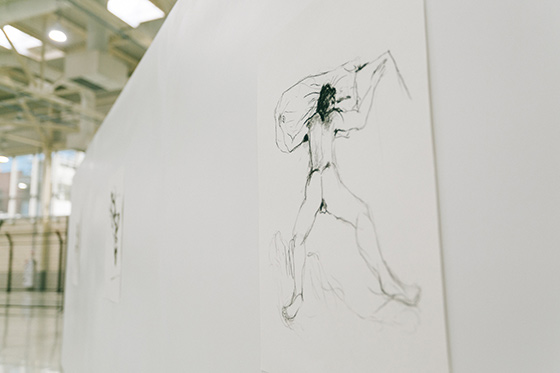 © Olga Podolskaya
But such bindings - to the relations of the authorities, not veiled and lying on the surface in the case of UOMZ, or to a feeling of fragility, which has become a common place in the discussions about today's Condition Humaine - look too straightforwardly. As well as comparisons in the industrial space of work on the topic of production and labor. Even so differently as a giant, manually woven lace napkin, Sheila Karemich (“Dangerous Work” (2010/2021)) and a collection of stones collected by Elena Popova during a trip on the location of the first -generation atomic reactors in the UK (“Do not touch, while hotly” (2019)).
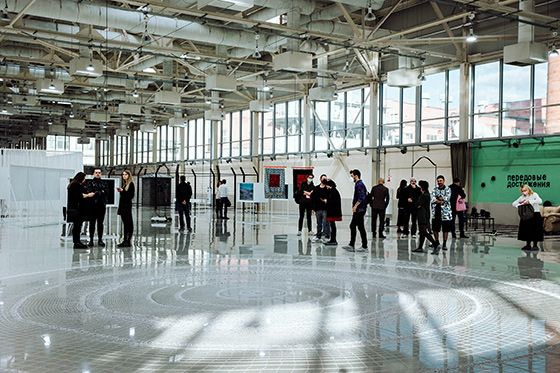 © provided by the press service of the 6th Ural Industrial Biennale
The curators of the current Biennale did not seek to avoid simple and ingenuous exhibition paths, and in some places they seemed to be completely “returning to the basics”, focusing on the basic correlations of the industrial identity of Biennale or simply physical configuration of the space in which it opened, far from always delving into the details of local history and context. In this sense, many works - quite in the spirit of the curatorial manifesto - are united only by their materiality and physical presence under one roof.
Some very curious works, alas, fall out of the general associative series and, it seems, require completely different context and environment. This happened with the film of the Israeli Yael Bartana “Two minutes to midnight” (2021) - you can see his fragment at UOMZ, and watch the whole in the Salyut cinema - and the installation of the Turkish artist Hale tenge with the long name “We Didn's Go Outside; We Were Always on the Outside / We DIDN'T GO Inside; We Were Always on the Inside ” (1995–2015/2021) .
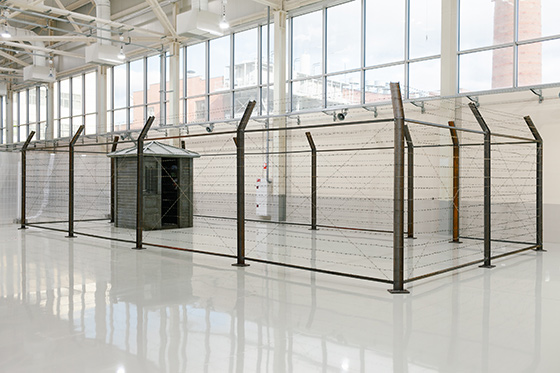 © provided by the press service of the 6th Ural Industrial Biennale
Tenge built a guard tower surrounded by barbed wire at the factory. The viewer, who went inside, could study her uncomfortable interiors, glued with cheap posters with types of idyllic landscapes, contrasting with a frightening look and a terrible atmosphere of work.
“Two minutes before midnight” Bartana is a story about a fictional state ruled by women. The country is faced with an important choice: to finish the project of its complete disarmament, creating a precedent in world history, or abandon this idea due to a threat coming from a neighboring power. An emergency meeting of the government, the roles of whose participants are also performed by real experts on international politics and security, is turning into an unsolvable dispute about the impossible choice between different values (ethics against pragmatics, the eternal world against realpolitik ). The polemic, which has aggravated in other decorations and taking into account the pandemic today, and in this sense, the work is valuable in itself, regardless of the exhibition environment.
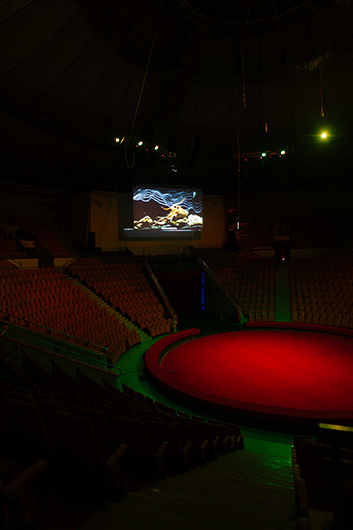
The most contradictory platform of Biennale was the Yekaterinburg circus. Shortly before the opening of Biennale, the Nizhny Tagil artist Alisa Gorshenina announced the refusal to participate in the project , publishing a post with a criticism of the circus as a “barbaric industry” and a “rude spectacle”, which Biennale is indulged in, choosing it as a platform. Gorshenina’s action was supported by curators, critics and artists, publishing an open letter “On the problem of exploitation and cruelty to animals in Russia, in circuses with animals in particular”.
Despite the protests, the curators did not refuse the circus to hold the Biennale in the building, saying that they were “not in the answer for the organization of the organization, network and infrastructure of the Russian Federation, but in our power to critically examine the complex history of 130 years of its existence.” However, there were practically no critical projects responding to a call from the community in the circus building, as the theme of animals was not affected. The exception was the performance of the participant of Rimini Protokoll Stefan Kagi “The Temple of the present: solo for the octopus”, in which the performer tried to make contact with a living octopus, which was very vividly and meaningfully reacting to the human presence.
 © provided by the press service of the 6th Ural Industrial Biennale
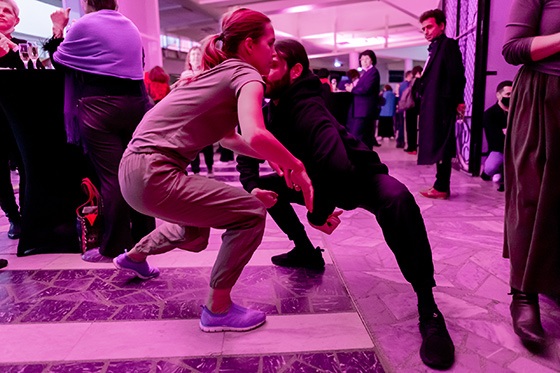
The main program of Biennale on this site consisted of living actions, which, as in previous locations, were formed in the alphabet of the basic concepts of human event and interaction. Participants in the performance of Jimmy Robert “Under Amour” (2021) entered into a pantomic dialogue with each other with the help of kung fu . Sheila Karemich, with the participation of local residents, arranged a session of joint weaving of napkins - the very ones that were presented at UOMZ. The acrobatic reprise on the vicissitudes of being was presented together by director Yuri Kvyatkovsky. Yan Art. Werner, together with Justin Vernona, in the framework of the performance, “Squares will fall” released acrobats dancing around those suspended to the ceiling and randomly swinging speakers. Living choreographic action and electronic music, literally setting in motion, mutually replaced and supplanted each other.
 © Toli Brown
With a curious performance “The Sound of Hair Escaping”, Kavachi performed: pulling his hair on his hand, he folded the phrase “I don’t want to be a soldier, not because I am Furri (gay) , but because I don’t want to direct the weapon to anyone.” The work refers to the episode from the biography of the artist, who, not wanting to get into the ranks of the Turkish army, decided to receive a “pink certificate” issued to the representatives of LGBT+ and releasing from compulsory military service. The phrase "You have hair in your hands, you cannot be gay!" He heard from one of the doctors.
 © Toli Brown
It is curious that even the work made in other genres in the space of the circus seemed to have found a performive component. This also referred to the translucent, glued circus windows to the photo collages of Katerina of the Water, playing with plastic and perception of the body in space. And to the video of Anton of Ginzburg “Turo” (2016) about the architecture of Soviet constructivism as a space of virtual bodily performance, in which many work on the Biennale were weaved.
The VI Ural Industrial Biennale gives a reason to reflect on many important things. On the nature of the abuse and problems of cultural memory. About a complex ethical choice in modern reality with its challenges and contradictions. About the new sensitivity and vulnerability, about the reversal of the gender order and psychology of the human event . But the focus of such reflection in the case of the current Biennale was not the drama of the project, but individual works, which, often not tied to space and time, fell out of the general host of biennal voices.
The previous Biennale in Yekaterinburg was also criticized for the simplicity of generalizations and the banality of certain moves. But the project Shaoyoy Wan had the coverage and ambition of Biennale. He not only stringing work on the thematic frame packed in the actual formulations, but set the prospect of perception of art in certain circumstances and claimed to integrate and scale in this. Chala Ilake, Asaf Kimmel and Adan Yildiz from the very beginning declare "the absence of a large in and Denia." Their project, it seems, does not always and not in everything strive to comply with the format of Biennale. The fingers of “thinking hands” run along the keyboard, producing meanings freely soaring in the virtual space that does not have to come into contact and interact with each other.