
Translated material
Coalition without rules of the game
In the Kremlin
 Coalition without rules of the game
May 22, 2012 Alexey Makarkin
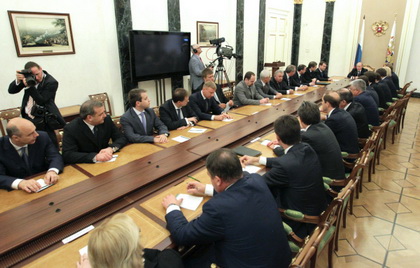
The government of Dmitry Medvedev was in a difficult situation before its creation. After Medvedev’s refusal from the re -election for a second term, a significant part of the elite was disappointed in his prospects, which came to the conclusion that the ruling diarchia is completing its existence, and a hierarchical structure in which the premiere can only rely on a certain degree of autonomy are replaced.
Hence the first serious problem of the new cabinet - the venerable list of those who could be in it, but absent - from Kiriyenko to Kuzminov. Many potential deputy prime ministers and ministers considered the good to refrain from participating in the Medvedev government-either not believing in his durability, or believing that the new prime minister will not have sufficient hardware resource to realize his undertakings. It seems that serious players are already looking at the vague outlines of the cabinet that Medvedev’s government can change. Hence the considerable number of "technical" officials as part of the new office.
The second problem is the compromise character of the new government. In the economic bloc, key ministries-the Ministry of Finance and the mayor-are under the control of Putin’s people (a similar situation was in 2000-2004, when the possibilities of Prime Minister Kasyanov were limited in a similar way). The role of the Ministry of Finance in the government cannot be overestimated - this is his "wallet". As for the mayor, his role is increasing right now, when Medvedev seeks to accelerate privatization, which Putin apparently relates without much enthusiasm. By the way, under Putin’s control, as far as one can judge, the federal antimonopoly service that gives sanction with the participation of large companies remains.
At the same time, Medvedevets Dvorkovich became a curator of industry, including the fuel and energy complex. However, the head of the Ministry of Industry and Trade is Manturov, who came to this department even with the submission of Chemezov and who was a candidate for the place of Khristenko’s long resignation, at least during the year (that is, long before Dvorkovich began to think about his new role). And on the post of head of the Ministry of Energy, it was not possible to find a single “industry” - as a result, he was occupied by the prostge by Khloponin, the Deputy Minister of Finance Novak, a very good financier, but a newcomer in the energy sector. And, most importantly, it is unclear what a real role in TEK is assigned to Sechin who left the government, which retained the decisive influence on Rosneft and a significant part of the energy sector. As well as direct access to Putin.
The Foreign Ministry and the Ministry of Defense (and, apparently, the FSB) remain, of course, for Putin. The situation with the Ministry of Internal Affairs, which was led by General Kolokoltsev, appointed to the post of head of the capital's Internal Affairs Directorate, is more complicated precisely under Medvedev. However, it may be more important - the Ministry of Internal Affairs, according to the Constitution, is under the jurisdiction of the president. Under Medvedev, this situation was controversial (all half of his presidency, he sought to strengthen his influence on this department, initiating his reform), but under Putin it may well become indisputable again.
Medvedev was able to achieve the appointment of Surkov to the key post of the head of the government apparatus (it is interesting that this body lost all the “migals” published last week by Putin's decree). Thus, he escaped the fate of the technical prime ministers Fradkov and Zubkov, with whom Putin picked up the “apparatchiks”. Surkova’s protege Govorun became the Minister of Regional Development with an expanded state of deputy ministers. At the same time, Medvedev could not advance to the key post in the office of his adviser Abyzov - he received only the newly institution of the Minister of Relations with the open government, whose prospects look very vague. At the same time, in the office there are many figures close to Putin - in particular, Kozak, Mutko, the new head of the Ministry of Agriculture Fedorov, who was one of the organizers of the ONF.
Thus, the government is actually coalition - but without certain rules of the game. In party coalitions existing in parliamentary democracies, such rules are determined during the formation of the office, and their revision can lead to the resignation of the government. The Russian coalition is informal (it is clear that the parties, as usual, were removed from participation in the formation of the office), and in the absence of rules to regulate internal competition will be much more difficult. And, it seems that competition will take place not only inside the government, but also between presidential and government structures.
And this is the third problem. You can admire a lot of the merits of the newly recognized Minister Nikiforov on the development of the "electronic government" in Tatarstan or equally actively complain about the replacement of the subtle and tactful Avdeev with a Medinsky PR man. But a more important question arises - whether the Government will preserve the Center for Making Economic Decisions or whether it will move to the presidential administration, to which a number of members of the retired office can go. If the last scenario is implemented, then Medvedev may be in a dramatic situation. Having not received real prerogatives, he will become responsible for all the cataclysms that are not even related to the work of the office - for example, for the consequences of fluctuations in world oil prices in connection with the events in China or Greece.
Alexey Makarkin, First Vice President of the Center for Political Technology