
Translated material
Syrian question
Around Russia
 Syrian question
June 9, 2012 Julia Latynina
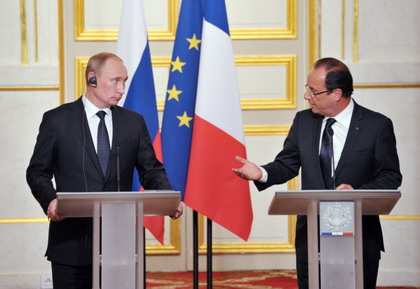
The expectations of Vladimir Putin that he, as in the first two terms, will be accepted as his own in the circle of world leaders, did not materialize.
Putin did not go to Chicago for the G8 summit. Putin will not go to London for the Olympics. His first departure abroad was a visit to Lukashenko. But the most, of course, the striking occurred after Putin from Belarus flew to Berlin and Paris last Friday. The central issue of this trip was the question of Syria, and then Putin found himself in complete isolation.
At first he came to Berlin, where before his visit, the Minister of Foreign Affairs Gido Westerwell said that "Russia's position in relation to Assad plays a key role in the Syrian crisis." Putin drove to Berlin for only four hours (at the same time, as usual, he was late for Merkel for 40 minutes). Hundreds of Assad’s opponents surrounded the place of his meeting with the angel Merkel and chanted the curses. All Western media wrote about the unloading of the “Professor Katzman” in Tartus. At a press conference, however, Putin did not find anything better than say that he does not support any of the parties and does not “supply such weapons that could be used in a civil conflict”.
I am still in deep thought. What is it - a weapon that “cannot be used in a civil conflict” in a country where the government is poking around that moves from artillery and tanks? And with the Yak-140 training aircraft, which the Syrian government suddenly, with the beginning of the riots, wished to urgently buy $ 550 million from Russia, the situation is exactly the opposite. In modern air battle, they are not suitable; But the unarmed crowd, if you put machine guns on them, can be shot simply wonderful.
In Paris, the case went even worse: the French media call Putin’s meeting with Holland “Ice” and “Dialogue of the Deaf”. It got to the point that at a press conference in response to the journalist’s question: “How do you like Olland?” - Putin was gloomyly silent, and then suddenly stated that Assad went to Paris more often than to Moscow.
It seems that Putin in the eyes of the world community is rapidly turning into a leader-rogue like Mubarak, Gaddafi and the same Assad. In part, this can be explained - Putin could not go for a third term (their own), and Western leaders cannot completely ignore falsification in the elections.
But why pull the MAZ for the bloody dictator Assad? Not for the money: well, what is Kremlin for OJSC 550 million dollars. For these unfortunate "yaks"? A penny - compared to billions with which they turn.
I believe that the matter is different: the model of the world adopted in the Kremlin is increasingly diverging with political reality.
It seems that Putin initially tried to exchange his position on the Arab revolutions to support his West. All these years of the Kremlin’s foreign policy, all these years have been built on this, characteristic of dictators and criminals, the manner - “You are our elderberry in the garden, and we are an uncle in Kyiv”.
Moreover, every time the Western leaders decided that it was better not to contact a bully, and inferior to the Kremlin - this was perceived as a confirmation of the fidelity of the theory. And every time they were not inferior-this was perceived as a personal insult, as a sign that there is a certain club of the elect, who are negotiating with each other behind Putin’s backs, how to rule the world, and for some reason Putin is not allowed into this club, and he has to agree only with such Assad or Gaddafi.
Apparently, the Arab Spring at first in Putin’s view was simply a bargaining card. “We will not help dictators in the Middle East, and you do not criticize our elections,” - this was the Kremlin message. The exchange did not take place because he could not take place.
And then other features of Putin’s psychology began to be put forward in the first place. Firstly, sympathy for any dictator, no matter how bloody he is. Secondly, Putin seriously imagined himself the leader of the geopolitical confrontation of America. The heads of Venezuela, North Korea, Iran, Cuba, Sudan and Zimbabwe consider themselves similar leaders, so we are in a good company.
Photo by RIA Novosti