
Translated material
Interesting movie
In society
 Interesting movie
11 February 2011 Boris Kolymagin

The other day, Russian President Dmitry Medvedev signed a decree that liquidates the Federal Service for Supervision of Compliance with the Legislation in the Field of Cultural Heritage Protection (Rososhranchulture) and transferring it to the Ministry of Culture. This decision did not meet a protest reaction from the cultural community, although it undoubtedly caused a certain harm to the defenders of cultural values.
Talking about the abolition of the federal agency began last summer. On August 2, Vladimir Putin instructed the Minister of Culture to Alexander Avdeev to prepare documents for transferring the “functions of the executive body for the protection of cultural heritage, copyright and related rights”, as well as “for control, supervision and legal regulation” in this area. And the coordination mechanism spun. The head of the department, Alexander Kibovsky, in November, took the post of head of the Department of Cultural Heritage of Moscow (Moskomnovania), and it became clear that the federal service was living in the last days.
Commenting on the abolition of the agency, the head of the Ministry of Culture openly accused Rosocracks of the inefficiency of its actions. And some kind of truth in the words of Alexander Avdeev was: painfully sluggishly, unnecessarily acted Kibovsky’s department in the regions, although, it would seem, in some cases it was simply obliged to intervene without afraid of the scandal. The conflict agency with the Russian Orthodox Church was especially afraid. Where was it when in the Zaraysk Kremlin the diocese exactly in the middle of the architectural ensemble of the 16th century stuck a “priest’s house” - a tasteless brick mansion with a garage, completely disfiguring the form of a unique architectural monument? (in the photo below) 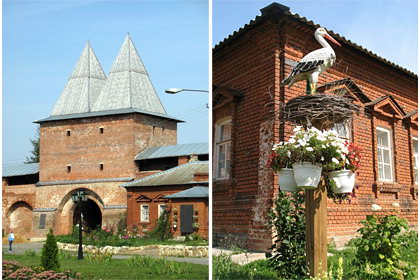 Where was it when, in the Tobolsk Kremlin, the Tobolsk-Tyumen diocese led endless perestroika and alteration? Where was it when, in the Trinity Summer Cathedral in Pskov, the local ruling bishop Vladyka Eusebius conducted heating and the ancient icons crackled? (in the photo below)
 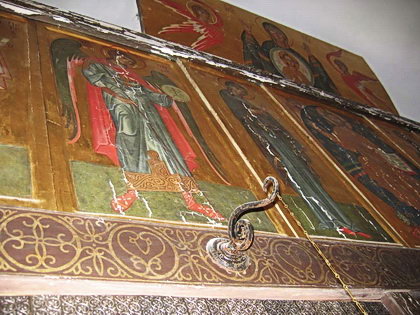 The agency did not resolve the situation with the Kostroma Historical Museum, which lost the premises of the Ipatiev Monastery. It did not intervene in the process of adopting a monstrous in its consequences of the Law “On Religious Organizations of Religious Property Property, which is in state or municipal property”.
Museum workers shouted that they should refuse to use the concept of “religious property” in application to cultural objects that received the status of museum monuments and became a nationwide cultural heritage. And Kibovsky was silent or even encouraged the appetites of the prevailing denomination, shut up the problem, repeating the common phrase that "the preparing bill does not carry any norms to transfer the church of museum exhibits, it is only about the return of real estate objects to religious organizations."
In fairness, we admit that, in this way, the Kibovsky department acted in the mainstream of general politics. Yes, it could not behave differently, because, having the status of a federal executive body and obeying directly to the Government of the Russian Federation, it was under the jurisdiction of the Ministry of Culture.
At the same time, the federal agency sometimes showed independence. As you know, it strongly annoyed Prime Minister Vladimir Putin, opposing the construction of the four-hundred-meter tower of the Okhta Center. Rososh security culture turned out to be the only executive body to say “no” to the construction of a skyscraper. The courts won by the defenders of cultural heritage with the support of the Federal Agency, and public protests forced the president to intervene in the conflict and stop the construction of the Gazprom monster. In addition, Rososhran culture confirmed in court the illegality of the entire high -altitude regulation system of St. Petersburg and opposed the sale of city monuments to private investors.
We will not forget that the abolished department adopted a number of regulatory acts that allowed the Law on Cultural Heritage to work. All this speaks in his favor. Defending his structure, Kibovsky said: “For two years, we managed to deal with the monuments for the first time, establish budget financing for their state preservations in the regions and create a legal mechanism for the execution of the federal law“ On Cultural Heritage Councils ”and new requirements for the rules for the import and export of cultural values.”
But the significance of the department was not only in this. Rooshranchulture acted as an independent body in assessing compliance with security obligations and monitoring state reasons issued for reconstruction and restoration. The largest customer is the Ministry of Culture today. Now it will order expensive restoration and control itself. An interesting movie is obtained.
Supporters of the presidential decree say that under the roof of the Ministry of Culture to take care of the monuments of antiquity will be easier. Well, wait and see. But experience suggests that most likely we will not see anything good. With all its shortcomings and an obvious weakness, Rooshran culture managed to do a lot of good. With its abolition, the possibilities of protecting the cultural property have decreased.
Photos fotki.yandex.ru and ramaria1.narod.ru