
Translated material
Ministry of Justice or Prosecutor General's Office?
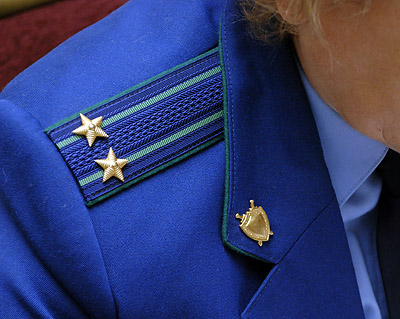
In the Russian media, information appeared about the possible merger of the Ministry of Justice and the Prosecutor General under the auspices of the first. This idea is not new, which has long been debating in legal circles. Among its supporters there are both “Westerners” and “soils”: the former love to appeal to the same US experience, the latter to the experience of tsarist Russia. Against, of course, the prosecutor’s corporation is opposed, which is not surprising. In the informal table about the ranks, prosecutors both in the Soviet and modern Russian times were higher than the ministry officials.
The Russian Constitution of 1993 does not interfere with the absorption of the Ministry of Justice of the Prosecutor General’s Office (the elasticity of the Basic Law has already been shown repeatedly - with a change in the procedure for the formation of the Federation Council, when canceling the governor's elections). Its 129th article provides that the prosecutor's office is a single centralized system with subordination of lower prosecutors to higher and Prosecutor General, who is appointed and exempted from this Council of the Federation on the proposal of the president. In addition, the article determines the procedure for the appointment of prosecutors of the constituent entities of the Federation (Prosecutor General in agreement with the subjects) and other prosecutors (only the prosecutor general). Finally, it contains a reference norm to the federal law, which determines the authority, organization and procedure for the activities of the prosecutor's office. The only minor problem is that when combined, a precedent can be created in which one of the ministers is approved by the upper house, but in conditions of complete loyalty of the Federation Council, the Kremlin can be neglected by the Kremlin.
By the way, the very “blur” of the formulation of the 129th article is not an accidental phenomenon. When discussing the draft Constitution, a decade and a half ago, two points of view collided - prosecutors who insisted on a detailed description of the functions and features of the functioning of their body, and liberal lawyers who wanted to remove the mention of the prosecutor's office from the Constitution or at least register the corresponding position as streamlined as for the cut of its authority and to unite with the Ministry of Justice. The position of the liberals was clear-the prosecutorial corporation was considered the most conservative part of the legal community, which actively resisted the adoption of a new Criminal Procedure Code, which the reformers insisted on. Thus, it was about a “slow action mine”, which could work at any time. Now the chances of this have seriously increased.
On the one hand, the prosecutor's office is weakened as much as possible. At first (even under Vladimir Ustinov), it was deprived of the function to authorize the arrest, search, seizure, etc. Then (already under Yuri Chaika) they created an independent Investigative Committee, the leader of which is only nominally listed as the first deputy of the prosecutor general, and in reality pursues a fully independent policy. Then the prosecutors were selected the right to sanction to initiate criminal cases, a search and a number of other functions. The head of the committee was appointed Alexander Bastrykin, a classmate of Vladimir Putin, who was considered a hardware ally of the “power” group in the authorities.
Already this year, the Ministry of Justice was headed by Alexander Konovalov, belonging to the Medvedev team and making most of his career in the prosecutor's office (in 2006, after Ustinov’s resignation, he was even read to the post of first deputy prosecutor general). Over a few months of staying in a new position, Konovalov had already managed to assign two of his protores to the posts of deputy minister and get another appointment - to become a special representative of the President for interacting with the European Union in the field of freedom, security and justice (he combines this position with a ministerial one).
Against this background, the positions of the General Prosecutor Gchaika look much weaker. Unlike Bastrykin and Konovalov, he has been in the federal elite since the Yeltsin times - he was the first deputy of the Prosecutor General, and. O. Prosecutor General (after scandalous removal from the post of Yuri Skuratov), Minister of Justice, which remained for most Putin's presidency. However, such significant experience, in the present time, is not so much a plus as a minus, meaning belonging to the elites of the 90s, which are now significantly weakened. It is not surprising that if Ustinov, with the support of Igor Sechin, persistently held the investigation within the General Prosecutor General, then the seagull could not withstand the hardware. Despite the periodically emerging microponflows of the Prosecutor General’s Office and the Investigative Committee, it is clear that the investigation will no longer return to the prosecutor's sphere of influence. On the contrary, the question is discussed about how to include in the committee of investigators who are now part of other departments (primarily, the Ministry of Internal Affairs) with a possible withdrawal of this body even from nominal submission to the Prosecutor General and transformation into the Federal Service of Investigations (FSR). The ambiguity with the solution of this issue is not associated with the position of the prosecutor's office, but with resistance from the Ministry of Internal Affairs (no one wants to lose part of its functions) and, most importantly, with the one who, in this case, will be the main investigator-Bastrykin or someone else. Recall that the Investigative Committee of the Ministry of Internal Affairs is led by another classmate Putin, Alexei Anichin.
In the same way, the fate of the Prosecutor General’s Office depends on hardware layouts, first of all, on the position of both participants in the ruling diarchia - the president and prime minister, who are now more occupied by the problems of the South Caucasus and the financial market. Therefore, the solution of the issue can be postponed to calmer times. But even if it takes place in the foreseeable future, the vast majority of citizens are unlikely to notice the disappearance of the prosecutor's office as an independent state body. On their fates, such a revolutionary (or, if you like, “restoration” - since such an experience was in domestic history) the measure will not affect the measure - they don’t care, the official of which department supports the charges in court or oversees the enforcement of laws (these functions have remained). And if in the 90s the question of combining the two departments had an ideological coloring, being inscribed in the context of competition between supporters of reforms, now we are talking about purely hardware rivalry.
Author-Vice President of the Center for Political Technology