
Translated material
The departure of the tired dad
In society
 The departure of the tired dad
12 February 2013 Alexey Makarkin
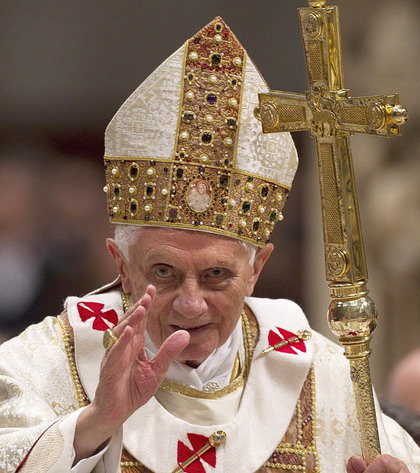
The departure of Pope Benedict has no analogues in modern history. You can, of course, recall the medieval church schism, when two, or even three cardinals were simultaneously considered dads at once. One of them - Gregory XII - resigned his powers at the cathedral in Konstanta in 1415. As you can see, there is nothing to do with the current situation.
A little closer, oddly enough, an even more ancient analogy - with a holy ascetic chosen by a dad under the name of Celestin V in 1294. The saint on the papal throne during the European Wars and Cardinal Corruption was clearly superfluous. Soon he renounced power, but still just in case, he was sharpened by his successor in the fortress. After the death he was canonized.
Of course, Benedict is completely different from Celestine - he became a dad, being already a well -known theologian and a multi -heartdic cardinal, who for many years headed the congregation on the issues of doctrine, one of the key Vatican departments. No one is going to send him in conclusion - after resignation, he must settle in a quiet monastery. But Benedict turned out to be a stranger in the modern secular "post -Christian" Europe.
Probably, Cardinal intrigues played a role in this resignation. Having become a dad, Benedict soon replaced the Secretary of State (church “Prime Minister”), appointing to this post not an official who has passed all the steps of a chicken career, but a cardinal close in spirit-professor of theology Tarchizio Berton. The coalition of Vatican notables quickly formed against him, which, apparently, inspired Vatikliks. In his course in the media, a confidential papal correspondence hit, and the valet of his Holiness (that is, personally close to dad) was arrested and convicted of this information). At the end of December, dad pardoned the valet, but, apparently, this story was a heavy blow for him.
But the point is not only in intra -church conflicts. Entering the papal throne, Joseph Ratzinger took the name Benedict in honor of the famous European saint. This was regarded as a signal about the priority of papal policy - the “rechristianization” of the Old World. Eight years later, it can be said that Europe became even more secular, despite the efforts of the pontiff, who, at his respectable age, continued to actively work on theological labors. Each of them became a bestseller, but only for practicing Catholics who did not have to be convinced of the truth of religious values.
For most of the modern European society, an elderly professor with his very sincere and thin discussions about Christ and Christianity, about love and hope was incomprehensible and stranger. The majority of the Western population is expressed in support of the same -sex marriages that are strongly rejected by the Catholic Church - in the last months of Pontificate Benedict XVI, French and British parliaments decided to legalize them, which became the bad news for the pope and, possibly, contributed to the decision to leave. The pontiff is clearly tired of withstanding the advance of a secular society, especially in the context of the growth of contradictions in its own environment.
The pope’s desire to consolidate conservative forces and return to the church of the broken “Lefevrists” (opponents of the innovations of the second Vatican Cathedral) also did not lead to the expected results. Negotiations with the “schismatics” came to a standstill, and the only assignment made by him - the removal of excommunication from four bishops - caused an unexpected scandal. One of the “four” was seen in the denial of the Holocaust, which caused a negative reaction of the media - especially since the newly recognized bishop continues to insist on his innocence.
By the way, from the very beginning of the pontificate, Pope Benedict had a “bad press”. It seems that only a very lazy journalist who wrote on the Vatican topics in the world media, by silence, by silence, the story of the short -lived stay of Joseph Ratzinger in Hitler Yuier and an even more brief service in the Wehrmacht. Initially, the press wanted to see the liberal pontiff on the papal throne and was pretty disappointed. Subsequently, any controversial statement of the pope was interpreted as a sign of his deep archaism and tactlessness. The history of Benedict XVI once again shows that in the modern world it is more important not what is said, but by whom it is said. The predecessor of Benedict John Paul II was not much different from him in his theological views (it is no coincidence that one of the noticeable events of the pontificate of Benedict XVI was the Beatification of the Polish Pope), but his charisma was at least a relative protection from a significant part of the attacks.
Hence the forecast regarding the successor of the pope. Now, unlike 2005, a clear favorite on the conclave is not visible. Veterans of the Vatican Curia will probably join the struggle, but their chances do not look too large. Obviously, the church needs a dad who would combine pastoral and administrative experience, would lead the diocese in his country and would preferably work (not for a very long time so as not to involve too much in the Cardinal intrigues) in Kuria. And at the same time would be relatively young (according to Cardinal concepts), and would have a charisma that can attract media sympathies.
It is no coincidence that the most likely candidates are the 64-year-old Ganz Peter Tarkson (since 2009-the chairman of the Papal Council of Justice and the World, responsible for work in the field of human rights protection) and 68-year-old Canadian Mark Welle (since 2010-the prefect of the congregation on bishop’s affairs). Back in 2005, the African Dad would look very exotic, but after the election of Barack Obama, this option became much more real. Both possible applicants received their posts under Pope Benedict, who leaves, leaving their successor difficult problems that do not have simple solutions.
Author - First Vice President of the Center for Political Technology
Photo: Claudio Peri / EPA / ITAR-TASS