
Translated material
The first in urgency
Around Russia
 The first in urgency
April 19, 2010 Dmitry Sidorov
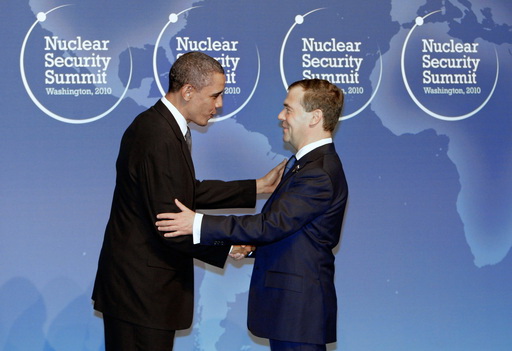
The nuclear summit that held in Washington partially reminded of the “significant return” from the conference of President Bush in the Middle East in Annapolis, which, despite the powerful PR, did not bring any serious results. However, some suggestions and performances were quite interesting.
So a few days before the start of the Washington summit, Barack Obama announced that the United States is guaranteed not to make a nuclear blow to nuclear -free countries, not noticed in violation of the non -proliferation of weapons of mass destruction.
Most observers perceived this statement as a clear indication that such guarantees do not belong to North Korea and Iran. At the same time, the microsence of the summit was the hints of the President of China at the probability of joining new sanctions against Tehran after negotiations with President Obama. I do not think, however, that this statement will have a meal of the nuclear ambitions of Iran, who confuses the fact that he is the largest supplier of oil in the PRC - the countries of the Persian Gulf and Russia are unlikely to be replaced by Iran, the not the volume of prey.
But even if my conclusions are refuted and part of these countries will increase production and pour China with oil, while dropping the market price, Iran still does not have any real reasons to stop the enrichment of Uranus. As well as withdrawing a ban on checking the IAEA inspectors of all nuclear facilities and related laboratories. That is, what is actively required from him in Washington, in Europe and, it seems, in the Kremlin.
The first problem is that Vladimir Putin and Igor Sechin, through his protege Dmitry Medvedev, clearly made it clear to Barack Obama and Europeans that Moscow would not agree with the ban on the sale of gasoline and equipment for oil processing in Iran. A reason is humanity, that is, a desire to protect the population from possible suffering.
Meanwhile, in the list of new measures, this is one of the most effective, able to make Tehran think. It is known that Iran’s capabilities are practically equal to Zaver.
The second story is an example of Saddam Hussein, who, not paying attention to any economic and political problems, came very close to obtaining an “Arabic” nuclear bomb in 1981. At the same time, the speech of the late Iraqi leader regarding the use of this weapon was very reminiscent of the rhetoric of President Iran. The latter also does not hide the fact that Israel is the main goal for Tehran of a nuclear blow, but another purpose of obtaining an atomic bomb is a change in the balance of forces in the Persian Gulf.
Attempts by a number of countries and leaders to convince Iran to stop the enrichment of Uranus are certainly noble from the point of view of the desire to solve a crisis peacefully. But, unfortunately, most likely they are doomed to failure, as they are unlikely to be able to bring success, even if the new sanctions of the UN Security Council are really strict (which is unlikely).
I repeat, once again, the news that any international measures is very faded from use is default, as they enter into full force 12-18 months after their adoption for purely technical reasons, that is, the logistics of the application of sanctions. At this point, Iran, most likely, will already be ready one or two nuclear bombs, and Tehran has been engaged in the tests of carriers for a long time.
In this case, the strike on Iran will be a big question due to the consequences caused by the possible answer of Tehran. In the face of a similar threat, Israel stood in the late 70s and early 80s, when the country's leadership (twice delaying) nevertheless decided to strike an Iraqi nuclear reactor in 1981. Europeans, who sold Saddam Hussein the necessary materials for the creation of nuclear weapons, then assured Jerusalem that they control the situation and would not allow the creation of an atomic bomb.
The successful airier was applied after Israel received evidence about the “peaceful” intentions of Saddam and the data that the reactor would be launched in the near future. As a result, Osirac was destroyed before the launch, and US Secretary of State James Bakeke and other officials in the presidential administration Reagan demanded to punish Israel and achieved their own, though for a short while.
However, Obama’s words about guarantees of refusal to apply a nuclear strike can be attributed not only to Iran and North Korea, but also to be regarded as a warning ... Israel. Despite the fact that the presence of nuclear weapons in Jerusalem is the secret of the postgraduate, the country's leadership never recognized this fact. Thus, a situation is formed when Israel de jure is a nuclear state suspected by the Obama administration in violation of the non-proliferation agreement.
It turns out beautifully, especially if you take into account the current state of relations between Washington and Jerusalem and the notorious statement by Rose Getemüller (assistant to the deputy Secretary of State for nuclear weapons control), who called in 2009 Israel, among other states, sign an agreement on non -proliferation of nuclear weapons. I hope that it is unlikely that anyone should be convinced that she would never dare to make such a statement on her own.
The nuclear disarmament of Israel, surrounded, to a greater or lesser extent, of hostile Arab countries and creating Iran’s nuclear weapons, “undoubtedly”, will lead to the discharge of the situation in the Middle East and Persian Gulf. But only if the goal is to destroy the Jewish state as a solution to all "ill -fated" problems.
With all the understanding that no one wants war, except perhaps Mahmud Ahmadinejad and the spiritual leadership of Iran (as well as, perhaps, the Kremlin who dreams of taking up world oil prices), the peaceful solution of the conflict looks less and less likely. Also, however, like the participation of the United States in it, for various reasons.
One of them is the possibility of victory in the next presidential election, as the leader of every democratic country thinks about the time of making a similar decision.
The second is the possible resistance of the military, which is also understandable: in any civilized country, people in the form try to avoid human sacrifices that have been made for the sake of political leadership.
The third is the resistance of a part of the special services that fuel in every way the conflict between Washington and Jerusalem.
The fourth is Iran’s possible response, associated with human casualties and damage to the infrastructure of Israel (including the attack of Hezbollah), Iraq and other countries of the Persian Gulf.
However, there is an answer to all these points. The receipt of a tiegran of nuclear weapons will mean a permanent threat to the existence of not only Israeli, but also the countries of the Persian Gulf (and significantly greater sacrifices and destruction in case of response), which directly hurts the life interests of the United States.
As for the second term of Obama, we should recall the list of doubts of Israeli Prime Minister Menachem Begin in 1981, when the same question was on the agenda, although he was by no means the first line.
And, briefly, about the second statement made by French President Nicolas Sarkozy at dinner during a summit in Washington. Mr. Sarkozy proposed to punish the leaders of states that violate the contract on nuclear non -proliferation. The White House called this proposal interesting and invited other participants to think about it.
It is curious how it will be possible to punish the leaders of North Korea and Iran, as well as Pakistan with India. It is even more entertaining to look at the choice of punishment for the Kremlin, which is still suspected, at least US Congress, on the sale of sensitive nuclear technologies.
I think that it is unlikely that it makes sense to seriously approach the Sarkozy statement. He either, as always, decided to remind himself of himself in the midst of discussions in the media, or will suit the list of punishables very selectively.
The proposal of the French president partly confirmed the “urgency” in the summit. Another evidence of urgency was the decision to gather in South Korea ... in 2012!
Photo by RIA Novosti