
Translated material
Colta.ru
We continue to talk about selected films from the Beat Film Festival program. Ilya Danishevsky explores the dull landscapes of the Grant Ji video , walking along the footprints of V.G. Zebald in an attempt to combine all the allusions and references of the “Rings of Saturn”.
Documentist Grant Ji repeats the path of V.G. Zebald through the county of Suffolk, in order to determine the width of the clearance between the author of the "rings of Saturn" and the voice of his narrator. With the same success, one can repeat the foot route of a love story and consider markers, who turned out to be random witnesses, but not to live it again, but only invent. Zebald’s speech at the first impression is transparent, total, and therefore its film adaptation (and “patience” is also a film adaptation or attempt to visualize) rests on the impossibility of interpretation and becomes the investigation.
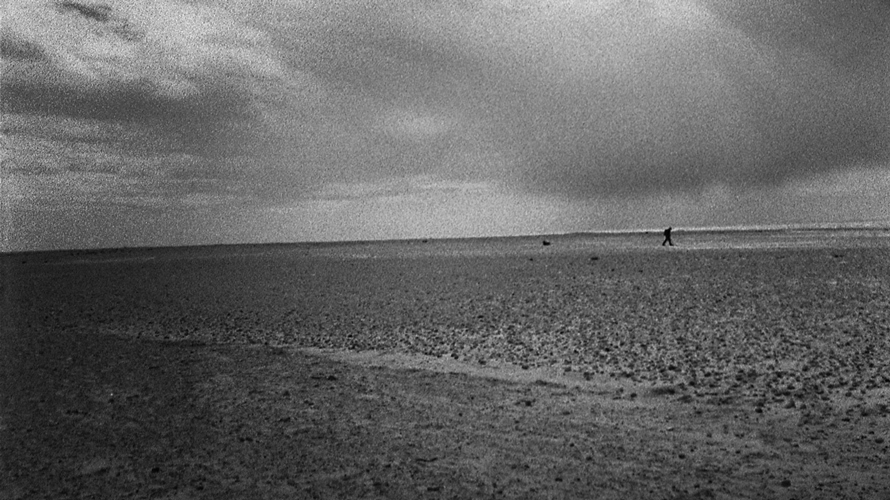
The hero of Zebald goes on a journey, “to get rid of the feeling of emptiness that has gripped [his],” his path passes through the void or what he sees empty: a granular image, an endless wasteland, hiding hundreds of years of bloody history behind his silence, the gray edge of the horizon does not separate the military scars of the recent past, but rather hints at their everyday proximity. The stunning effect of the “Saturn rings” is not in a warning about the possible repeat of the disaster, but in its presence at the structural level - inside the visually serene present. Grant Ji uses a commensurate with Zebald's inner and external landscape, something like we could imagine, imagining heather fields and old mills that turn time, that is not destroyed under external intervention, but crumbles from old age. Between A (when Zebald sees the starting point that pushes his memory to action) and b (when it gets into the lens) passes enough time, which is impossible to patch up, and the emphasis on the interval between Zebald and the next director fills the “patience” of congenial “rings” with melancholy.
Speaking of Zebald, speaking of the film adaptation of Zebald, we automatically find ourselves in a narrow corridor. You can write about him exclusively dictated by Zebald himself with the tongue (or we will be forced to retell and outline) - or, surrendering to our own memory, illustrate how the small provincial city of my childhood scatters - along with memories - under the expansion of new buildings. Zebald does not cut off the last opportunity, because the victims of the story, the memory of which he retains, is not called name, they include in their register and those whose catastrophe - in the future - is predicted by the past. Including us, and therefore there is a temptation to repeat the journey of the “rings” not literally, but through our own experience, but in the same neutral-gray decorations, on the one hand, lulling their usualness, on the other, causing anxiety.
 © Illuminations Films
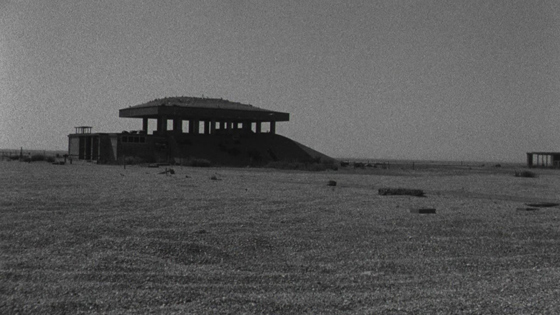
The image of a wasteland (formed by a distant explosion of renovation, which is trying to destroy the coordinates of our memory and make it difficult to hiking on the love history of yesterday) very well fits into Russian reader's experience: the wasteland not only fills the place of loss, it is an original space inaccessible to the development in the future. “Patience”, which denies himself dynamics and exquisite installation, is not trying to be functional, its search is in an attempt to decipher the structure of “rings”, to draw a map of the interaction of heroes and toponyms of the book, and this attempt can be considered based on the two, more mutually exclusive (but capable of productively supplement each other) assumptions about the advances of the director. First: Zebald for Ji is an outstanding writer - a subject occupying a “status”, separated from others, a position, those against whom the “battle” of Zebald was conducted in favor of all infringed and deprived of their votes [various] authoritarian verticals. Second: letting go into his hermeneutic experiments, Ji, on the contrary, follows Zebald's intentions. His invasion is part of the work on deciphering the memory of everyone who allowed their memory to record, become a certificate (but should we / can we find out something else besides that is chosen for fixation?).
Zebald’s poetics is a spacious description of the horizon (external and internal), visible through the prism of memory, the work of which can resemble the technique of blackouts ([poetic] technique, in which fragments are removed (painted over), and the remaining form new meanings in contact with each other. - Ed. ) - despite the fact that the “rings of Saturn” can be read as an integral work, it is obvious that it is obvious, it is obvious that it is obvious, it is obvious that it is obvious, it is obvious that it is obvious, it is obvious that It is made up of the default zones and fragments of memory that Zebald separates from his hero.
Photos embedded in the book should not only serve as a confirmation of the reality of the narrative, but, ultimately, prove the impossibility of an exclusively rational reading of your own life or an alien past that has an influence on your life. The director’s attempt to rationally comprehend the system of relationships in the book, physically restore the journey through the saffolk, directly encounters this not even position, but the point initial for Zebald’s speech. An attempt to touch and not see in a dream or invent a strange in reality of “rings”, where imagination or memory is the most important tool of communication, as well as a source of threat (memory of disasters and imagination of a disaster that has not yet been incident causing a similar affected affect). Zebald, who decided to leave Germany back in school, immediately after he found out about concentration camps, as if we would tell us that all the crimes that we can come up with were once committed-and they all influence us; Where we can imagine a wasteland, once was-or will be a wasteland. So the cities are rebuilt for convenience and beauty, destroying the coordinates of the memorials of the stories.
“Patience” is an ideal film adaptation in its own way, the same as the “radiance” of Kubrick (which King did not like): this is how, following such patterns and images, the shaky, ghostly visualization of “Rings” in the reader’s imagination occurs-a dull, monochrome video of the film seems to be an obvious solution, but still he leaves a number of issues. Is it worth it to decipher the symbolic system for the perception of the book? Does the “patience” add something to Zebald himself-or is it an attempt to retell it?