
Translated material
Marina's songs
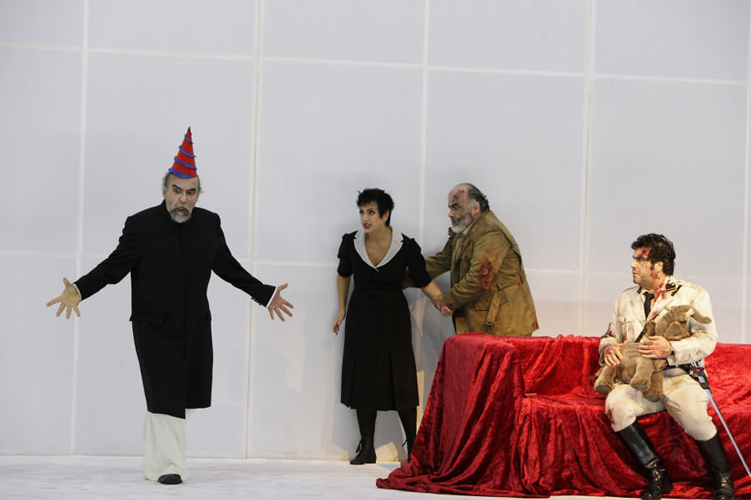
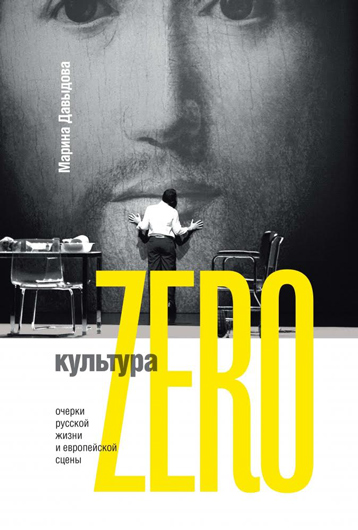
On Monday, April 2, in the new space of the Theater of Nations, a presentation of the book of Marina Davydova “Culture Zero” , published by the publishing house “New Literary Review” with the assistance of the Golden Mask festival, will be held. Today we publish the afterword to her, written by Vadim Gaevsky and kindly provided to the disposal of COLTA.RU Publishing House.
Are you asking for songs? I have them.
Lev Slavin. "Intervention"
The second book of Marina Davydova “ Zero Culture” is as good as her first book “The End of the Theater Age”, just as smart, just as fascinating, is just as brilliantly written, but in a sense and more merciless. She, however, has a different genre - or, more precisely, the contamination of several genres at once. Theatrical reviews, theatrical portraits, and theater theoretical articles were collected there; Here they also have, but there is another thing that can be called journalistic sociology, and just the theater allows - and sometimes forces - to penetrate this fairly closed sphere. Apparently, this should be, especially with us, contemporary art history books. The reviews themselves in the new book are reminiscent of manifestos.
 © "New Literary Review"
But it is not merciless not in relation to chosen plots and named names, not to the tendency that triumphant everywhere, but to those who do not support this trend, cannot accept and evaluate who lives the past, venerable, but dead. Or maybe invented, composed (to these near, timid people, apparently, I belong, but my arguments will be presented later). The chosen stories themselves and the named characters themselves cause Marina Davydova not only sympathy, but also deep interest; She supports them not with banal praise, but by analysis, sometimes extremely sophisticated. And, for example, about the most debatable performance of recent years-the “Karamazov brothers” staged by Konstantin Bogomolov on the stage of the Moscow Art Theater, on the very stage where, a little more than a hundred years ago, the legendary Moscow Art Theater, Kachalov and Moskvin, was played a short, masterfully built study, which I have, my opponent, my opponent Davydova, nevertheless, causes an association not with anything, but with the article by Vissarion Belinsky about Mochalov Hamlet in the performance of 1837. Moreover, here, in the article about the Bogomolov, both the shadow of Hamlet and Hamletism arise, cemetery motifs also appear. You joke, tell me: a frantic Vissarion and the cold -blooded Marina? No, it’s not at all cold -blooded, inexhaustible lives in it, but a completely different kind: the inexhaustible is ironic, postmodern - or (we use this promoted Davydovaya concept) spent spent. It turns out that this is needed. It turns out that this is possible.
In short, Davydova’s book is whatever she thinks about it - a book born of enthusiasm and addressed to readers, similar to inspiration. I would call her a collection of songs. Despite the fact that the music theater is not at all on the periphery of Marina's interests, today it is not separated from the dramatic theater. There is both a conventional Peter, “one of the pillars of the opera directing”, and Alain Payer, “Outstanding Choreographer”, and our compatriot, a brilliant opera director Dmitry Chernyakov, here and there arises in the pages of the book I read.
Inflexibility also lives in it, but a completely different kind: the frustration of ironic, postmodern - or (we use this promoted Davydovaya concept) Patopramic fury. It turns out that this is needed.
Some judgments of the author raise questions, and the main question is this: Davydova writes remarkably and completely uncontrollably about what a high and low mishmash creates this very post -dramatic performance she promoted by her. But is there an objective way to determine what is good in it and what is bad, where it borders on a brilliant breakthrough, and where - with a grand failure? There are no such criteria as there is no way to establish where professionalism ends and where amateurry begins. But there is no more necessary quality - the one for which people go to the theater. There is no catharsis, catharsis is canceled, like Mimesis, like all Aristotelian laws. In my outdated look, this is also canceled by the art of the theater. The last time I survived the cleansing catharsis not in the theater hall, but at home, turning on the TV and watching - once again - the film “8 1/2”. The final scene cannot be watched indifferently. I called back to many friends: everyone said that they listened to Nino’s music with tears, we watched the boy with a large drum with tears. There was no tragedy situation, there was neither suffering nor fear-nothing, Catharsis was born from some deep and hidden, just truly human feelings-from a sense of farewell to something cherished. I wish Marina, a talented colleague, at least once to survive this feeling at the performances of the post -dramatic theater.
There is no doubt - and Davydov herself wants the same. Once she managed to "survive the condition close to catharsis." This happened on the Aida, which was already mentioned by the initial of the Concavor. Yes, and all the half -transcendence she spoke - pantage of foreign directors, deliberately mixed with the same articles about compatriots - leaders and masters, which creates a colorful picture of the modern (namely modern) theater, nevertheless filled with another unspoken feeling - a sense of expectation. Waiting for what? Miracles? But this word is not for her - it is too childish, it is too romantic. Shocks? This is already closer, although it also sounds suspiciously traditionally. Maybe the expectations of an art strike? But this is just right. This is what corresponds to the temperament of Marina, her combat and her female nature. For this, she rushes through the European capitals, organizes the NET festival - a touring enterprise that has become the festival of the most radical ideas, the refuge of the most radical performances. And from time to time he receives a blow - from the old man Peter Bruka, who put the “magic flute”, and from our Anatoly Vasiliev, who transferred his old performance to the cinema, “almost the first expressive example of a post -dramatic theater on Russian soil.”
And returning to her book, we first note that we see in her a happy mismatch of the method and object: the subject allows situations, plots and even words that seemed completely illegitimate on the stage yesterday, and the method operates with concepts, techniques and words, quite classical, orthodox and still alive. Briefly, the texts of Davydova can be called artistic, written in the tradition of Russian artistic criticism; No wonder we remembered Vissarion Belinsky. What does interest in living art and the brightness of direct interpretations mean. What implies the talent of perception and freedom of assessment. And therefore, the book of Davydova, the Teater Scientist, but also criticism-artist, is so not like the book of Hans-Tis Leman, a dry abstract erudite, which is propagated by it, and recall these names-the classic books of the best domestic theater experts: Pavel Markov, Boris Alpers, Maya Turovskaya, Maya Turovskaya. Boris Zingerman. This is why her book in no way belongs to the “ zero culture”, and with all its system, style, in the most accurate and very literary language, it is the culture of high art history - art history of thought, art history of hope so necessary for us.