
Translated material
Museum of one disaster
The text continues the joint project of colta.ru with the official Sweden website in Russian ru.sweden.se - “For example, Sweden” .
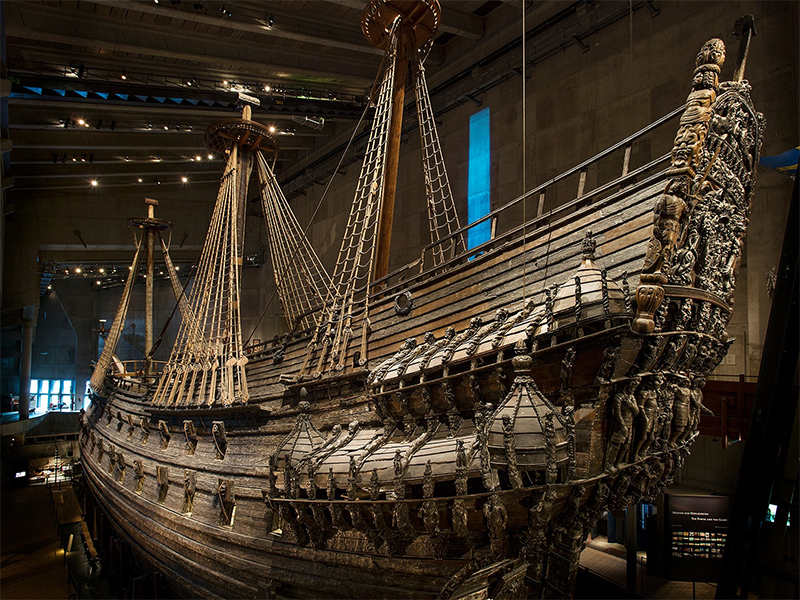
On August 10, 1628, a ship left the Stockholm harbor, which sea fleet had not yet seen: with two weapons decks (each of which could give a 250-kilogram salvo, which is about two times more than that of the largest European ships of that time), 58 bronze guns (in total, it was designed for 64, but the gunsmiths could not cope with the order on time) and a total length) 69 meters. A real floating fortress, which was supposed to catch horror to the entire Baltic from Revel to Copenhagen. However, the powerful ship of the Navy, named after the Royal Dynasty of Vas, spent a few minutes. After 1130 meters of the first voyage, a disaster occurred: the ship tilted from a strong gust of wind in sails, the water began to fill the cannon ports, the ship lay aboard and sank after a short time, taking away from 30 to 50 crew members and their family members.
The story of Vasya is a sad example of where excessive ambitions and loss of common sense can lead. It was conceived in 1626 as a small ship of the traditional design, turning into a sea giant two and a half years after numerous design changes. Europe was covered by a thirty -year war, during which the king of Sweden Gustav II Adolf hoped to establish control of the entire Baltic Sea. In 1625, the king entered into a contract for the production of four ships (one of which was supposed to become Vasa) with the Dutch shipbuilder Henrik Hubertson and his business partner tenant de Grota. Having learned that the Danes - the main competitors of the Swedes in the Baltic at that time - began to build a ship with two weapons decks, Gustav Adolf ordered to double the weapons rows on Vasya, which was not initially provided for the project and required an increase in Kile. It is not known whether the necessary drawings with modifications were made, but as a result, the depth of the keel became too small for a ship of this size, and it itself - too narrow compared to the length of the vessel. Shipbuilders were able to expand only the upper part of the vessel, which led to a change in the center of gravity and predetermined its sad fate. In addition, the king several times demanded to increase the amount of weapons: if the initial 33-meter ship was supposed to carry 32 guns, then Vasa went to the water with 64 cannon ports-32 on each side.
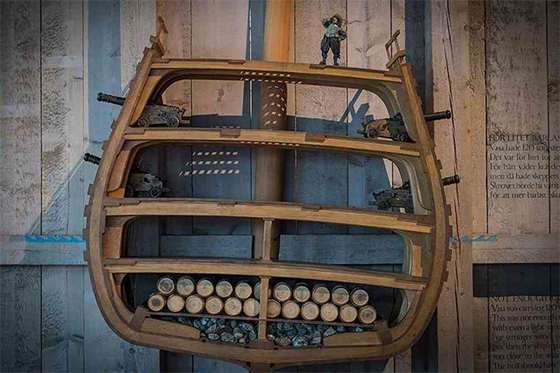 © Anneli Karlsson / SMTM
I must say that such a number of guns contradicted the fighting strategy that prevailed at that time, according to which the successful outcome of the fight was not sunk, but the capture of the enemy ship (it could then be used for its own purposes). But Gustav II Adolf was known as a fan of artillery and believed (not unreasonably) that the future of naval battles - it was in artillery fights, and therefore demanded that the ships supply the most modern weapons. However, the enemy of Vasya had no chance in the event of a direct clash: the “floating fortress” was designed for a huge team of 300 soldiers and 145 sailors.
Despite the concise terms of construction, the flagship was supposed to become a symbol of Swedish domination at sea, which required appropriate visual design. It would not be an exaggeration to say that Vasa was not only the most powerful, but also one of the most beautiful ships of his time. At least six skillful woodcarks made more than 400 wooden sculptures and 300 ornaments from oak, pine and linden - among them were the statues of ancient gods and heroes, and Roman emperors from Tiberius to septimium of the North, and biblical symbols. Gustav II Adolf was depicted above the stern in the form of a little boy with long fluttering hair, and a little below all this baroque-exciting decor (pretty much loading the already unreliable structure) was crowned by the Swedish state emblem, which held the pairs of a pair of lions.
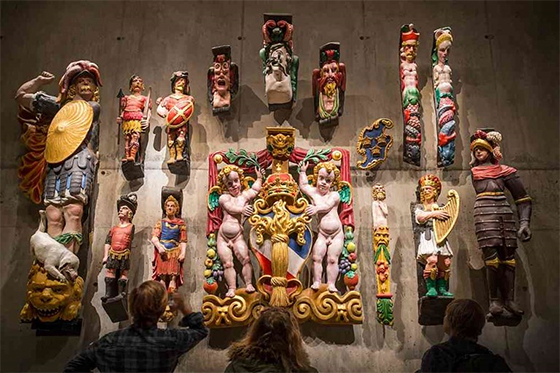 © Anneli Karlsson / SMTM
And now the luxurious in every sense the ship sank before the eyes of a large audience. The news of his death found Gustav II Adolf in Prussia only two weeks after the disaster. The monarch was allegedly furious and demanded that he immediately understand and punish all the perpetrators. Henrik Hubertson, responsible for the design of the ship, by the time he had been dead for a year - he died from a serious illness before the ship was launched. His followers Hein Jacobsson and Assett de Groot only shook his hands, saying that they had fulfilled all the king’s instructions according to the contract. As a result, no one was involved in punishment.
The Vasu’s incident did not prevent Gustav II Adolf to stay in history as a great commander and military reformer. True, they recall him more from ground battles: so, a well -equipped and disciplined Swedish army inflicted a severe defeat of the Catholic League in the Battle of Breetenfeld, in which the artillery was played by the King of Artillery. After the death of the monarch, Sweden conducted a successful war with Denmark (1643–1645) - his main opponent in the Baltic Sea. Thanks to this war, Sweden gained control over the Baltic states and dominance in the entire region - ending only 76 years later with defeat in the Northern War. As for Vasya, the ship had to lie on the seabed for 333 years.
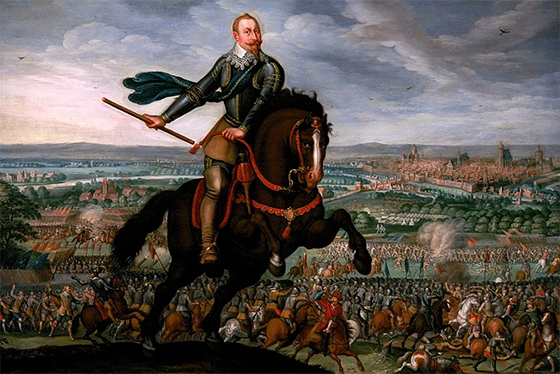 © Musée Historique de Strasbourg Johann Jacob Walter. King Gustav II Adolf in the battle of Breetenfeld. 1632
The second life of "Vasya"
Attempts to raise the ship have been made since the 17th century-interest was not the 700-ton ship itself, but the expensive bronze guns with which it was equipped. It is difficult to imagine how the divers in 1664–1665 coped with this task: they had to look for heavy guns in complete darkness and pull them through the cannon ports. However, 53 guns were saved, after which practical interest was lost to the ship.
In 1954, an engineer and amateur marine-fan Anders Franisen began to comb the Stockholm harbor in search of a legendary ship. In the southern part of the port, according to his own memories, only “rusty iron stoves, women's bicycles, Christmas Christmas trees, dead cats and other things that are better not to talk about.” After careful work in the archives, he discovered that Vasa was resting in the northern part of the channel. On August 25, 1956, Franisen was finally lucky - he discovered a piece of old black oak using a home -made device for studying the bottom. After that, a diving expedition was held, finding a ship with two rows of cannon holes on the deck.
Anders France in search of "Vasya"
In fairness, it should be noted that the ship has never been truly lost: evidence of several diving expeditions for Vasu in the 19th century has been preserved. Another thing is that they were in no hurry to get the ship from the bottom, and if it weren’t for the purposeful and stubborn franisen, who knows how much Vasa could still lie on the seabed.
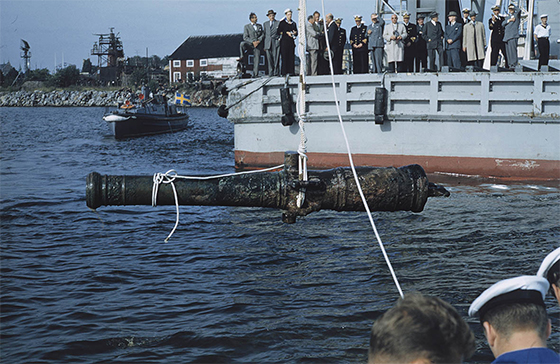
Five years after the engineer finding, the ship was able to raise and towed in the dry dock Gustav V on the island of Bekholmen. Due to the low amount of salt in the Baltic water, he was in excellent condition, but needed special conditions of conservation. “The conservation period lasted 17 years, during which the entire ship was sprayed with synthetic wax - polyethylene glycol,” says Malin Stalstedt, the restorer of the Vasa Museum, “he was supposed to replace the tree that rotted during the stay in the water.” In addition to the large destruction of the stern and the upper deck, the specialists had to figure out how to identify and place on the ship more than 13,500 parts found during the search. Over time, the ship was completely restored by the forces of scientists and restorers - today it consists of 95% of the original details and materials.
 © Vasamuseet
"War machine" VS "Technological achievement"
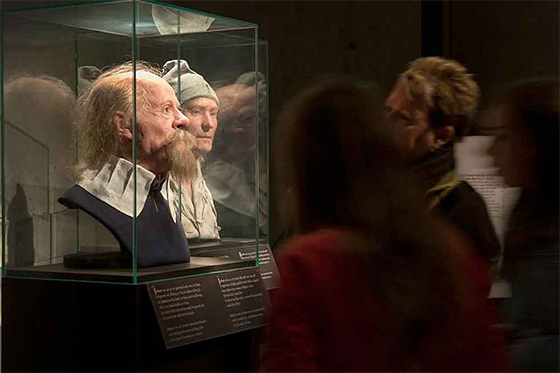
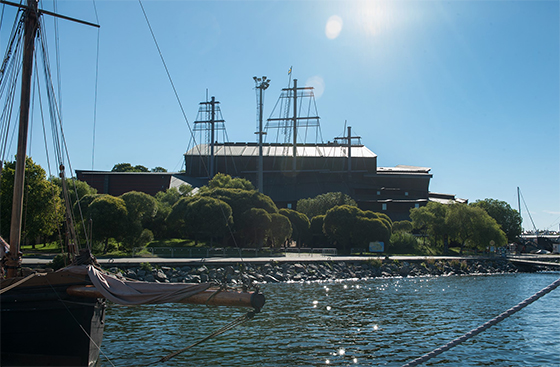
In 1990, the Vasa Museum was opened on the island of Yurgorden, which became one of the most popular in Scandinavia. In 2019, according to the official site, it was visited by 1.5 million people - an absolute record for the entire time of its work. For a visit, it is better to allocate for more than one hour to consider the ship from all possible points, to see the wax dolls of people who died on the “Vasa”, to find out what kind of salary the team received, as well as many other non -sophisticated things.
But how do today the ship’s history and the museum exposition today? The researcher from the University of Uppsala Pers Vaiden believes that the museum is distanced by the fact that Vasa was supposed to become a tool for Sweden in her desire for dominance in the Baltic. “As a result of the crash, the ship fell into a kind of“ time capsule, ”he says in an interview for Sverige Radio ,“ in the 1950s, not a warfare tool was found and saved, but a large historical object. Instead of analyzing the military and political strategy of Sweden, the museum represents this ship as a technological achievement of its time, even if it was awaited by failure. ”
This echoes the dominant in Swedish education and Swedish public life a look at its own history, which avoids admiring the imperial past. The imperial period itself in local historiography is called a more political correct term “period of great power”. In the same 2014, when Crimea “returned to his native harbor”, Sweden celebrated the 200th anniversary of the end of the Swedish-Norwegian war, which became the latter in the history of the country. According to the director of the Center for Modern History of the University of Suderman Andrei Kotarschuk , Swedish identity is now being built on the memories of the victories of the XVII century, but on pride in the century XX, during which the country managed to preserve neutrality in two world wars and built a socially oriented prosperous state.
 © Anneli Karlsson / SMTM
"Vasya" syndrome "
The disaster of the ship served as a visual aid not only for future shipbuilders and military leaders, but also to modern entrepreneurs and marketers. The term “Vasa Syndrome” was even included in the management dictionary. So, carefully understanding the history of the creation of the ship, American researchers Mary Jane Wilshire and Richard Fairley identified 10 similar mistakes that are made by software developers. Basically, they are associated with changing goals, a lack of design documentation and problems in communications between team members. One of the examples of “Vasya Syndrome” was called an attempt by the famous American bus carrier Greyhound to introduce a system of reservation of tickets in the image and likeness of American Airlines . Due to the fact that the developers did not have a deep understanding of this industry and they had to “improvise” all the time (as well as shipbuilders, which the king constantly drove), the project turned out to be a failure. An even more dramatic example of “Vasya” syndrome is called the tragedy of the Challenger space shuttle in 1986, which occurred due to significant design and technical errors.
Sweden itself “Vasya Syndrome” in any of the meanings no longer threatens: while the “world political pendulum” swayed to the right, tension in international relations is becoming increasingly obvious and the government of other countries tend to turn the views of the residents to the glorious victories of the past, the Swedes in the edification of future generations are improving the museum of one of their largest failures.
The Swedes have their own struggle, on which colossal forces are thrown: to preserve the only surviving ship of the XVII century. Even despite the careful storage of the vessel in a specially created microclimate, from the beginning of the 2000s, traces of wear have become more clearly visible on its building. It is encouraging that the behavior of the tree is monitored by specialists in molecular physics, the deformation of the ship is monitored at 400 points throughout the ship. So, according to the restorer of the museum, Malin Stalstedt, at least our grandchildren and their own grandchildren will still have the opportunity to see Vasu.
 © Vasamuseet
“The public consciousness in Sweden is turned towards the present and future,” continues Per Wayden, “the conservative nationalist tradition that has prevailed in the 19th century has not been easy, but the identification with modernity and progress turned out to be more attractive in the long future.”
“Schools and museums prefer to focus on social and cultural history,” says Vaiden, “they try not to raise questions about why Sweden got involved in one or another war or sought to expand the boundaries.” Instead, the military museums focus on the life and life of the soldiers, the difficulties that they had to deal with. “The war is not shown as a result of decisions of politicians or individuals, but as one of many misfortunes that people face is blindly and unpredictable.”
“The frank longing for imperial times has disappeared,” Eric Emilsson writes in his work “Alternating Swedish Historical Identity,” “it is now customary to talk about the departed glory only in the most general words - say, such as the words of the national anthem.”