
Translated material
China: features of development
During the life of one generation, the Middle Kingdom from a poor country has risen to the level of world economic leaders. What is the basis of such an impressive breakthrough? This question haunts specialists and simply indifferent people in many countries - both rich and poor. Zhang Weivei, professor of the Geneva School of Diplomacy and International Relations, Professor of Tsinhua and Fudan universities in China, who was a translator of English by Dan Xiaopin and other Chinese leaders, saw such foundations in eight “big ideas”. Interesting.
Search for the truth in facts. This is an ancient Chinese concept and Credo Deng Xiaopin. He believed that facts, and not ideological dogmas, are the final criterion of truth - no matter, eastern or western origin. Having studied the facts, Beijing made conclusions that neither the Soviet communist model, nor the model of Western democracy are suitable for the developing country as a means of modernization and that democratization usually follows modernization , and not vice versa. Therefore, in 1978, China went on its own development path and began a large -scale modernization program on the basis of a pragmatic approach, the method of trial and error.
Primate of the welfare of the people. Beijing accepted this old Chinese principle of government, proclaiming the eradication of poverty with the most fundamental right of man. This idea paved the way for China’s success in the release of 400 million people from the shackles of poverty, unprecedented success in world history. Perhaps China committed a revolution in understanding the rights of man, defended by the West, which, starting from the Enlightenment, saw them almost exclusively through the prism of civil and political rights. Maybe this idea will have historical significance for all our poor in the world.
(Compare with Russian practice, where enrichment by embezzlement is the real goal of the mafia elite.)
The importance of holistic thinking. Under the influence of its philosophical tradition, China since the beginning of the 1980s has been implementing a holistic modernization strategy. This allows you to build priorities at each stage of the transformation, following the light reforms are more decisive and difficult - in contrast with a populist, short -term policy that is common in the world.
The state is as a necessary good. Throughout the centuries -old history of China, the times of welfare were associated with an enlightened, strong state . Contrary to the American vision of the state as a necessary evil, the transformation of China was carried out by an enlightened state aimed at development. Dan Xiaopin reoriented the old system of China from the desire for Maoist utopia to promote modernization. In all its shortcomings, the Chinese state is able to form a national consensus on modernization and go, developing new technologies, to the intended strategic goals (reform of the banking sector, the development of renewable fuel sources, stimulating the Chinese economy in the context of a global decline, etc.).
(Compare with the realized rather than declared programs of the President and the Government of Russia, with discussions on TV. The goals, ways and means of achieving them, the development of the economy of innovation are not discussed. Instead, the scenes about the gayirop, fairy tales about holy relics, consolidation of society through Agpessia - the annexation of Crimea and the war in the Donbass. The country is immersed in poverty: 5 millions of people Get a salary of 7500 rubles a month!)
Effective management is more important democratization . China rejects the stereotypical dichotomy “Democracy against autocracy” and believes that the character of the state (including its legitimacy) should be determined by its essence, that is, the effectiveness of management, and is evaluated on the basis of how successfully it copes with its functions. Despite gaps in transparences and legal institutions, the Chinese state ensured the fastest economic growth in the world and sharply increased the standard of living of the population.
(In this, it is in solidarity with those political scientists who, on these statistics, proves that wide democratization often leads to the power of dictators, to the poverty of the people in countries where the subject of the leadership culture of society is at the Middle Ages. Examples: Congo, Turkmenistan, Uzbekistan, Russia.)
Legitimacy as a result of effectiveness. Beijing practices this principle (although not always successfully) within the framework of its political system, based on the Confucian tradition - meritocracy (smart power). Criteria such as effectiveness in eradication of poverty and in environmental protection through Innovation And new technologies are key factors of career growth of officials. China leaders are educated, competent and tested at different levels of responsibility. (In Russia, governors are appointed by the guards devoted to the President.)
Selective training and adaptation. China is a secular culture in which the ability to learn from others is valued. The Chinese have developed a remarkable ability to select and adapt to new challenges, as evidenced by how quickly China entered the world of new high technologies and took one of the leading places in it . (In Russia - a crisis of science and education. Projects of the Skolkovo type did not have an effect.)
Harmony in variety. Beijing revived this ancient Confucian ideal in relation to a large and complex society. Rejecting the policy of confrontation in the western style, the authorities are working hard to emphasize the commonality of various groups of interests, to mitigate social contradictions associated with quick changes, and create a system of social guarantees for everyone.
Digest on the materials of the press
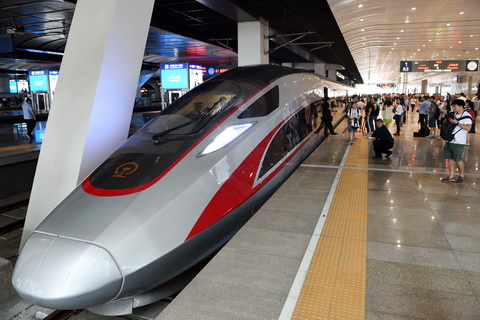
Photo: 06/26/2017. The new generation of the Fusin high -speed train began to run along the Peking -Shanghai route. Ju Huanzong/Zuma/Tass