
Translated material
How to close the "factories of losers"
The text continues the joint project of Colta.ru with the official website of Sweden in Russia Sweden.ru - “For example, Sweden” .
The Swedish Constitution guarantees all children free education from seven years old - does not even just guarantee, but obliges him to receive. Moreover, in the article of the Ninth Law on Education, it is separately stipulated that it should be “equivalent” in all schools of the country.
In Sweden, it is customary to pay attention to what is written in the laws, but in recent years, the education system has encountered a serious problem. A lot of refugees with children come to the country, and they all guaranteed a place at the school at the place of residence. But, as a rule, in large cities, refugees tend to settle in the same areas - the cheapest, of course. The result was commented in March by the Minister of Education of Sweden Gustav Friedolin: "10% of schools accept half of all refugee children." Such a forced segregation is a real challenge for the Scandinavian spirit of equality, but the Swedes would not be Swedes if they had not come up with an elegant and simple solution.
In general, this, of course, is a common effect for the whole world: children from the middle class go to some schools, guys from poor areas - to others. You can invest as much as you like in an increase in the level of teaching in these educational institutions, in the development of infrastructure, but if the class does not have social diversity, if children of movers and engineers are not able to communicate with each other, this skew cannot be eradicated.
The problem is well studied in the USA - there it feels much more acute. Last year, the Tampa Bay Times from Florida was nominated for a prestigious Global Editors Network Award for a large -scale investigation of the dynamics of academic performance in primary schools in the region. Journalists revealed five of them, where the results of national tests were stably the lowest of the year a year. The discovery became that they are not even in the "bad" areas, but simply in the most segregated. And no matter how much the municipal authorities invested in the development of schools, this did not affect the assessments of the students. A series of articles was called Failure Factories and caused such a resonance in America that the Minister of Education immediately flew out in place and promised to fix everything.
In France, the same problem is complicated by the fact that students are distributed by classes on the basis of their previous performance. There is wild hypocrisy: such a system is considered as a means against low indicators in schools where immigrants prevail (in the documents such schools are designated as Zones d'éducation Prioritaires - French officials love to play in words). But in reality, she writes part of the students in the "eternal losers." In Catalonia, they went even further - for children of refugees, separate schools were simply created there. You can’t imagine better.
In Sweden there are no areas that would be called “little Baghdad”, but there is a certain level of forced segregation, and it is discussed in society.
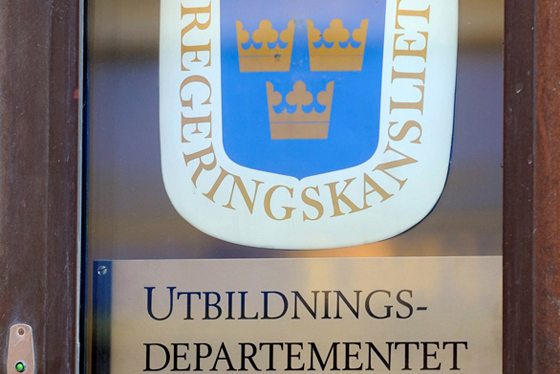 © Emma Leijnse / Sydsvenskan door of the Ministry of Education of Sweden
The state administration of secondary education, Skolverket , regularly publishes the results of national tests in key subjects and generally leads a rather meticulous statistics. When looking at it, it becomes obvious that in large cities there are schools where the vast majority of students have parents without higher education. There is a clear correlation: it is in these schools that the guys most often fail national tests, performance here is below the average. This also applies to the Swedish language - it is difficult for children to learn it when for most classmates it is non -native.
This creates a situation where in some schools the Swedish does not know the majority of students, which affects other subjects, the teaching of which is, of course, in Swedish. But for many Swedes it seems unacceptable when up to 95% of children with low -income families is in one school. Because it is not only about the past of the parents, but also about the future of their offspring, and hence the country.
“30 years ago, when my children grew up, the situation was completely different,” recalls Ali Moeni, the president of the municipal assembly of the suburbs of the Angered in Gotheborg, now mainly immigrant. “The situation in schools was more balanced: approximately 60% of the children were from Swedish families, the rest had some other language-and it worked well.” The director of the local school, Nils Kaiser, also confirms in a conversation with me: “In recent years, we have had waves of children from Somali, Syria, Iraq. All these families settled in Angern. ” At the moment, the Kaiser school has 98% of students - from families of recent immigrants.
The situation is complicated by another factor with which you, if you move to Sweden with children, will certainly collide. In theory, the system allows parents to freely choose schools throughout the city, but in practice - no. The procedure for recording in municipal educational institutions here is centralized, and despite the fact that you can submit an application to any, the last word remains with officials, and they will proceed from the so -called principle of geographical proximity (Närhetsprincipen) . This is a rather complicated algorithm, but in fact it means that the further the school is located, the less chance you have to get a treasured place - and much. You can avoid the yoke of this “principle” by writing your child into a private school, but it is recommended to get up to the child in line literally in the hospital.
The problem is obvious to everyone, and the authorities in large cities began to experiment. Eva Petersson has been engaged in a project for a desegregation of schoolchildren in Angern since last year. The municipality organized a special bus that transports children from "dysfunctional" schools to the other end of the city, to the Achimbadet area, inhabited mainly by the Swedes from the middle class. Now they are recorded in classes there, bypassing the “principle of proximity”. The path takes 26 minutes, and there are not too many volunteers yet, but the result has become noticeable to almost everyone at once. “The guys teach the Swedish much faster, because in Achima everyone around them speak him,” says Peterson. - I believe that you need to mix everyone, - if my will, we would carry Swedish children to study in an Angered. The change of places of terms does not matter - it matters percentage. ”
I talked with the guys who already take part in the program. Of course, they do not like to get up half an hour earlier, and they miss friends, but the difference is obvious to them. We speak freely with them in Swedish, although they received refuge only last year; Their friends in the old school, according to them, still almost cannot speak in the language - not only to teach algebra on it.
Hans-Oka Norrbu, the director of the school, to which they now go, told me at the end of winter: “Participation in the program is voluntary, and the parents who write down the children in it are simply more concerned about their education. We are talking about national policy, the situation requires a political decision. This topic must be constantly raised, work on all fronts. It would be nice to introduce a quota to the distribution of children who have just arrived in the country in different schools of the city - but I do not think that it is now possible from a legal point of view. ”
As it turned out, Mr. Norrbe was mistaken. In early March, the Minister of Education Gustav Friedolin made a sensational statement on the radio of Sweden. Based on the positive results achieved during the experiment in Gotheborg and similar in Stockholm, the government decided to introduce a mandatory quota of refugees in city schools - without reference to the district. Now, each school should have no more than 6% of “new” students, that is, children of immigrants - the guys should be evenly distributed to schools.
The decision will enter into force on February next year and has already caused an extensive discussion. Does the state have the right to decide for parents what kind of school to go to their children, where is the moral border here? Nevertheless, it was to the conclusions about the need for such a quota that researchers from the United States have already come to at one time. Only in this way, in their opinion, can one actually end up with the "Factory of Losers."