
Translated material
All by the beam
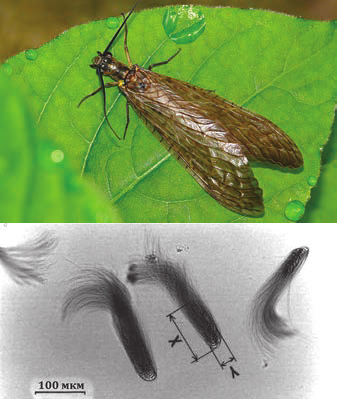
This is the case of insects Parachauliodes Japonicus , belonging to the corridal family. Males p . Japonicus produces sperm in bundles, several hundred cells in each (Fig. 1). The heads of sperm are united, flagella are free. During the copulation, the male packs about five hundred bundles in one sperm and attachs it from the outside to the genitals of the female. Bunches float in a viscous seed fluid, synchronously moving flagella, and reach the spermate of the female - a special organ, where they are stored in anticipation of fertilization. The process takes several hours, and the males all this time make sure that the female does not remove the spermatofor.
The Professor of the Tokyo capital University of Fumio Hayashi (1] became interested in these beams [1] . He found that the larger the bundle, the easier it moves in a viscous environment and reaches spermate faster. The distance that the sperm p . Japonicus , more than many other insects that do not attach spermatopher from the outside, but lead inside the female. Thus, the unification of sperm can create an advantage for them, and one by one they generally risk not getting to the goal. And there everyone is already for himself: in the spermate, the beams break up.
The cooperation of spermatozoa is also beneficial for the males of the membranes of eSocial insects: bees, ants, OS, which live in large colonies with one queen and many working individuals. Korolev’s life is strictly regulated, they are supposed to be only one marriage flight, during which they mate with several males, load the spermate of their germ cells, and then use this margin for 20-30 years, producing working individuals. Fate let the males release even fewer joys: shortly after mating, they die, they have no second chance and have to make every effort so that their sperm reaches spermate and transmitted to the next generation. And then spermatozoa are included in the postcopular race.
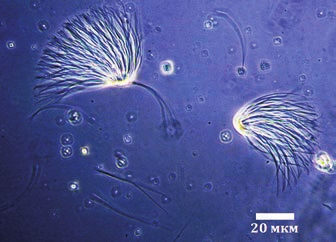
Specialists of the Brussels Free University, led by Serge Aron, studied spermatozoa of the desert anti-trunks Cataglyphis Savignyi [3] , who have to withstand acute competition because females of this species take up to 14 males (on average about nine). Researchers dug up the ants in the desert Arad (Israel) and transferred to the laboratory. When the males reached puberty, they were strewn with chloroform and, pressing the abdomen, caused ejaculation - a drop of seed performed at the end of the endopallos. Microscopy preparations were prepared from this drop. It turned out that the sperm from the ejaculate C. Savignyi are collected in the beams of several dozen. Their heads are glued with glycoproteins of the extracellular matrix, and the flagella remain free and all are directed in one direction (Fig. 3). Their consonant movement sends the “Volan” forward, but along the spiral trajectory.
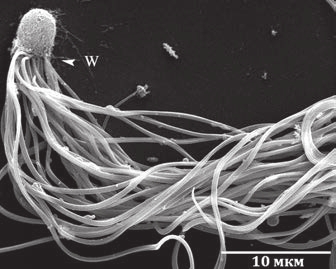
Males of the membrane of the haploids, their sperm in the process of ripening were not subjected to meiosis and are genetically the same. Therefore, they are united without prejudice to themselves in the team to win the race at spermatozoa of other males. It is very important to come to the finish line not only faster than others, but also more friendly, because the parental success of each male depends solely on how many spermatozoa they were able to introduce into the female. This fact was established by the specialists of the universities of Helsinki and Copenhagen, working with the anthors of Atta Colombica [4] . These ants also introduce sperm in bundles, which are dissolved in a spermate. With the help of PCR, the researchers determined the share of spermatozoa obtained by the queen of leaf -cutting from different males, as well as the contribution of these spermatozoa to fertilization and the birth of working individuals. The spermatetext consists of two shares, and in each of them spermatozoa of different manufacturers are represented with approximately the same frequency, that is, well mixed. Scientists failed to find evidence of different viability of sperm, their incompatibility, some kind of internal selection. The viability of sperm, apparently, is high, their choice for fertilization of the next egg occurs randomly. The more cells the ant into the female introduced, the more of his descendants she will produce.
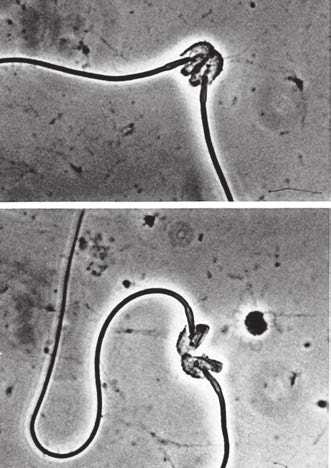
During estrus, the sexual paths of the females of the OPSSUM are filled with vaginal musk, the viscosity of which is comparable with a viscosity of a 5% PVP solution. Having united in pairs, spermormas overcome this obstacle, almost overwhelming for a loner, and very effective. It is known, for example, that in the Virginsky Opeksum, the DIDELPHIS Virginiana, the target reaches one sperm of 20, and the rabbit - one of 5-10 thousand. Such effectiveness allows the murderers to cost less germ cells than other mammals.
Apodemus Sylvaticus forest mouse is also important, speed and effectiveness are also important, because their females mate with different males and spermatozoa of different manufacturers are present in their sex tract. Many rodents, and the forest mouse in particular, the head of the spermatozoa is sickle, with a hook. With these hooks, the cells adhere to several pieces, and then huge “trains” consisting of hundreds and even thousands of cells form from these small associations. This caravan moves much faster than a single sperm [6] .
So fertilization in many species turned from the individual championship of sperm into team competitions, in which they win not so much by skill as in number.
1. Hayashi F. Sperm Co-Operation in the Fishfy, Parachauloodes Japonicus // Functional Ecology. 1998. 12. R. 347–350.
2. Burnett We, Heinze J. Seperm Bundles in the Seminal Vesicles of Sexually Mature Lasius Ant Males // Plos One. 2014. 9. E93383, DOI: 10.1371/Journal.pone.0093383.
3. Pearcy M., Delescaille N., Lybaert P., Aron S. Team Swimming in Ant Sepermatozoa // Biology Letters. 2014. No. 10. 20140308. DOI: 1098/RSBL 2014.0308.
4. Holman L., Strup M., Trontti K., Boomsma JJ. RANDOM SPERM USE and Genetic Effects on Worker Caste Fate in Atta Colombica Leaf-Cutting Ants // Molecular 2011. No. 20. R. 5092–5102. DOI: 10.1111/J.1365-294x 2011.05338.x.
5. Moore HDM, Taggart da SPERM PARING IN THE OPOSSUM Increases The Effaciency of Speerm Movement in A Viscous Environment // Biology of Reproduction. 1995. 52. R. 947–953.
6. Moore H., Dvora´kova K., Jenkins N., Breed W. Exceptional Seperm Cooperation in the Wood Mouse // Nature. 2002. 418. R. 174– DOI: 10.1038/Nature00832.