
Translated material
A year after the arena
In the opposition
 A year after the arena
December 21, 2011 Alexey Makarkin
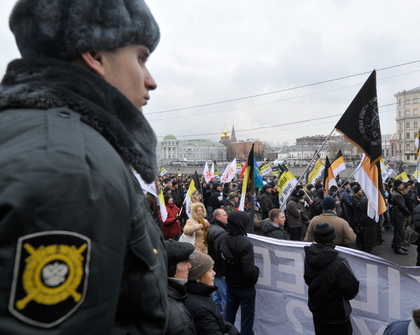
A year ago, fans and nationalists entered Manezhnaya Square. One part of society perceived this action with anxiety, the other with hope. However, since then, the positions of nationalists in Russian society have not intensified - on the contrary, recent events testify to their weakness. The day after the rally, the nationalists, held in the same place, gathered several hundred people (less than the apple rash, spent in a week after a week). And although the nationalist ideologist Yegor Kholmogorov compared them with three hundred Spartans, it was only a good mine with a bad game. After all, the leaders called their supporters not in the farm polls to fight with the hordes of Xerxes, but to the authorized Moscow rally, which the authorities were not going to disperse. A rally held on Saturday on Pushkinskaya Square by another organization of nationalists, the People’s Cathedral, also attracted several hundred people.
The problems of nationalists are chronic. By their inability to negotiate with each other, they bypass even liberals, also known a lot of internal contradictions. More interesting, however, something else. Liberal can be in the opposition for a long time - he is by nature a skeptic and critic, who is characterized by irony - as an offensive, so, often, protective. It is uncomfortable to the nationalist in the opposition, he associates himself with the state and is looking for any possibilities of interacting with him. It is interesting that Alexander Prokhanov in the 90s produced the newspaper “Tomorrow” for some time as an organ of “Spiritual opposition”, but, in the end, renamed it to the “Russian State Gazeta” (then the nationalists suggested to the allies of Korzhakov in the struggle against Chubais). Its pathetics is usually more compatible with state propaganda than liberal irony. Liberal, joining the propaganda system of a non -liberal regime, ceases to be a liberal. The nationalist, performing the same action, remains a nationalist.
Another thing is that the nationalist, entering into relations with the authorities, dreams of partnership, the role of Katkov under Alexander III. After 1917, power, if it treats nationalists, is only as customers who should act in a tough framework. In Soviet times, they were allowed to participate in organizing the celebration of the 600th anniversary of the Battle of Kulikovo, but not to publish their work in Samizdat (even with the "state" criticism of liberal dissidents). Now they can significantly more, but the requests have grown immeasurably. At one time, the authorities had plans to build closer relations with nationalists as with “anti -Orange” power (recall the first “Russian March”), but Afront with the “Russian image” broke these plans. The leader of this “loyal” and “constructive” organization turned out to be a close friend of the murderer Markelov and Baburova who was in the illegal position.
After the “Manezhka”, the nationalists tried to lobby for the idea of registering their own political party, but in the Kremlin they decided differently - there was no informal taboo to expand the narrow framework of the party system. Apparently, not only the relatively recent story with the “Russian way” played a role, but also the older and more loud - with the “Motherland”, which has gone from the political technological Kremlin project to the “untied” party with the leaders starving on Okhotnaya. Therefore, the conduct of agitation among the nationalist electorate was allowed to be experienced in these matters and repeatedly proved his loyalty to Vladimir Zhirinovsky.
After this failure, some nationalists began to evolve towards greater criticality in relation to the authorities. These include, for example, Konstantin Krylov, who achieved the opportunity to perform in Bolotnaya Square, but not too benevolently met by the audience. And the Kholmogorov mentioned above, who publicly renounced the former fidelity of corrupt power and became a supporter of a certain democratic nationalism. And many others. Some nationalists continue the previous games - for example, the rally of the "People’s Cathedral" was held under the "anti -Orange" slogans, and one of its participants was the conspiracy therapy Nikolai Starikov, who previously declared that the rollers denounced the falsifiers are a fake.
But the possibilities of cooperation with the liberal opposition even among the opposition part of nationalists are extremely limited. The nationalist “human rights” is often in the protection of killers who have received long terms of imprisonment for crime on national grounds. On the account of one of these groups - 27 murders. At the same time, Mikhail Khodorkovsky is a criminal for them, the organizer of a conspiracy against a great state. Liberals insist on equal rights of people of different nationalities and tolerance-this word for nationalists is abusive, and they insist on the abolition of the 282nd article of the Criminal Code to resolve Xenophobic propaganda. Liberals are needed for the introduction of civilized rules for the game in Russian politics, to nationalists - to come to power and create a “Russian regime”. Even situational coalitions on consensus “general democratic” issues (for example, attitude to the past elections, the need to transition to the election of governors and the Federation Council) are extremely difficult, evidence of which is an unsuccessful attempt by nationalists to disrupt the rally on Sakharov Avenue on December 24 by sending competing applications for the organization of rallies.
And, probably, the most important thing. If the authorities are afraid of the people, and the liberals fluctuate between fear and hope, then the nationalists love the people. But the ideal people, existing in their minds, ready for endless sacrifices in the name of the Great Nation and for the Holy War with all its enemies, external and internal. The existing people - “office”, devoid of state instinct of plebs and others - they despise. We add to this the strongest emotional “negative” that is felt in their rhetoric and scares away even the potentially sympathetic people-it is enough to give an example with the dreams of Krylov about the execution of the White House defenders in August 91st for the sake of saving the empire. “Russian marches” are effective only when they come to be close -knit detachments of football fans. As soon as the fan activists decide that it is not worth coming, the events of nationalists turn into between the landers, and in their mood, very different from a friendly rally in Bolotnaya.
Therefore, populists for which nationalist rhetoric are in the background are much more likely successful - such as Alexey Navalny and Evgeny Roizman. They publicly resist corruptions and drug trafficking, and are not fixated on the “Russian question” and, in addition, are able to create coalitions with various ideological forces. As for “professional nationalists”, in the foreseeable perspective, they, apparently, will remain on the public periphery.
Author-First Vice President of the Center for Political Technology
Photos of RIA Novosti