
Translated material
Neighbor scientist Galileo ...
And yet it happened ...
George Clooney’s film “Good Night and Good luck” about the American television of the 50s and about the brilliant reporter Edward Murrow, who put the end of McCartism with his author's programs (about this film and about his projection on the Russian television situation, I already
I wroteIn “EZ”), a stone fell into the stagnant water of domestic political television journalism (if there is still one). And caused circles on the water.
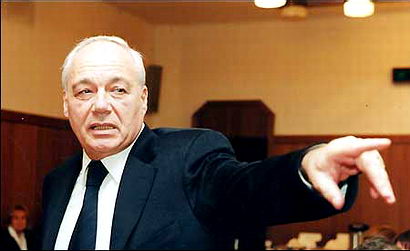
The summary of the last three weeks:
In his branded "farewell" in the program "Time" on March 19, Vladimir Pozner spoke about the film. “That's when I watched this film ... I, a political journalist working on television, had a lot of questions. In particular, what do we do, for whom do we work, who are we working for? For yourself, for your career, for earnings, to please the boss in order to please the authorities in order to express their personal point of view? In general, as far as we think about the very viewer who is actually expecting from us a balanced, objective, honest and timely information? .. There are many questions that you could ask and which we, of course, should ask ourselves ... ”
Telekritik Irina Petrovskaya in his column with the characteristic name “The party said:“ We must! ”, The journalist replied:“ There is! ” In the newspaper Izvestia on March 24, I immediately responded to Pozner's words. The “revolutionary farewell”, in her opinion, sounded “like a scream of a wounded soul”, especially noticeable “in contrast with a completely servile and completely safe program that the respected Vladimir Vladimirovich just conducted.”
The essence of the text of Petrovskaya can be reduced to bewilderment: to whom this passionate message of Posner is addressed, and who, “if not the most authoritative political journalist of the country, might and should answer the questions sounded”? Further, Irina wrote about the obvious contradiction of Pozner’s questions and the subsequent plots in the “Sunday time” of Pyotr Tolstoy about the “fascist Rogozin” and in the “Vesti of the week” Sergey Brilev about the allegedly hereditary disease of Andrei Sychev, who caused his monstrous injuries ... in the final of her column, Petrovskaya turned to Pozner: “Dear Vladimir Vladimirovich, you still have you Are there any questions? Or is it not journalists, but representatives of some other sphere do all this? Alas, these are journalists, and they work on one field with you called modern Russian TV. ”
Three days later, the same Irina Petrovskaya, together with Evgeny Kiselev and Masha, Slonim on the air of Echo of Moscow spoke with Ksenia Larina about political television journalism and again could not pass by Pozner's "Farewell". To what the telecritic wrote about in the newspaper, several more theses were added on the radio. The first Slonim formulated by Masha: Pozner's “Farewell farewells” is a kind of “beacon” that gives the viewer a signal, they say, he is forced to endure all the traction of boring programs and irrelevant topics, so that in the last minutes it seemed to shout from the underground to shout something important. The second thesis: "Pozner television and Pozner Gazeta, magazine are completely different things." Evgeny Kiselev cited Pozner’s author’s commentary as an example in the Esquer magazine, where Vladimir Vladimirovich calls the six main troubles of modern Russia - from the appointment of governors and the Chechen war to the conclusion of Khodorkovsky. Kiselev suggested that "Vladimir Vladimirovich could never utter this text on Channel One." And the third thesis: Posner today professes the theory of “small deeds” and accepts a “certain system of prohibitions and compromises”, the violation of which is fraught with troubles not only for Posner itself, but also for the leadership of the Channel One.
Summing up that conversation, Ksenia Larina expressed hope for his continuation with the participation of Pozner himself, but she hardly assumed that the continuation would follow so stormy.
Exactly a week later, on April 3, Vladimir Vladimirovich came on the air of Echo of Moscow (with the same composition of the participants, there was not only Masha Slonim), but before that he spoke in his program. In Pozner’s words, a personal resentment was clearly felt that the discussion of his program led to the discussion of his person. And even on the “critic” Petrovskaya, who “did not understand anything - it sometimes happens with critics, well, what can you do!” In addition to the emotional reaction, the essence of Pozner’s objections was as follows: he is “not poor, not driven”, the topics of the programs are determined by the “time” team, “without asking anyone”, but his “farewells” is “not a signal, but simply my desire to speak out” because the host of the television programs “does not have the right to speak out during the conversation, but should only ask questions”.
As a result, during a very stormy conversation, the protesting against the assessments of colleagues Posner himself confirmed that "there are topics that, in particular on the" First Channel ", are absolutely unrealistic." The word "absolutely" sounded several more times. “I absolutely understand that I do not have absolute freedom. She is limited, ”Posner said. A little later, he agreed with the definition of “self -censorship” and added: “I understand that there are topics that cannot be touched ... and I understand that the corridor has narrowed, but I can work in it so far.” Vladimir Vladimirovich refused to designate the framework of this corridor, but emphasized that he travels a lot around the country, sees the reaction of people to his programs and therefore continues to work even in this narrowed corridor.
That is, Vladimir Vladimirovich came almost the same, which was talked about in the studio without him. In this case, what did Posner offend? Only on the fact that he was suspected of concealing true views and trying to express them to the public in their "farewells"? Or that as a result of such discussions, his image of the main liberal and the main professional landmark of domestic TV faded somewhat? Or that this image faded without a Petrovskaya column, without the programs of the Echo of Moscow, but simply because it became less than light directly on its own air?
In fairness, Posner is the only one of the political journalists working in the open television space (or journalists who consider themselves to be such, or not even counting, but occupying the position of political journalists), who spoke about the issues raised by the film Clooney. None of the current Pozner colleagues occurred to do this, especially on the air of the national channel. Neither Brilev, nor Soloviev, nor Tolstoy, nor Svanidze, nor Leontyev, nor fur - no matter how differently we relate to the listed people, all of them in the domestic television space go through the category of "leading political programs" - did not try on the questions of Clooney. At least they did not publicly do this, they did not take out the litter from the hut of their own soul. And all confidence in the correctness of the chosen course (like Leontiev and Solovyov) or all their doubts (which, I would like to believe, have Svanidze) with them.
Pozner voluntarily or involuntarily made his doubts about the universal discussion. But, reading and listening to these endless skirmishes, I could not understand - what is it about? Indeed, about your conscious choice, about the readiness to work in changed conditions and exist in given circumstances until at least some opportunity to do what you think is important, the explosives have said repeatedly. With pride to say that many years ago he decided “never to follow any instructions” again, he always honestly admitted that there was a certain amount of restraining factors that did not allow him to simply slam the door and leave the profession.
A year and a half ago, I gave Vladimir Vladimirovich an interview for the Russian Newsvik. Pozner then admitted that in the previous “election” season he had to make concessions, fulfill some requests of the leadership. Vladimir Vladimirovich defined his concessions as follows: “There were no direct prohibitions - they don’t talk to me like that - but there were requests not to invite one or another policy on the air.” And he explained them with several reasons.
One of them is the desire not to harm the leadership of the channel on which his program goes on the air. “Konstantin Lvovich Ernst is far from the worst manager of the channel, but of those that exist today, in my opinion, of course, the best. You can spit on the consequences and do what you consider necessary, and as a result of some of my actions, let the general director take off. And who will be appointed in his place? Some possible surnames are hung, and they all cause a terribly unpleasant sensation. ”
The other is not only about myself (“... over many years of work, I managed to create some, as they say in English, a“ pillow ”, an economic reserve that, if I lose my job, will allow my family not to starve ...”), but also about the team that makes the “times” (“... Okay, you slammed the door, or you“ slammed ”and what will happen to them?”).
That our conversation ended with Vladimir Vladimirovich’s recognition of a decision with the “Questions for Default” no longer put up. “If I understand that the request for silence is dictated by some political interests, then I won’t go to it.”
Pozner walked or did not go to this in the past year and a half, only he can answer. As soon as he himself can answer the question of the degree of self -censorship and the framework of the notorious “corridor”. For example, I know for certain about one prohibited surname of a potential participant, more precisely, the “non -person” of the “times”, with which Posner agreed, believing that the non -rejection of this person in the Ethi of leaving the profession is not worth it. I know a few more names that know that in the current situation Posner a priori will not call them on the air.
In an interview with a half year ago, Posner cited the lines from Yevtushenko’s poem, which he often quotes his schools for young journalists:
Neighbor scientist Galileo
was not stupid Galileo,
He knew that the earth was spinning
But he had a family.
So what about?