
Translated material
The revolution is ambivalent
The theme of revolutions has always been complex, voluminous and acute. But recently, the sharpness has increased, and the topic has become clearly overheated.
The parliamentary elections and the subsequent mass rallies of protest against their results even more politicized public consciousness. And in recent years, the “color revolutions” in our neighbors have so excited Russian power that it is trying to prevent the concept of “revolution” in every way, to prevent even a hint of its possibility.
Personally, I am not a supporter of revolutions. But this hypocritical-rack of the maximum transfers me-“Russia has exhausted the limit on the revolution”, launched into circulation and pronounced as a spell, and liberals, and power, and part of the opposition. The next phobia is imposed by public opinion: the revolution is absolute evil, blood and chaos, after it exclusively villains come to power. The revolution becomes a frank scarecrow.
Yes, it is important not to romantizing the revolution, as it was before, but not to demonize it, as is happening now. It is better not yet late to draw bridges, look for a real dialogue, and not lie and intimidate.
The revolution is almost always a disaster for the country, like an earthquake, shaking the foundation of the state. “Revolution,” said Prosper Merima, “as illness, announce themselves with an unclear poor well -being, the meaning of which becomes clear only later.”
The revolution really raises the muddy, dark forces of the masses from the bottom, which can practically not be controlled and which most often destructive.
The revolution is uncontrollable, it rarely or almost never ends with the victory of the Girondins or Cadets, and, mostly Jacobins and the Bolsheviks.
The revolution begins with calls for freedom, but ends with reactions and despotism.
The revolution is, first of all, the Committee of Public Salvation and the Cheka. These are mass sacrifices among innocent people.
The revolution devours its children, those who were most active in its initial, most romantic phase.
This is the practice of revolutions. (Although, let's make a reservation: there are also the so-called “velvet revolutions” that took place in Europe at the end of the 20th century.)
On the other hand, it is also obvious that the revolution is always a surgical surgery without anesthesia, when the patient may not withstand pain shock. But in such a position, when you have to “cut it on the living”, the power that led to the advanced state of the body and did not leave another chance on a different path of recovery is to blame. There is no other way for changes if the government rests on its prejudices and crimes. She, the authorities, first of all, is to blame for revolutions, not revolutionaries. She is responsible for chaos, because she did not find a common language in time with her people, did not establish dialogue with people, could not carry out pressing reforms in time.
All prominent researchers of revolutions, from Carlyle to Berdyaev, noted that the revolution is an retribution for the sins of the previous government.
No revolution can be fully imported. No conspiracies can lead to a real revolution without visible objective reasons for the crisis of power.
The Russian monarchy, for example, could not agree with her people. With its formed part, with smart youth, bringing them to a boil.
The first Russian revolution would not be without a mediocre Russian-Japanese war and bloody Sunday. The second Russian revolution would not take place without the losing World War I and Rasputinchina, without harmful intervention to the reign of the king’s wife, without the many mistakes of Nicholas II himself. And Masons have nothing to do with it.
And the October Revolution would not have occurred, if it weren’t for the complete imperious failure of the Provisional Government, who had not managed to solve a single serious issue in eight months: neither about war or peace, nor social problems, nor the urgent peasant issue, nor the issue of struggle against an extremist opposition. And again: no German money could play a serious role, if not for the mediocrity, idealism and purity of power.
Thus, the revolution is ambivalent - a scalpel is a dangerous and traumatic tool, but sometimes only saving.
This is what, for example, Russian philosophers and historians wrote, thinking about the revolution in “hot traces”.
Nikolai Berdyaev:
"The revolution is above the conjured punishment for the sins of the past, the fatal consequence of old evil."
"... The revolution is the end of the old life, and not the beginning of a new life, reckoning for a long way."
“... The revolution always suggests that the authorities of those who have not fulfilled their destination. And condemnation before the revolution of the ruling strata of society is what they brought to the revolution, allowed its opportunity. ... There was no creative development from above, the light did not radiate, and therefore darkness broke out from below. It always happens. This is the law of life. "
“Revolutions are preceded by the process of decomposition, the decline of faith, the loss in society and the people uniting the spiritual center of life. Not creative processes, but putty and destructive processes lead to revolutions. ”
“... The people who have fallen into the power of the revolutionary element loses spiritual freedom, they obey the fatal law, he experiences the disease ... Not people already think and act, but for them someone and something thinks and acts. It seems to the people that he is free in revolutions, this is a terrible self -deception. He is a slave to the dark elements, he is conducted by inhuman elementary spirits. There is no freedom in the revolution, the revolution is always hostile to the spirit of freedom. ”
"... The revolution happens as a sudden serious illness with possible complications."
"... revolutionaries are mediums of the faceless and dark elements of the masses."
“... it is impossible to lead the revolution. Reactions are replaced by the revolution. ”
“... you (revolutionaries - ed.) People of the spiritual middle and mediocrity, people of medium, gray, popular thoughts. And your rage is the fury of the gray mass, envious of all greatness, all glory, all genius. ”
“Everyone who considers themselves to be losers and offended and embittered, all the stepson of God, and not the Sons of God, grab onto the revolution and live on it. Revolutions are not born from noble consciousness of guilt of the sons of God, but from the distant consciousness of resentment by the sons of dust. ”
Semyon Frank:
“Every revolution is Troubles. No matter how deep, the needs of society are not satisfied and organic, not satisfied with the “old order”, the revolution is never the appropriate, meaningful way of satisfying them anywhere. It is always only “unrest”, that is, only a disease that bursts out as a result of the failure of the old order and reveals its failure, but in itself not leading to the satisfaction of organic needs, to something “better”.
“... every revolution costs the people too expensive, does not pay for its costs; At the end of any revolution, society, as a result of the innumerable disasters and suffering of anarchy, is in a worst position than before it, simply because the exhaustion caused by the revolution is always immeasurably more exhausted, caused by the most painful social system, and the revolutionary disorder is always worse than the worst order. ”
Ivan Ilyin:
“... Troubles were a chaotic rebellion and a disorganizing robbery. The revolution saddled the rebellion and stately organized universal plunder. ”
“Nobody thought to confuse: it was an excess of despair, a popular fall and social decay.”
"... the madness of the Russian revolution arose not just from military failures and fermentation, but from the lack of political experience, a sense of reality, a sense of proportion, patriotism and a sense of honor among the masses and revolutionaries."
“... The revolution softens, decomposes the spiritual ridge of the soul. People lose their ability to concentrate, hold themselves in their hands; Their attention is scattered, their eyes run, the words jump; From everywhere fears, danger, uncertainty, temptation of permissiveness undermines the ability to discipline, a sense of general instability, danger, social dysritmia - it plunges the soul into a state of continuous “rut” (drive) and “homon” (was fried). ”
“... the revolution is the criminalization of politics; The sources of this - in nationalist egoism (villainy, baseness, ferocity - in the name of the homeland - is considered direct valor), class revolutionary, in wars. "
“... The revolution is essentially indictable and almost never complies with the faces between political and criminal offenses, between public law disobedience and private legal seizure.”
"... The revolutionary differs from criminal often only" intelligence "and the desire to take possession of state power."
Georgy Fedotov:
“The revolution for the Bolsheviks was already a matter, not sacrifice ... They were professionals of revolutions who always looked at it as a“ business ”, as a merchant and diplomat melt on their job, without any moral attitude towards him, subordinating everything to success.”
“... If one fact needs to be called, one, but the main one of many components of the Russian Revolution, is: in the third year of the World War, the Russian people lost strength and patience and refused to protect Russia. Not only lost understanding of the purpose of the war (he hardly understood it before), but lost the consciousness of Russia's need. ”
Pavel Milyukov:
“... In general, one could say that there is a well -known period in the life of nations that can develop when a violent coup becomes very likely, as the shortest means to end the outdated political and social institutions of the outdated system and facilitate the transition from the Middle Ages to modern democracy. The Russian revolution is no exception to this general rule - and this is its main meaning. ”
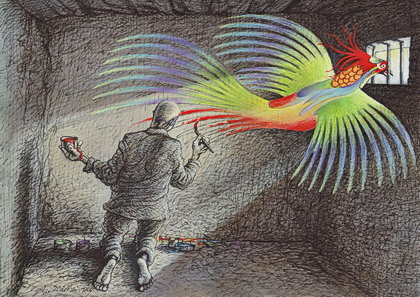
Graphics of Mikhail Zlatkovsky / Zlatkovsky / ru