
Translated material
Cave innovators
In the Kremlin
 Cave innovators
October 30, 2009 Mikhail Delyagin
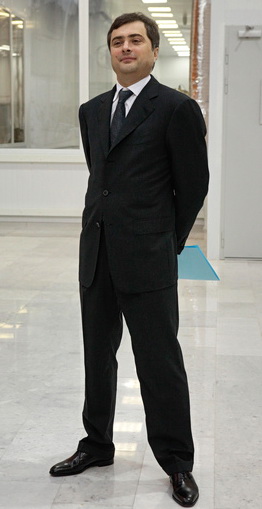 In the magazine “Results” (thanks to which many learned that he was still successfully coming out that the good news has already been released), a program interview with the deputy head of the presidential administration V. Surkov, who was modestly recommended by a “practical ideologist”, was published. It is clear that it precedes the message of President Medvedev and is aimed at preparing public opinion for a more complete, more intelligible perception of this message.
As a person who participated in writing more than a dozen such interviews of various kinds of managers, I can say: his real meaning is to outline the main directions for the writing public, which should be paid attention to and which should be commented, as well as the main theses that should be reproduced in their comments, naturally, “creatively rethinking” them, that is, setting out slightly in other words. “Correct” comments will be supported, and giving them can count on certain benefits; The “wrong” will be perceived as Front and “jam” the media.
These are the rules of the game.
In fact, Surkov’s interview is an instructive letter, the genre is quite rational and familiar since the propaganda of the CPSU Central Committee.
And it would seem that it simply, by its very genre, has nothing to do with normal people who do not crave crumbs from all kinds of lamb tables and are not ready to wrap their tails and, according to the elegant expression of the president, “lick”.
However, any propaganda contains some substantive provisions that indicate the actual state of mind and intelligence of the control system and therefore are of national significance.
These substantive sides of Surkov’s interviews really deserve attention.
Conventional modernization
First of all, even in the journalistic Preambul, the article says that President Medvedev "outlined the strategic goal of all ... transformations ... This goal is a comprehensive modernization of the country." But modernization as such cannot be a goal: like democracy, this is not a goal, but just a tool. A simple question - for what is the modernization for? - Not even mentioned by official propagandists. But its goals can be diametrically opposite: for example, ensuring the defense capability - or the well -being of citizens. In one case, “guns instead of oil”, in the other - strictly the opposite. Both will be modernization. And the solution of all problems is immediately impossible: first you need to focus on one thing.
And the fact that Surkov honestly responds to the interviewer that “the word“ modernization ”is a sufficiently conditional term,” completely reveals the attitude of our leadership to this “strategic goal”: it is a trick and propaganda tinsel, and not a goal. “Update” and “modernization” on their own, like slogans that do not reveal the essence of these processes, are an even greater dummy than the Gorbachev’s good wishes, which turned out to be disobedient and blood.
Think about it: it is officially said that "modernization ... there is a tightening of the economy to the modern level." But while the modernization will go, the “modern” level will be hopelessly out of starting! It will turn out, as with a well-known Superjet-100 aircraft: at the stage of ideas, this machine was quite modern, and already at the design stage is morally obsolete-the technologies have gone ahead.
The leaders of our “ruling party” do not even think that modernization is possible only as a jump into the future. The orientation to the “modern” today, that is, “yesterday” tomorrow, the level officially proclaimed by Surkov, programs the aggravation of the systemic lag of Russia, programs the new editions of the notorious “ideological superpower”.
"Serve technology!"
Speaking of technology, Surkov notes that we must understand, "where to get them." This is an amazingly primitive dependency: our authorities are not interested in creating new technologies - they want to take a ready -made one as a city child eager to tear off the already ripened roll from the bush.
But technology is not a suitcase with a bribe, they cannot be transferred from the room to the room, they can only be grown. Another experience of the USSR showed: having stolen (or, in Surkovsky, “taking”) a complex technology, you can’t apply it. For technology is not equipment, but people in unity with this equipment, and they should not only be educated and cultural enough to use it, but also organized accordingly. Human capital must correspond to production, which means that complex technologies can only be grown; If you borrow modern equipment from the neighbor, it still will have to increase “social meat” - human capital.
Toward the end of the interview, Surkov returns to this thought from the other side: “The more open and friendly we will be and the more we can get money, knowledge, technology from the advanced countries, the more sovereign and stronger our democracy will become.” In addition to the fact that Surkov, like most of the official propagandists, annoyingly makes a grammatical mistake in the term “souvenir democracy” created with their participation of the regime, which is unconditionally reflecting the essence of the regime, he pretends that he does not understand the essence of modern competition.
Friendship happens between people and even peoples, and alas, only competition is between countries - and in recent decades it has been tightened. Modern global competition resembles a boxing fight. It is clear that the “open and friendly” boxer, as the foreign policy practice of the liberal reformers of the first half of the 90s showed, will receive, including from the “advanced countries”, but by no means “money, knowledge and technologies”, and the resulting will make it neither stronger nor “sovereignty” (“souvenue”, however, will do it).
In addition, there are almost no transmission of truly modern technologies (except for the technologies for tying ties and cocktail consumption) in the modern world - for the same reason that in ancient times there was no “transmission” of gold. Indeed, today it was the technology that have become the main attribute and a tool for success in competition, which was once gold: their transfer is technically difficult, and politically almost impossible.
However, in addition to the illiteracy and traces of dependency, this passage has a clear political meaning: like Medvedev’s statement about the unacceptability of the Chinese path, it is a “systemic rebuild” from the conflicting with the West and the Putin Kina who had just made enormous concessions. It is no secret that the leaders of Russia have been behaving like participants in the exhausting electoral marathon for about a year, and a statement about the “openness” and “friendliness” of the Surkov, probably signals the West on behalf of Medvedev: we are not Putin, we are our new Gorbachevs, you must put on us!
Regardless of the degree of frankness of such signals, they are politically correct, although they are informatively obvious signs of dependency.
Who will order innovation?
No less striking dependency shines in the formula "Society is not yet a customer of innovation." And the point is not that some “wrong people” constantly come across the reformers (and now the “innovators”). The fact is that society is never a “customer” of significant innovations. Society did not order the plane to the Wright brothers, the tank of Churchill and even an electric light bulb - neither Lodygin, nor Edison, nor even Ilyich. Innovation is the emergence of a fundamentally new thing that did not exist before, and society cannot be its “customer” and “present demand” for it for the simplest reason: it cannot imagine it.
Further, Surkov, almost completely quoting the Gorbachev “Conversion of the military -industrial complex”, suggests that the modernization should be “starting with what the consumer needs”. Not understanding that the consumer did not need Skype, the Internet and the steam locomotive.
Not understanding that the task of state development policy is not to satisfy the existing needs (even the most imperfect market copes with this), but to promote the creation of new needs or, at worst, to create them directly!
And it is impossible to create a “non -combatant frying pan” without a fundamental science beloved by Gorbachev, because it is the fundamental discoveries that are based on new applied technological solutions. This is the alphabet, and our leadership does not “understand” this, not because he does not know something, but because he does not want to know.
Talking about modernization is much easier and more pleasant than trying to do something on this path.
In addition to the people, our bureaucrats were unlucky with business. Surkov complains: "The domestic business is still not focused on the understanding that the main competitive advantage is unique knowledge or technology." The question involuntarily arises why Surkov does not explain why our business is so stupid.
And he does not explain this for a childish reason: our business is not stupid, but very smart. And he knows very well that in Putin’s (including Surkovskaya) Russia “the main competitive advantage” is not “knowledge or technology”, but the ability to correctly give the right bribe and, secondly, “drive Tajiks”, which “will do everything”. Technologies of the XVIII century - because with almost free, in fact, all other technologies are unacceptably costly and, accordingly, relatively ineffective.
Kremlin "ambitions"
As an example of “ambitious projects”, surkov gives an example of increasing the availability of broadband Internet. This is the understanding of “ambitiousness”. It is good, of course, that the task is not to increase the average -Russian “rollback norm” from, for example, 30 to, for example, 50%. However, when “ambitiousness” is understood not to solve a large -scale problem of society, not a technological breakthrough, but only a petty technical improvement, which is already perfectly going on without any state and without any modernization commission, you understand: this is not a modernization, but another illustration of the anecdote “So we’ll touch the mice”. As mentioned in relation to the ten -year -old Gref strategic program (2000 model), “the mountain gave birth to a mouse; Well, at least not a cockroach. ”
For such “ambitious” projects, Surkov considers it necessary to “grow primarily scientists, inventors and specialists.” Before cutting the wirs in the style of “we raised the surkov on loyalty to the people, inspired us to work and on exploits”, we think: why do these “scientists and specialists” do not grow themselves? After all, this is precisely the sphere where the liberal approaches are justified: the state creates a normal education system, sets priorities, and experts are already growing themselves.
And the whole point is that the state (“we” in the terminology of Surkov) today should grow not “scientists, inventors and specialists”, but officials who can at least not exterminate them. For there is no innovation not because someone inattentively read Medvedev’s speech, but because the whole “vertical power vertical” is focused on the human and cabinet painstakingly, in our country, as far as possible, theft of money-and thereby the extermination of innovators. It got to the point that in the budget sphere the concept of “research” is often perceived as a synonym for the terms “cut” and “washing”: because practice is a criterion of truth.
"Yes, death!"
Surkov absolutely rightly says that the issue of innovation and in general about modernization "for Russia is a matter of life and death." And then it gives an example from which it follows that the party that is ruling - of course, is not in their own words, but with his own affairs - definitely made this choice in favor of Russia's death. Because if Putin “a few years ago spoke about the need to overcome technological backwardness,” and during these “several years” the first steps to create development institutions were taken by the “several years” - it is clear that this “overcoming backwardness” is actually no one in the ruling party and no one actually excites anyone there.
It would be necessary-at least they tried to do something.
The formula "non -violent modernization" is beautiful. Let me remind you that the main preacher of the idea of “non -resistance to evil by violence” personally plowed the earth with an antediluvian plow and was anyone, but not “innovator” in the Surkov’s understanding of the word. And this contradiction is not by chance, because any new technology takes away bread from those who use the old technology. And if you defend yourself from their righteous anger with “non -violent” methods, there will be neither new technologies nor yourself.
And besides, the state is obliged to use violence to protect its citizens. Including innovators. Roughly speaking, if you plant for corruption, this is direct violence. And if you do not plant - there will be no modernization, including "non -violent".
And violence against the enemies of the company - in this case, corrupt officials - by the way, today will be the highest act of humanism. For if they are not planted today, in five years, or even before they will simply be torn to pieces. As one police chief said, looking at the personal business of the next innocently killed reformer: “Some people can save their lives only by putting them in prison in time.”
But back to our ... of course, not to the rams - innovators.
Surkov speaks of the need to "modernize, relying on democratic institutions." The possibility of such modernization in modern Russia is the theme of a separate discussion, as well as the possibility of patients with patients of the detector of the head physician of the institution. However, if the “democratic institution” of the Surkov and others understand “United Russia”, then we are really not about the unpleasant authoritarian modernization for them: we are talking about the modernization of totalitarian. But it is impossible for sure, already without any discussion.
Frightening political instability, surkov, probably imperceptibly for himself, draws a vivid picture of the result of the activity of modern ruling parties, inertia to transfer it to the future: “There will be a lot of demagogy, a lot of chatter, a lot of lobbying and pulling Russia in pieces, but there will be no development.” That is, roughly speaking, everything will be like now-and that means that there is no need to be afraid of "some kind of political instability." In principle, Limonov and Kasyanov, having read this phrase, should bite the elbows: you can’t describe the results of the current leadership (including Surkov himself) brighter and more.
Unpromising Russia
It is amazing that throughout the interviews of the Surkov demonstrates the fundamental and consistent misunderstanding of what is the modernization that he advertises. It is enough to indicate that he is afraid to answer the natural question of the journalist about the problem of dying enterprises in the conditions of modernization. Surkov essentially evades the answer to this question, although this answer is elementary: the salvation of non -competitive production is a tactical measure that provides social stability necessary for the strategic course for modernization. Roughly speaking, outdated enterprises should not be closed, but converted into modern ones. Russia needs an auto industry, but not half a century ago, and to create this automobile industry, people in Togliatti should not die of hunger.
Surkov, however, says an enchanting thing in the style of Yasin, Fadeev or Chadaev (this is really the absence of one letter no less than one gene): “We must make people from hopeless industries go into more promising ones.”
As a conductor and statesman to the brain of bones, I cannot but pay attention that the state is not needed for this process. Of the unpromising sectors to promising people, they are quite successfully transferred, without any help: the irresistible growth of the number of officials, guards, fraudsters and the number of employees of various kinds of public companies are a living and visual evidence.
The state receives taxes and patience of the people for completely different: it is obliged to create new promising industries, including the transformation (or, if you like, modernization) of old and unpromising. This is a completely different task, and the innovator, forgetting about it, makes the impression of not understanding what he, in fact, dreams of.
Surkov’s attitude to the Soviet inheritance is amazing: “The main thing is to prevent this inheritance to destroy us.” That is, for him, the Soviet inheritance is not a resource of development, not a margin of strength (even if it is exhausted), but a danger. A children's question arises: how is the “practitioner ideologist” of the Presidential Administration differ from Novodvorskaya and Podrabinka?
At the end of the interview, saying that “our business ... still lives ... redistributing and exploitation of the property that is not created”, Surkov quite rightly indicates: “And this is not his fault. This is the specifics of the historical moment. ”
True, he certainly does not call the specific names of people working on this “specifics of the historical moment”.
And he also does correctly: the Russian people know these surnames well without their help - and will not forget them until the complete and final solution of all the problems born by their efforts.
Author - Director of the Institute of Problems of Globalization, Doctor of Economics
Photos of RIA Novosti