
Translated material
Exiting
On May 20, 1969, the phrase "Initiative Group for the Protection of Human Rights in the USSR" appeared in Moscow. Thus, a letter addressed to the Human Rights Commission of the United Nations was signed. The details of this plot are still interesting and instructive today, but I will not touch them, as well as the next one and a half decade of a glorious and heroic history. Let the participants in those events say, "initiators of the first rank." Date is just a coincidence.
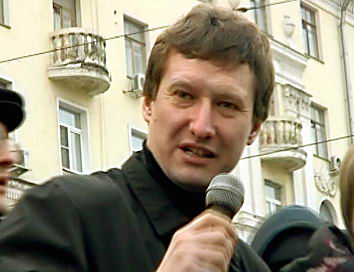
Five years later, on May 20, 1974, Stanislav Markelov was born in Moscow. The legal student with the Hippov Hero year in 1993 came into contact with the very "human rights". His personal story began - “Left” among human rights activists, human rights activist from among lawyers and a lawyer for “left”. About this man who connected various, seemingly not mixing layers of social life, about these one and a half tens of years “on the front line”, a lot has already been said and written about life on the rise. Much more will be told by his friends, because his life has already become a story: on January 19, 2009, in the center of Moscow, Stas was killed in the head.
I want to touch the intersection of these two stories.
A few years ago, one of the "memorial" colleagues turned to me for help in a difficult criminal case. A letter came from places not so distant from Moscow. The writer was unfairly condemned, but this condemnation was formed "purely". The case is not political, just local corruption and arbitrariness ...
However, in Soviet times, there were many such cases.
For example, Andrei Amalric, a person, who seemed to be invented by the word "dissident", not among the "initiators", but did not escape the hit in the Magadan camp - set out a lot of stories of his salesers in his memoirs. Amalric, by the way, remained in the camp the "human rights activist": he wrote a statement and complaints for the colaigers for a revision of cases.
In fact, such statements are no less “human rights” than the statement of the initiative group of May 20, 1969. Only a statement with a capital letter could be attributed to "social activity", "journalism" or "journalism" (in the future this genre was not translated). And the statements in the instance were rather to lawyer practice. Two genres, two forms of "human rights" work. A lot of time has passed since then.
The post -Soviet human rights defenders were professional. Journalists who specialized in the subject of human rights appeared. Let us recall Galina Kovalskaya or Anna Politkovskaya - it seems, journalists, but "ours". And some of the "human rights defenders" himself began to write tolerable quality texts on the same topics.
However, the "chronicle of current events" and in today's times can be considered high -quality journalism ...
In recent years, "right -human" lawyers appeared, one of whom was Markelov. And some human rights activists themselves have mastered the appropriate language and practice, specializing in the subject: war, refugees, prison, Strasbourg ... However, in the "classical" time there were dissident lawyers - Sofya Kallistratova or Dina Kaminskaya ...
For some time, “human rights officials” appeared-deputies, their assistants, experts who prepared and promoted laws who were lobbying for human rights at the state level. There were no such people in Soviet times, and now, it seems, transferred: the "ecological niche" has become collapsed ...
... So, a colleague addresses me with a letter from the "Sidel". At the same time, a colleague addressed the lawyer Stanislav Markelov, and he did not refuse help, went into business as a defender.
And I see: according to the law, I can’t help. The same conclusion was made by my other colleague, already from among the "initiators". But after all, there are experts in our human rights community - I send to the "adjacent people" who competently protect the victims of arbitrariness. They also see: there are practically no prospects for revising the case in court. But to support the defender undertook, as they say, "by the final result." "The final result" of the appeal of the sentence was predictable - as the skeptics said ...
But lawyer Stanislav Markelov did not limit himself to his lawyer function. He organized a press conference in this case. There were some publications. And after some time, the "Sidel" was ahead of schedule. And there is every reason to see a causal relationship here ... Here, in fact, is the whole story.
"Professional" human rights activists considered the case to be hopeless. A lawyer who understands the limits of the profession went beyond her framework-and achieved something.
But those who forty years ago were called the "initiative group" also went beyond, forming for some decades the first independent public association. The transition from appeals and statements (who is reading them now? Once, in the ringing silence-yes! But when the "white noise" goes off scale ...) also expanded the borders. Yes, now, forty years after the “letter to the UN”, Russian independent communities are again limited. These boundaries narrow. But after all, those frames that people come up with themselves are no less limited.
We say and write everything. And this is important - while people say, weapons are silent. It is very important to speak and write competently and interestingly. But it is even more important that these words break out of the circle where they are said and written.
"If you are given a linked paper - write across."
The author is a member of the board of society "Memorial"