
Translated material
Three myths about conspiracy
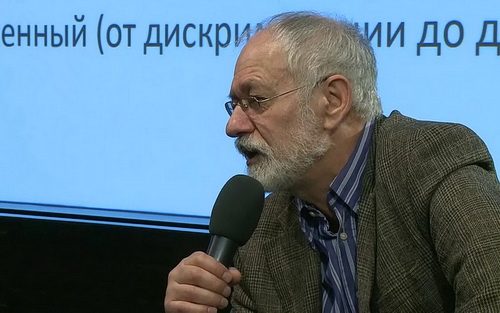
Review of the book of Victor Schnirelman
Viktor Schnirelman is an anthropologist who has been involved in anti -Semitism in Russia for 25 years. His last book, published at Academia, “Three Myths of the Conspiracy. Anti-Semitic propaganda in modern Russia ”, composed of articles printed from the beginning of the 2000s to recently in various publications, mainly academic.
The author notes that the beginning of the 21st century in Russia is characterized by an unprecedented surge in xenophobia. Anti -Semitism in these sentiments is clearly inferior to hatred of labor migrants (as sociologists note), however, it has a much more developed ideological basis, based on a number of mythological constructions, many of which have developed for centuries. The book analyzes three popular Xenophobic myths in detail. The first, the myth of the Antichrist, tells about the “last times” and is directly related to the early Christian apocalyptic, which, according to Schnirelman, played a significant role in the formation of medieval anti -Semitism.
The myth of the Antichrist
Viktor Schnirelman specifically emphasizes that in this case he is interested not so much the official position of the Church (usually contradictory), namely the form in which theological versions of history reach society and what feelings give rise to. After all, it happens that the views, considered the highest clergy marginal, become unusually popular and on their soil social activity develops up to mass protests, vandalism, etc.
The first holistic doctrine of Antichrist, the researcher notes, was formulated by Irinei Lyon (135-202). The ideas that Antichrist was a Jew from the tribe of Danov and that he will become the king, whom the Jews recognize his Messiah, ascends to him. At the same time, the Jewish Messiah from early Christianity was perceived as a false prophet, which will come in order to turn people away from Christ and subordinate to his evil will.
Over the centuries, individual subjects received a new interpretation, but faith in the inextricable connection of the Antichrist with the “knee Danov” survived to this day and was perceived by Russian Orthodoxy. In certain church circles, Jews are now not perceived otherwise than agents of destruction.
Eskhatological moods always intensify during periods of social disasters: this was the case at the beginning of the twentieth century, when the idea of the fatal role of the Jews before the “death of the world” was extremely distributed and S. Nilus prophesied the close end of the world. So it was throughout the 1990s, when the theme of the Apocalypse was replicated by mass literature. The author emphasizes that the book of S. Nilus “Near is, at the door”, containing the “Protocols of the Zion sages”, then reached 150 thousand copies in the top ten publishers.
Schnirelman analyzes in sufficient detail the content of the national-patriotic media outlets that gave tribute to the theory of the “world conspiracy” and the outstanding role of Russia, designed to stop this conspiracy (“Tsar-Cell”, “Zemstvo”, “Russian Bulletin”, “Day”). He dwells on the works of modern authors (O. Platonov, M. Nazarov) and, especially, compilers of the collections of “apocalyptic prophecies” (A. Strizhev, S. Fomin, and Ilyinskaya), who are reprising by newcomers insinuations.
All this “war of words” was called, in his opinion, to rally a society around a single idea and uniform values, and on the other, to create a demonic image of an external enemy, the struggle with which requires solidarity and social mobilization. The “War of Words” partly resulted in a war of real actions: organizations such as the Eurasian Youth Union, “Holy Rus'”, “God's will”, formed squads to protect faith from “blasphemers” and attacked museums more than once, burst into “objectionable” performances and exhibitions. Meanwhile, fundamentalist propaganda does not capture the wide segments of the population and remains for the most part marginal. Judging by sociological surveys, the researcher notes, the majority of the population does not perceive it.
Aryan myth
The Aryan myth, which has become one of the most popular ideologies over the past 10-15 years, according to Schnirelman, was based on two fakes-the “Vleshovaya Book” and “Protocols of the Zion sages”.
“Protocols”, who played an important role in the Jewish pogroms of the Civil War, were fabricated at the end of the 19th century in the bowels of the tsarist security officers, and after the revolution, exported by Russian emigrants, were widespread in Europe.
Vlesova Book, containing the “Slavic-Aryan wisdom”, was also born in the circles of Russian emigration in the early 1950s and narrated about the valiant and righteous Slavs-nomads who grazed their herds from the Mongol steppes to the Carpathian mountains.
A significant contribution to the creation of an Aryan myth, notes Schnirelman, made Alfred Rosenberg. The Nazi Aryan myth was built on the opposition “we” - “they” and painted an exclusively two -color picture of the world. “We”, the Nordic race, the creators of the most ancient civilizations, seduced by social equality, which inevitably leads to racial mixing, eventually came to decline. Not the last role in the decline of the “Aryan civilizations” played, according to Rosenberg, “they” - “harmful elements” in the person of the “Asians” and “Semites”.
In the Russian version, the Aryans are not the ancestors of the Germans, but the Slavs. Moreover, the Aryans are identified with Rus and Slavs, while the Rus is often drawn by the progenitors of the entire “white race”. All Russian radicals consider Semites a different race that is different from the "white". There are also completely exotic versions: some, for example, present them to the result of an experiment conducted by Egyptian priests - supposedly an artificial population, devoid of positive moral qualities. Others show the "younger brothers" of the Rusichs who have lost their way. At the same time, all of them do not cease to prove that the Slavic culture was much ancient and richer than Jewish. Allegedly, the Jews borrowed all their knowledge from the “Rus-Aryans” and Judaism was formed on the basis of the Aryan inheritance-an ancient Vedic religion. Others, however, accuse the Jews of creating and spreading "murmur of" murmur of ideology " - Christianity. At the same time, the idea of “Aryan Christianity”, trying to clear Christianity from the “Semitic heritage”, is certainly popular.
After the collapse of the USSR, when the borders of Russia sharply moved to the north, the “Nordic idea” gained particular relevance. In addition, the localization of the ancestral home of mankind (or a significant part of it) in Russia gives the special prestige, making it a sacred place from where humanity leads.
Today, the “Aryan myth” is directly related to identity, Schnirelman concludes, offering people the image of prestigious ancestors, often constructed according to racial canons. Such a context opens the scope for racist discourse with its division into “higher” and “lower” races, a hierarchy of peoples and “incompatibility of mentality”. The “Aryan inheritance” here plays the role of symbolic capital, designed to strengthen the position of each side.
Khazar myth
The third myth, the so -called Khazar, is associated with the phenomenon of updating history, when the events of the past, sometimes very exotic, gain political relevance. Here, Schnirelman, as in other cases, intentionally goes beyond traditional historiography and attracts the most extensive material, including popular literature and political pamphlets, when the motivation for choosing a particular interpretation of the past is associated with the incoming factors lying outside the field of “pure science”.
In pre-revolutionary Russia, the general tone for the attitude towards Khazaria was set by the orientalist V. Grigoryev, who, in his notes of 1834-1835. He presented it as an oasis of civilization in a sea of unbridled wildness of the VIII century. However, Schnirelman emphasizes, the “Khazar question” did not really fascinate historians of the 19th century - it seemed much more important to them to resist Normanism, and therefore some even attributed the creation of the state in Rus' not to the Varangians, but to the Khazars. Of the major historians, only Klyuchevsky, as Schnirelman writes, paid some attention to this topic. He adhered to the point of view that the Khazars, having created an extensive and powerful state, erected a serious barrier to the migrations of warlike steppe nomads and thereby provided the Eastern Slavs for a long -term peaceful respite.
The situation changed at the beginning of the twentieth century, when, on the one hand, a burial attributed to the Khazars was discovered at the village of Verkhnyaya Saltovo Kharkov province, and on the other hand, there were a lot of historians who sought arguments in favor of the independent formation of Russian statehood. Then, with the filing of an amateur historian General A. Nechvolodov, Schnirelman notes, anti-Semitic motifs were first weaved into the Khazar problems. Nekvolodov describes the origin of the Khazar so: one of the steppe peoples of the early Middle Ages were warlike Turks Avars. Over time, the “merchants-guards” who seized power, turned the accident into Khazaria and, having secured the support of Byzantium, imposed the Slavs of the Slavs by tribute on their Wednesday. The author made it clear that Khazar domination for a long time delayed the development of Rus' and only the destruction of Khazaria allowed her to strengthen.
Since then, other Russian anti -Semites have repeatedly turned to the image of Khazaria, arbitrarily changing concepts depending on their goals. One thing remained unchanged: the “Khazar episode” testified to the harmfulness of the Jews, their aggressive aspirations and the destructive consequences of their reign. It was in this discourse of Khazaria and Khazars that they turned into euphemisms, allowing to give a new perspective “Jewish theme” and include supposedly convincing historical parallels.
In the Soviet period, the attitude to Khazaria changed depending on ideological attitudes. During the campaign of the struggle against cosmopolitanism, when the Jews were depicted miserable and rootless, Khazaria also acted weak and worthless. When one of the main enemies of Soviet power became “international Zionism”, Khazaria began to portray a powerful expansionist empire, which was not easy for the Russians to defeat. The first approach, notes Schnirelman, was characteristic of the works of academician Boris Rybakov, the second was reflected in the concept of Leo Gumilyov.
If in Soviet science a fracture in relation to the Khazars occurred in the late 40s-early 50s, when they smashed the "rootless cosmopolitans", then the literature, according to Schnirelman, was growing up only 15 years later, when the "six-day war" began. The formation of the “anti -Hazar tradition” went gradually, and Schnirelman analyzes a whole layer of literature on the topic, in the terms of Gumilyov, the “Himeric ethnic group”, seizing power in a foreign state and brutally exploiting the local population (including the works of V.D. Ivanov, A.V. Kostin, V.V. Amelchenko, articles by V.V. Kozhinov, etc. later, authors). Moreover, even the “invention” of Christianity and its introduction in Rus' are often interpreted by the National Radines as a “Jewish path” to world domination.
In the last two decades, the search for the “New Khazaria” has been conducted, Schnirelman notes, and there is nothing surprising in the fact that they bring to Ukraine, where the “Nightmare Project” supposedly received their embodiment (before that, if we take the modern period, the “descendants of the Khazars” were accused of separatist moods in Chechnya). After the Maidan, the reasoning about Ukraine-Khazaria appeared on the whole of monarchical and neopagan sites, the oligarch I. Kolomoisky began to attribute the concepts to be relocated to Ukraine in case of danger of the population of Israel, for which, in fact, the Zionists staged a revolution in Kyiv, where the Kaganat was now established.
This version was readily picked up by Russian fundamentalists, in particular the head of the Union of Orthodox Borensers L. Simonovich-Nikshich. It is noteworthy that among the conspirators he includes the Jewish magazine "Lehaim", philanthropists from "Dog" and British intelligence Mi-6. However, Schnirelman emphasizes, starting in the fall of 2015, the interest of bloggers in the theme of “New Khazaria” in Ukraine has almost completely cooled out, which, in his opinion, allows us to make an assumption about a well-organized and paid campaign in the interests of some influential forces.
All three myths that were analyzed in detail in the book, smoothly flow one into another, and the coden words and metaphors associated with them (for example, “Khazars” instead of “Jews”, since the insult by national attribute is fraught with attracting to court under Article 282) invariably revive the main xenophobic ideologists in the memory of interested persons. It is only a pity that until today the researcher traced the existence of only the Khazar myth, however, the author’s separate book is devoted to the myth of the Antichrist - “The knee of Danovo. Eskhatology and anti -Semitism in modern Russia, ” - published last year.
The movement associated with faith in the “world conspiracy” and “end of history” concludes, the researcher concludes, could not give rise to authoritative leaders in Russia who could lead a really mass rise. In addition, the government holds back the development of anti -Semitism, but does not interfere with anti -Semitic propaganda. This suggests that Schnirelman believes that the regime needs the “enemy’s image” in the person of the Jews, but leaves him in a frozen state until there is an acute need.
Shnirelman V. A. Three myths about the conspiracy: anti -Semitic propaganda in modern Russia. - M.: Moscow Bureau of Human Rights, Academia, 2017. - 390 p. ISBN 5-84389-169