
Translated material
Still, the work is going on
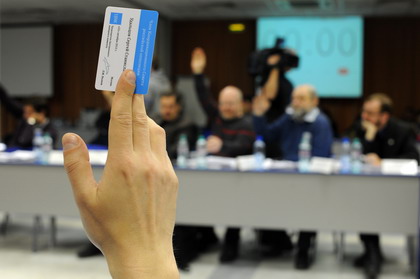
In less than six months, even some of its members at the meeting spoke of the inefficiency of the coordination council of the opposition. Nevertheless, they managed, albeit in a very incomplete composition, to make decisions that allow us to say that the COP still has any prospects. Several members of the Coordinating Council at the request of the "Daily Journal" shared their impressions of the meeting on January 20.
Harry Kasparov :
Those who expected the Constitutional Court, consisting of such heterogeneous parts, will begin to act synchronously and harmoniously, nevertheless overestimated our capabilities. Such things do not happen with lightning speed. But, in my opinion, normal constructive work is gradually being established. Of course, there is a rather sharp ideological antagonism between many members of the CS, but the inner desire to establish work and begin to intensify. This, it seems to me, is a very positive moment. It can be seen, of course, that people with political experience have much more effectively joined this work. The “group of citizens”, with such a pathos, declared itself before the elections, was absent in almost the full composition yesterday (from the representatives of the “group of citizens” at the meeting on January 20, Mikhail Gelfand and Vladimir Mirzoev were present - “Hedgehog”). Probably, there were good reasons for this, and, nevertheless, the talk that those who previously participated in political life have exhausted their capabilities are completely unreasonable.
We are reproached with excessive attention to the details, to the regulations, but in order for such a complex, extensive structure to work, all this is necessary. Yesterday an important stage was passed, working groups were formed. Essentially, this will be a test for the operability of the KS - the created working groups will have to take on organizational work in key areas. In addition, yesterday we once again made an attempt to complete the acceptance of a software statement about the goals and objectives of the KS, but, unfortunately, there was not enough time for this. I think that now this issue will already be resolved within the framework of the created working group for the adoption of software documents.
The question of the “rule of 23” was raised: in the coordination council there is a tough rule on making decisions by a majority of the list of the list, which, of course, makes it difficult to work at full-time meetings. Alas, those who initiated the issue of reducing this bar failed to get the required number of votes-the same 23 votes-to cancel this situation. Thus, there is a situation in which, on the one hand, you have to negotiate, and this is a positive moment, and on the other hand, the possibility of non -participation for many is the best form of torpedoing documents and proposals.
Of course, there is an opportunity to resolve issues using electronic voting on Democracy-2, although, in my opinion, it is necessary to use confrontations as fully as possible, since they are broadcast. The KS lives an open life, and we must use this resource of openness to the maximum. Important decisions are best taken during a lively discussion, and this requires quorum. Therefore, Sergei Davidis raised the question of reducing the bar on behalf of our group. The argument of our opponents was that you still need to have a high bar so that the KS decisions are made by a qualified majority so that many different people agree. This is a reasonable argument, but it is good at the initial stage, when they are still looking at each other. When the clear positions have already been formed, it must be understood that there may be political disagreements, there are those who are more determined, there are those who are more careful, and this is a given that cannot be changed by regulatory tricks.
Nevertheless, with all visible deficiencies in the process and ardent criticism, we still move forward. The COP has practically formed as an organization that is able to solve any problems. Whether it will be able to solve-this is already the following question, but to demand from the COP to do something great on the first day, it seems to me that it was completely wrong, but yesterday, in my opinion, it became obvious that the left, and the liberals, and nationalists, and people who did not have clear political affiliation try to find points of contact. The discussion takes place in a good form. Obviously, the topic of repression, the topic related to political prisoners, applies to all members of the Constitutional Court, regardless of their political views. This is an important unifying factor, the formation of a united front of the fight against the regime, which is becoming more aggressive and tough, so I look into the future of the Constitutional Court with careful optimism.
An important issue that will be resolved by the working group in international affairs in which I enter will be associated with further steps to promote the Magnitsky List: both its specific filling in the United States and an attempt to promote the corresponding bill in Europe.
The key question for the Constitutional Court is work in the regions and the creation of existing mechanisms of electronic democracy. It is necessary to extend the experience of the KS to the regions, creating alternatively acting local structures that could deal with local problems. The base of electronic democracy should help in this, because it should serve as a way of uniting our supporters. Still, there are many of us, the elections showed that tens of thousands of people are ready to participate in this. I hope that in the future it will be possible to unite not dozens, but hundreds of thousands of people.
Naturally, for many members of the Constitutional Court, the main problem is associated with very specific threats that come from existing power. Ten members of the Constitutional Court are under criminal prosecution. Two of them are in prison, two - in forced emigration, Navalny and Udaltsov under the subscription about the lower room. There is a bad foreboding that this amount will only increase. No matter how much the Constitutional Court is rinse, just as our supporters (many bitterly say that the Constitutional Court does not fulfill their destiny), so the Kremlin propagandists, the Kremlin repression machine is clearly aimed at the destruction of the Constitutional Court and the grass of its members, with the use of articles of the criminal code. On the one hand, this is the recognition that the CS is very important, on the other, it is a colossal test.
Sergey Davidis :
On the one hand, there was an important positive advancement along the path to constructive work on specific issues - the approval of the composition of the working bodies in which the substantive work should be carried out. This is great progress. On the other hand, there was no essential part of the coordination council, for some reason, mainly literally coinciding with the list of the conditional faction of the “group of citizens”-either it was a protest in connection with the chairmanship of Vladimir Thor, or the accidental coincidence associated with great employment, I do not begin to judge. But the fact that there were relatively few people - 30 people - once again demonstrated the importance of modifying the rules of the regulation, which would allow us to work more efficiently. The proposal, in particular, was made to me, to reduce the number of votes necessary for making a decision, to half, not from the list, that is, the full number of members of the Constitutional Court, but from the number of those present, if there are two -thirds or more. Thus, a certain protection against a spontaneous solution and the need to search for a wide compromise is maintained, but along with this, any activity of the Constitutional Court is not held hostage by those who not only do not walk, but also do not connect remotely. Now it is likely that the failure to appear a large number of people will simply block work, make it impossible, as it was at the end of the last meeting. But, fearing that the vote is less than half of the list of composition, then it will allow you to reconsider the decisions that the authority of the decisions will be less high, the colleagues rejected this proposal - we did not have five votes to adopt it. I think you still have to return to this issue, since many were absent. The question of replacing members of the Constitutional Court did not pass. Now, a member of the Coordinating Council from the Left Curia, Ekaterina Aitova, has announced the withdrawal from the composition for personal reasons, and seems quite natural and reasonable in such a situation to replace it with the next in the number of votes scored by the candidate from the left curia and in similar cases to do in other Kuria. But there was not enough votes to accept this offer. Despite the fact that the majority of those present unequivocally supported the proposals both on the first and second question, they did not pass. Thus, failure to appear for a meeting is not just a non -appeal, but an unambiguous vote against any proposals.
Another important point that would, I think, allowed the transition to constructive specific activity, could be the adoption of the KS in the final form of the political declaration, which formulates its goals and objectives. This long -suffering document is already considered within three meetings, more than 50 amendments have been made, there is a large and serious process, although, in my opinion, now in the essence of the text there is an understanding and consent of the vast majority of the Constitutional Court, there are only purely editing corrections. Sometimes the struggle goes for commas and the order of words, someone gives them significant significance, but it seems to me that this is not so important. At the meeting, the technical reason did not allow us to accept the document: the secretariat, distributing the texts of the amendments to us, did not prepare the text of the document itself. For this strange reason, the consideration and this time did not take place. I hope that by the next time everything will be studied in absentia, and we will quickly accept this document.
It was decided to hold a protest rally under the working name “march against executioners”. We are talking about those people who are responsible for torture, the fabrication of criminal cases, unlawful sentences against political prisoners, primarily prisoners on May 6, since in the spring, obviously, the court will begin. Our opportunities to help them are not so great, and street events are one of such opportunities. The corresponding working group was instructed to prepare this in more detail and in detail. It was decided on January 26 to express our position in connection with the death of Alexander Dolmatov and support to Sergei Krivov to the starving for more than a month. In the near future, a special working group should offer a specific form of action.
Documents were adopted on solidarity with political prisoners. A decision was made to collect signatures in support of a member of the KS Daniil Konstantinov. He also begins in the spring, he is ridiculously, obviously for political reasons, he is accused of murder, his situation in some sense is the hardest, he is the most difficult accusation, of all the maximum term threatened by him. We also support Maxim Kalinichenko, the St. Petersburg political prisoner, who was directly accused of inciting violence against police and has been in jail in connection with protests, he also has a court soon begins.
In principle, despite the low turnout, it seems that the Constitutional Court nevertheless goes to the trajectory of substantive work. It may not be so clearly visible outside, but now there are almost all conditions for it to finally earn effectively and justify the expectations that are assigned to it. I think that by the next meeting according to the results of the first work of working groups, this will be noticeable.
Without doubt, all problems, including a low turnout, are due to the fact that the coordination council is only 45 volunteers (now 44), which quite accidentally got into this body, since voters, as it seems to me, did not have the opportunity to evaluate and analyze their activities or at least often did not take advantage of this opportunity. These are busy people, they have a lot of their own affairs, someone in the field of literature, journalism or something else has reached great heights and is forced to spend a lot of effort on it. Everyone has their own classes, no one is a professional member of the CS. This unequivocally determines that it is almost impossible for the forces of members of the Constitutional Court to realize all those tasks that are assigned to him by voters. The only way to overcome this obvious lack of resources is the openness of the KS to meet their voters, civil society, the active involvement of the broad masses of protest participants in the co-creation in the framework of the tasks of the coordinating council and the direct involvement of the specific projects of the protest movement, which once established themselves, and there are tens and hundreds of them, including hundreds, including hundreds. Former candidates for the Constitutional Court. No one, in principle, refuses such work. But the questions about the creation of the conditional forum of free Russia, that is, the site for feedback with voters, and about establishing the procedure for interaction with the formed expert advice of the opposition, which unites all comers, for example, former candidates who are ready to work for a general result, these issues have not yet been resolved, discussion due to lack of time has been postponed the next time. The main problem of the Constitutional Court is a certain closeness, isolation on itself, the unremarking to widely attract participants in the protest movement. This can dramatically affect the fate of the Council. I hope that this problem will be resolved in a positive way and the CS will acquire a full -fledged legal capacity.
Mikhail Gelfand :
It seems to me that the meeting was held in a reasonable working mode. I believe that before the activity of the CS was effective - I just had no illusions and high expectations from the very beginning: if you put forty different people with different beliefs in one room, from the Nazis to the liberals, it is strange to hope that insanely productive activity will immediately begin. A specific positive result is the formation of working groups that can begin activities in specific areas. At the last two meetings, a reasonable regulation was developed, which can be useful not only to this coordination council, but also to the one that will appear later. Partly conducted by the Council coordinated by the Council on the organization of the inclusion of activists in the election commissions.
It is important to note that the role of the Constitutional Court is precisely in the coordination of the work that occurs in the field, it is not by chance that it is called coordination, and not organizational. If no work happens, then 45 people from different cities with different pictures of the world themselves will not be able to organize anything. In this sense, often the claims of the claims do not seem to me rezone-why, they say, the CS did not make one or the other, and everyone has their own “one or the other”. However, it must be admitted that serious shortage is the lack of a site and other feedback mechanisms. The work of the site will soon be established, but now, let's say who and how will moderate the forum is a big (and sick) question.
Disputes about what a majority of votes to make decisions - from those present or from the list - seem small, technical, but, in fact, this is a rather deep dispute about whether we are really looking for consent - or, in another wording, are we limiting ourselves to the issues that there is consent - or try to make sharp decisions, regardless of what the rest think about this. I insisted that the initial regulatory norm be preserved, that is, for decisions to be made by a majority vote from the list of the list. Firstly, this forces the participants to come to an agreement. Secondly, this does not allow to deal with those issues on which there is no consent. In addition, from a purely technical point of view, the norm, which involves a quorum of 30 people and most from those present, theoretically makes it possible to make two opposite decisions.
Vladislav Naganov :
I, unlike many, have positive impressions. There was a feeling that something similar to a meeting of the European parliament happened: amendments, a discussion of the regulations. Of course, this may not be interesting to someone, but here it’s not a circus to come and have fun. This is the costs of deputy work. In the Duma, the deputies are boring-they solve crosswords, play iPads, someone simply does not come. We noticed that some members of the KS did not come either - perhaps they also became uninteresting. I think voters will appreciate this in the following elections if these members of the KS will be advanced again. In general, I would like to pay attention to the fact that all members of the Constitutional Court that were present were extremely efficient, no one slept, as they say, everyone participated in the discussion.
Working groups were formed, I have hope on them - I think that a full -fledged work will begin there. Already today, for example, work will begin in a group of software statements, in the evening there will be a meeting. Naturally, it all depends on the participants of the groups. The evening meeting was personally organized by Andrei Illarionov, who went around all the members of the group and discussed time and place. This approach is necessary. Я считаю, что в этих группах должны принимать участие не только члены КС, но и бывшие кандидаты, и эксперты. Не вижу к этому никаких препятствий.
Материал подготовлен Григорием Дурново
Photo by ITAR-TASS/ Sergey Karpov