
Translated material
Presidential filter
In the Kremlin
 Presidential filter
December 16, 2011 Alexey Makarkin
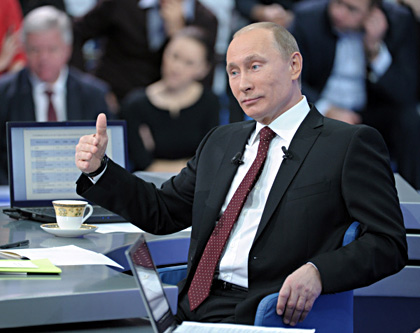
Vladimir Putin on a straight line proposed returning to the election of governors. But with three conditions - only political parties nominate candidates and the president approves, and parties should be represented in the local parliament. It seems that the authorities offers initiatives in the extreme hurry in order to bring down a wave of discontent of the middle layers that have sensed themselves in the middle class. And therefore, strange hybrids arise that are either in modern theocratic Iran (in which the “filter” functions are performed by the Council of Guardians, consisting of representatives of the highest clergy), or pre -revolutionary Russia.
The first condition-nomination of candidates from parties-could be recognized as advisable as contributing to the development of the party system, but only in the case of its liberalization, which cannot be understood as the registration of one or two new parties (for example, for the middle class). Liberalization can include at least three components. Namely: the introduction of the notification principle of registration of parties and a significant reduction in the minimum number of parties (for example, up to 10 thousand people), normal law enforcement, which excludes discrimination. During the same “direct line”, Putin spoke of the possibility of registering new parties, but specific conditions are still unknown. And the devil, as you know, lurks in detail.
The question of what only parties that have passed to the regional parliament can put forward candidates are serious doubts. In this case, the rights of the “minority” parties are violated, which should be able to offer the company their programs in the elections not only by legislative, but also by the executive branch. And in order to limit the possibility of participation of knowing outsiders, some reasonable restrictive measures can be provided. For example, not prohibitive (but quite significant - to be insulting to lose it) an electoral pledge, which returns when overcoming a certain barrier (for example, 3%). A less acceptable more democratic option with voters' signatures is less acceptable - this registration principle is discredited by the numerous sorts of graphologists that can “wrap” almost any signature sheet. The last example is the story of the Yekaterinburg candidate for deputies Leonid Volkov, withdrawn from the elections from under the graphologist, who, according to the estimates of the victim, made approximately 540 thousand pair of pair of signatures in 20 hours.
But the most controversial issue is about the "presidential filter." It seems that for Putin he is fundamental in nature - in order to prevent power in the regions in the regions of the semicriminal and separatists. As the Russian authorities use a criminal topic, we saw before the current campaign - when Evgeny Roizman, convicted three decades ago, was not allowed to participate in the elections (of course, the criminal record has long been removed). This story became the reason for the special operation to replace the leader of the “right -handed business”. In the absence of universalist traditions, this right of the president gives a lot of opportunities for such stories, only discrediting the party system.
As for crime and separatists, it is not necessary to deal with them with the help of the “presidential filter”, but through law enforcement agencies, in whose immediate duties such work includes. As well as through the development of strong independent media, which will be able to betray the attempts of criminal groups to break into power, creating conditions under which the political party will be morally impossible to put out dubious figures as candidates. Particular attention should be paid to the prevention of the existence of "sofa" parties, which are "leased" to various regional groups of influence. Therefore, with a sharp decrease in the minimum number of party members, reasonable control is needed to ensure that this rule is observed (forms of this control, excluding abuse, may be the subject of public discussion). Also in the multinational federation, the creation of regional parties that can become the basis for the growth of separatism looks inappropriate.
But, most importantly, the “protective” principle is ineffective. Let us recall the experience of pre -revolutionary Russia, whose authorities in every possible way sought to protect themselves from unpleasant surprises. During the beautiful beginning of the Aleksandrov days, the poet and Minister Derzhavin put forward the draft election of the then Russian elite senators, and the emperor received the right to approve one of every three candidates. However, Emperor Alexander I did not even decide on such a moderate project - as well as later, he also rejected the more radical initiative of Speransky in the creation of the State Duma, in which such the king was not provided for. Later, the principle of discretion of the highest power fell into the current legislation. For example, the city heads of St. Petersburg and Moscow were appointed by the emperor on the proposal of the Ministry of Internal Affairs from among the candidates elected by local thoughts.
And what? In 1912-1914, there was no mayor in Moscow-several quite respectable candidates proposed by opposition deputies were rejected at the highest level. Only with the outbreak of World War I approved the fourth of the applicant. Has this stability to Moscow brought? No, the actions of the Tsar and the Ministry of Internal Affairs contributed to the growth of alienation between the authorities and society, offended quite moderate politicians, contributing to their radicalization. So now - with the difference that not relatively small groups of intellectuals, but wide masses are involved in political activity. If the president will use his “filter”, then it may encounter a rally protest. If not, the right will turn into profanity.
Author-First Vice President of the Center for Political Technology
Photo by RIA Novosti