
Translated material
Reforms 1991-1999
In the economy
 Reforms 1991-1999
January 19, 2011 Julia Latynina
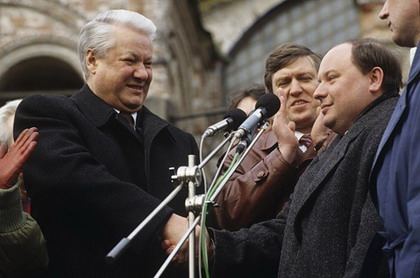
The historical role of reforms 1991-1999. You can formulate very briefly: they ended in failure and led to the power of Vladimir Putin.
Any reform, like any battle, is evaluated by results. Yeltsin and Gaidar lost the battle. Everything else is details. The commanders, they say, were wonderful, only the army disappeared. Or the guns stood on that flank.
When I say that Gaidar's reforms ended in collapse, I mean the following.
First. At the time of Gaidar came to power in Russia, there was a huge corps of “red directors”, which, it seemed, were the first to be interested in the privatization and prosperity of their enterprises. However, all the “red directors”, without exception, plundered their plants. At the same time, the reformers explained to us that the whole thing was that the “red directors” were not adapted to market conditions. The reforms were excellent, only the director’s corps got a bad.
Frankly, I myself thought so until I came to Estonia and met Fedor Berman, the former director of the Tallinn shipyard. Now the Red Director Berman, appointed to the plant a year before the collapse of the USSR, is one of the largest Baltic shipowners. He was happy to explain to me how in 1993, in order to maintain a reputation, his plant hired 10 Swedish and 10 Finnish welders to fulfill the constant contract. “After all, reputation is everything,” Berman explained.
Question: Why in Russia in 1993 the directors plundered their plants, and Berman hired Swedish welders? Is this Estonia air acted on him?
Second. Throughout the reign of Yeltsin, the people de facto voted against reforms. In 1993, he voted against them and for the Communists and the LDPR, he would choose Zyuganov President in 1996, I would not rape his television, and in 1999 the Russians voted for Putin, and if Putin were not, then for Luzhkov.
The people voted against reforms. The reformers were excellent, but the stupid people came across. Question: If the Russian people are not suitable for democracy, then why was democracy? And if the Russian people, in principle, are suitable for democracy, like any other, then maybe it was in the reformers?
Third. The reforms ended with Putin’s power. You must admit that if you want to build a market and democratic society in the country, and the case ends with Putin, then it is difficult to call this successful reform. Chili reform, with a pinch, for example, was successful. And Hugo Chavez in Chile will never win anymore.
In order to understand why Gaidar's reforms failed, we must first understand why other reforms were successful. For example, in the same Estonia.
Let us return to the question of why Director Fedor Berman in 1993 hired Swedish welders, and his Russian colleagues plundered their plants. Answer: Because in Estonia there was financial stabilization. The crown was nailed with iron nails to the brand, and then to the euro. Accordingly, it was economically beneficial for Berman and other Estonian directors to strategically develop the enterprise. For the Russian “Red Director”, in conditions of hyperinflation, it was economically profitable to steal. The director, who in 1993 in Russia thought about the implementation of contracts, was an idiot.
The second reason why Fedor Berman could think about strategy was the lack of crime. Crime in Estonia was: in 1992-1993, which was not happening in the porty Tallinn. But literally a few years later, the police earned, as in the West, and all the bandits sat down.
The same, in fact, was in China. Financial stabilization in China has always been, and, therefore, the strategy won in business. At the same time, Chinese state -owned enterprises remained state, and although they were managed badly (sometimes it’s bad), they were not plundered. It did not often occur to the directors of Chinese state enterprises to transfer a million dollars to a private company or shop. For the simple reason that they shot for it. In any case, Chinese “red directors” robbed their plants no more than passers -by robbing banks.
Here are two simple components of any reform: financial stabilization in which the one who thinks about the strategy wins, and a strong police who plant those who think not about strategy, but about tactics. In the presence of a stable currency and strong police, the most profitable business strategia is entrepreneurship. In the absence of stable currency and strong police, the most profitable business strategic is banditry.
There was neither stable currency nor strong police under Yeltsin. There was a “vacation of prices”, but it is difficult to call it reform. Prices in the USSR were released in connection with the death of the USSR everywhere, even in Turkmenistan. We do not claim that market reforms have passed in Turkmenistan.
What reform was, if there was neither financial stabilization, nor a strong police? The answer is very simple: there was democracy.
Under Yeltsin in Russia there was democracy. Neither before nor after Yeltsin was there. We can say that under Yeltsin there was democracy in Russia, but there was no state.
As a result, the country fell into the classic trap Illiberal Democracy - this concept was invented by Farid Zakaria in the 21st century, but both Aristotle and Machiavelli described the phenomenon.
Beggar voters in a poor country did not demand the freedom of business. They demanded money, and in addition in Russia there were many groups of interests generated by a non -market society and interested, tactically, in maintaining, first of all, their position. Their tactical interests with a weak, fussy state have always dominated their strategic interests. Such groups were the security forces, the Communists, and the “Red Directors”, and the largest group of all were workers of non -competitive factories. Workers did not think about the distant prospects of their own business. Their thoughts were very simple: “There is a plant, there is a family, and it doesn’t matter to me that no one buys the result of my work, give a salary here.”
The weak government was forced to swim from the requirements of all these groups, promoting the flywheel of inflation, giving endless promises and not fulfilling half of them. And democracy - that is, the obligation to listen to the opinion of voters and groups of interests - was under these conditions an additional weight on the neck of the reform. There was democracy, but there was no state, and in the absence of a state, no democracy is long.
In the history of the 20th century there are several reformers, whose good intentions do not excuse the resulting result. The two most obvious parallels are the Spanish revolution of 1931 and the Sinhai Revolution of 1911.
In both cases, in the once -powerful, but backward and devoted to the ground by bureaucracles, pro -Western well -intentioned reformers came to power. In both cases, the case ended with anarchy and massacre, which compromises the very concept of reform (“ruined the country”, “mired in corruption” - even American diplomats made these accusations against the Kuomintan), and the advent of the dictator - the extreme right Franco or the extreme left -wing Mao.
As subsequent historical events have shown, the point is not that the people of Spain are not suitable for democracy, and not that the Chinese people are not capable of modernization. And in the fact that in some historical conditions, the reform, like slavery, should be introduced with an iron hand .
Not Gomintan ruined China - this was done by three hundred years of the dominance of the Manchu. Not Manuel Asania is to blame for the backwardness of Spain - the rule of the Republicans preceded four hundred years of degradation. And not Gaidar ruined Russia, at least for the simple reason that the Bolsheviks were ruined and destroyed by Russia. In the most literal sense of the word - on the site of the Russian Empire, they organized a state called the Union of Soviet Socialist Republics and launched the peoples of Russia on raw materials for a giant military machine, which was supposed to win the whole world. The car did not win the world and therefore broke.
It was the Bolsheviks who even ruined Russia to nationally. There was no Republic of Tatarstan in Russia - there was a Kazan province. And there were no republics of Georgia and Armenia - there was a Transcaucasian region. It was the Bolsheviks in search of an ideological fiction that would allow us to find out the conquest as liberation, that the state of the USSR was invented and recorded in their constitution that each republic of this USSR has the right to self -determination up to the department. Did they think that the constitution is a fiction? Sorry, the countries in which the Constitution is a fiction do not live for a long time.
The Communists often complain that, they say, the reforms had to be carried out “according to the Chinese model” - under the leadership of the Communist Party. Well, the Communists had the full opportunity to carry out reforms on the "Chinese model", from 1917 to 1985.
The reform in China began in 1978, after the death of Mao, thirty years after the victory of the Communists in China. At this time, in China there was a poor village - a great source of the difference in economic potentials; At this time, in China there were no social guarantees to the peasants (they were replaced by a large family); The industrial sector was not so great, the generation was still alive, remembing the life to Mao, and the Communist Party of China was a powerful and charismatic force.
Nikita Khrushchev could also begin reforms in 1953, after the death of Stalin, 26 years after the start of collectivization. At this time, a poor village still existed in the USSR - a great source of labor; There were no social guarantees to collective farmers (but there was a family and the habit of working); The industrial sector was not so great, there was still a live generation that remembered life before the revolution of the NEP and the CPSU was a powerful and charismatic force.
If such reforms were carried out, then the pace of development of China would have turned pale before the pace of development of the USSR in the 1960s, and it is unlikely that the USSR would have collapsed into pieces. But Khrushchev and Brezhnev prefer rotting to the reforms, and we pay on their bills. At the same time, Russia's payment for the lack of modernization increased all the time. In conditions of a rapidly changing world, it grew exponentially. Under Khrushchev, she became large, under Gaidar - huge, under Putin - astronomical.
Not Gaidar pushed Russia into the abyss - this was done by the Communists. But he failed to keep the fall.
Not Gaidar ruined Russia. But neither Sun Yatsen, nor Chan Kayshi, nor Manuel Asanya are among the outstanding reformers, and no one argues that they "saved China from hunger" or "saved Spain from the Housing of the clericals." In the same way, neither Gaidar nor Yeltsin are among the outstanding reformers. Their goal was to create democratic and market Russia, and they did not achieve their goal.
Photo by RIA Novosti