
Translated material
Why are we not with them
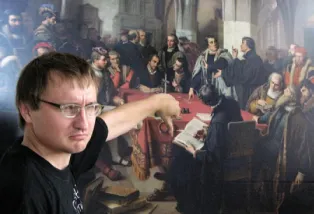
In early April, the Internet portal “Orthodoxy and Mir” published a large letter to the editorial office, entitled “Why am I not Orthodox?” ( www.pravmir.ru/pochemu-ya-ne-pravoslavnyj ). The author of this letter is Alexey Simonovich Kondrashov, a well -known specialist in evolutionary genetics, professor at the University of Michigan.
To all of us, fans of freedom of speech, of course, it is gratifying that the Orthodox publication published a letter whose author explains in detail why he is not Orthodox - and not a Christian at all. Such a publication is already a wonderful event. But the most remarkable in this letter is still its content. And although it did not go unnoticed (it was actively discussed on blogs and much more), and almost four months have passed since the day of its release, I would like to remind the readers of the Trinity Option about him and his subject. In addition, who knows, maybe you missed it, so do not pass by. The theme of this letter is by no means circumvented, but in it it is discussed in such detail and objectively as little where.
One of the reproaches (I will return to reproaches) to the author that I heard, consisted that such a letter would not convince anyone, because it is a criticism of Orthodoxy, obviously written from the position of secular (or atheistic, if pleased) humanism, and the Orthodox Christian, they say, does not think a secular humanist. This, perhaps, is, but I do not think that Professor Kondrashov believed that his letter would cause the massive appeal of readers of Pravmir to secular humanism. After all, it is entitled “why I'm not Orthodox,” and not “why the Orthodox are mistaken”, for example.
Nevertheless, this letter is not only about Professor Kondrashov’s personal attitude to Orthodoxy. It is also a detailed exposition of it ... no, not only him, but our credo. Under “us” I mean those numerous people, especially those related to science and education, who are ready to subscribe to the basic theses of this letter. In our large numbers, I have no doubt, although many of us are not engaged in the propaganda of our beliefs. But we are glad that they found someone in detail and reasonably state in Russian. (In English, something similar to one of the first, and for quite some time, did Bertrand Russell, to the name of the lecture “Why I am not a Christian”, read in 1927 and printed in the same year, and the name of the publication discussed here rises.)
The letter of Professor Kondrashov was an answer to the article by the abbot Peter Meshcherynov on the same site “Reflections on the schismatic”, the author of which tried, in particular, to figure out what the dislike of “many sincere, moral, thinking people” is connected with, ” as well as how to fight this attitude. Kondrashov, in turn, explained in detail what this dislike is connected in his (and not only him, but also our) case, and listed, under what conditions (hardly feasible) our attitude to the church could change for the better. At the same time, he cites many facts about the history of Orthodoxy and the current position of the Russian Orthodox Church, because of which it is very difficult for us with our ideas about good and evil to reconcile with this organization and its teachings, despite the fact that we share many components of this teaching with enthusiasm. It is difficult for us, for example, to reconcile with the fact that the Church still worships the saints of a number of historical figures, known for its atrocities, not at all trying to disown from these atrocities.
It is impossible to disagree with the fact that "finding something repulsive in the very image of Jesus is very difficult." And our claims to the church are caused, of course, not at all that this image is dear to her. Meshcherynov also writes about this, but he seems to be surprised by our opinion that the Russian Orthodox Church "has a very small attitude towards Christ." But there is nothing to be surprised here. An unbiased look (appropriate to the scientist) and acquaintance with history (appropriate to any person) do not leave us in this. It is difficult to live on a naked sermon, but how many of the reverend (and, moreover, today's) figures of the Church at least tried to live on it? Isn’t it as our church authorities said: “And what are you looking at the bitch in your eye of your brother, and you don’t feel logs in your eye?”
Among the workers of science and education, including biologists, there are many believers. Both these believers themselves, and those who call themselves agnostics, often argue that there are no contradictions between science and religion. But we cannot agree with this. The scientific picture of the world, at least modern, contradicts any religious picture, in particular Orthodox. Often we hear that science and religion have non -overwhelming areas of competence. But it is easy to give examples that show that this is not so, and Kondrashov in his letter analyzes several such examples. Religion requires faith in miracles and other supernatural phenomena. Science does not recognize miracles. It is difficult for a person who knows in biology to believe, for example, in an immaculate conception. You can, of course, imagine the Holy Spirit, condescending to the Virgin Mary in the form of a divine y-chromosome (without which an immaculately conceived child would hardly have grown as a boy). Other of our colleagues are ready to believe in such things, but it seems to us that such a faith does not fit a biologist. It may well not interfere with the study of any other phenomena (none of the biologists, it seems, does not deal with the problems of the genetics of Jesus Christ), but we consider the worldview of these colleagues not quite scientific.
Without faith in supernatural from any religion, including Christianity, in particular Orthodoxy, little will remain, and modern science denies the supernatural. Many people insist that the science of supernatural simply does not deal with. But science does not allow supernatural explanations of the observed phenomena precisely because all scientific data indicate that the supernatural causes of violations of physical laws, i.e. What is called miracles does not happen at all. The church supports faith in miracles by hook or by crook, and by crook very often and very willingly. “According to the experience of fake miracles, Orthodoxy will not yield to any other religion. Moreover, the gullibility of the Orthodox flock allows the deceivers not to be particularly strained. ”
The Orthodox may well see in the Russian Orthodox Church a unique, by God himself this system, the stronghold of the only true teaching, recognizing its individual representatives of certain shortcomings. But for us, this is nothing more than a religious and political organization, one of many, distinguished from among others, primarily with its size and influence on the life of Russian society, as well as its extreme conservatism. Is it worth it to be surprised that those who are far from conservative beliefs do not like it? Among the Orthodox, of course, not all conservatives, but the political position of the leadership of the Russian Orthodox Church is frankly and very conservative. The church is still firmly for much of what causes us a sharp rejection. Take, at least, the homophobia hated by us, which the leadership of the Russian Orthodox Church willingly encourages. Why will we relate to such an organization well? The contradictions between her position and ours are too fundamental so that we can close our eyes on them.
The publication of such a letter on the Orthodox site could not but cause some seething. Only on Pravmir answers appeared with a dozen, to varying degrees of critical. But in essence, it is difficult to object to this letter. What to object to a person who only explains, based on facts, and not on speculation, why does he adhere to some beliefs? Unless to bring some other facts, and to explain why your conclusions from all these facts differ from the conclusions of the opponent. However, there is no such fact that someone would not dare to declare a lot. Some of Kondrashov’s opponents undertook to argue even with the statement that modern scientists are absolutely confident in the origin of man from a monkey. (Do not believe them, dear readers: their objections only say that they are incompetent in this area. Believe Kondrashov, he is more competent.) A letter was actively discussed in the blogosphere. I got the impression that the objections of the opponents were mainly of two types: “There are no words, only emotions” and (as he called this one blogger) “And you are linked”. Emotions mainly boil down to how Kondrashov did not care that such a bad letter published, and how unhappy he is, that he does not know the happiness that his opponents know so well. And the Negroes are linked, firstly, in America (it did not slip away from the attention of vigilant readers that the letter was written by an emigrant), and secondly, “in this science of yours”. It happens that they are lying. But there are no saints in science. It may well be that Newton, for example, was not a very good person, but we, as they say, love him not only for this. Scientists do not pray to Newton. Science as a social institution does not claim that it is given to people by the Creator in order to instruct them on the true path, and the church claims, and the demand of the other and the demand of it.
Since the letter was published, life illustrated it with new examples that can be brought, explaining why we are not only not the Orthodox, but also the spirit of the Orthodox Church does not tolerate the spirit . The outstanding anthropologist Igor Semenovich Kon died, and the famous Orthodox priest met this event with a sense of "deep, but not yet complete satisfaction ." In my hometown of Chelyabinsk, a new governor from the presentation of the patriarch is preparing to transfer the building of the organ hall to the churches, and the unique tool, built specifically for this building, is transferred to another, not at all suitable for him. The Moscow authorities once again rudely stopped, with the active assistance of some citizens, the attempt of representatives of sexual minorities to defend their legal rights, and another famous priest, chairman of the ROC department on the relationship of the church and society, praised them for a “very correctly” prevented action. If someone wants to see in the Russian Orthodox Church and its “sacred principles” of the sowers of a reasonable, good, eternal-free will. And we see in them completely different. We are not on the way with them.
Peter Petrov,
cand. Biol. sciences,
Heidelberg