Translated material
INSUCTURE PIKHT
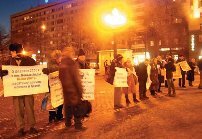 A gloomy frosty day on February 5, 2009. A small picket on Pushkinskaya Square participants in the anti -war movement and just sympathetic people remembered victims of the tragedy of nine years ago. Then, in the Chechen village, the new Aldes were shot and burned by dozens of civilians. They were killed and robbed by military personnel of the Russian army. Few of the fellow citizens managed to tear themselves away from the sofa into a cold Moscow evening.
Only a dozen picketers, mostly Muscovites. Persons are recognizable, their owners are the same “disagreed” that they go to opposition actions and marches and are not shy about criticizing power aloud. Human rights activists, former political prisoners, civilian activists. Oddly enough, there was not a single native of Chechnya among those present. And this is in Moscow, where a rather large diaspora lives. Apparently, these people express their grief in the dead in another, less noticeable way. But whoever at the picket was more than enough, so this is the police. Fortunately, the leadership decided not to reduce her ranks in connection with the crisis, so she works as she can. 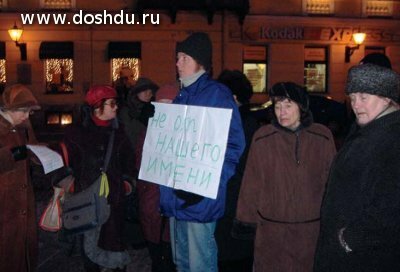 - As soon as we appear in the square with posters, the policeman immediately approaches us, writes down the names and surnames of the pickets, today they also rewrote everyone. Such lists, as we know, are neatly transferred to the department for combating extremism, ”says Anna Karenikova, representative of the anti -war club and the organizer of the picket. -Sometimes then you have to give explanations in the department if the law enforcement officers misunderstand something. According to Karetnikova, the provocation is not uncommon for weekly anti -war actions:
- Nationalists are suitable, threatened, in rude form explain to us where we should get out. At such moments, the police are obliged to protect us is prudently hidden from the eyes, preferring to observe the development of events from afar.
Passers -by, according to Anna, most often react to the picket indifferently. Although some join, but there are few of them.
In the Ledican February Solo, compatriots, running from an imported eatery to the metro, gloomyly turned away and hid their hands in his pockets, when the human rights activist and former political prisoner Elena Sannikova, risking her fingers, held out a leaflet with the chronology “battles and losses over the past week” and a story about the lack of vascular executions in Aldes.
The chronicle of the tragedies that are performed in the Caucasus is continuously enriched with new chapters, the Aldinian massacre among them became one of the most bloody, but far from the last. Only the metropolitan inhabitants who are in a hurry by, with annoyance and boredom turning away from the wrong posters, so reluctance to know about
Inquiring the anti -war club: “On the morning of February 5, 2000, new Aldes included special police officers. (According to human rights activists, these were riot police of St. Petersburg and the Ryazan region). The faces of riot police were covered with camouflage paste. This was probably done specifically so that it was impossible to then recognize.
For several hours, more than fifty people became victims of extra -courts, including a one -year -old child, nine women and eleven elderly inhabitants of the village. The riot police not only shot innocent citizens and set fire to houses, but also engaged in looting.
For several weeks, local residents did not bury the bodies of their killed fellow villagers, hoping that law enforcement agencies will begin an investigation on the fact of the massacre of unarmed people. However, there was no serious investigation of extrajudicial reprisals of the residents of the village of new Alda.
The military prosecutor's office adopted a decision to refuse to initiate a criminal case on the fact of massacres. As the main reason for the refusal, it was noted that "military personnel of units of the Ministry of Defense and the Ministry of Internal Affairs of Russia, superior to the bodies of the military prosecutor's office, did not conduct military operations in the indicated days in the village of Alda, did not conduct inspections of the passport regime" and "for the lack of a crime in their actions."
Here are just a few small excerpts from the memoirs of those who survived after the “cleansing”: “Those who entered our yard first demanded money. The father-in-law went somewhere, brought three hundred rubles. The soldiers remained unhappy, cursed so that I was inconvenient for my relatives. Then there were shots. Together with my father -in -law, the brother and sister of Abdulmezhidov died, our neighbors ... After all these horrors, I can’t respect the Russians. It is unlikely that we will live in one state. ”
“... they killed and burned people without asking for documents. The basic requirements of these killers are gold and money, then only shot ... "
“... I saw Gul Khaidiev, the old man of the murdered. He was lying on the street in a pool of blood. The soldiers killed the eighty -year -old Rakyat Akhmatov. At first they wounded, then finished off the lying. She screamed: "Do not shoot!" In total on that day, we missed 114 people. 82 corpses were found. "
Nine years ago, in the village of New Aldy and the adjacent quarters of the city of Grozny during the "large -scale stripping" from 50 to 100 people were killed. Despite the fact that the units who conducted this “special material” are established, the guilty of the murders of unarmed people have not yet been punished.
In St. Petersburg, shares of the memory of the victims of the tragedy in the new Aldes, organized by the regional public human rights organization “House of Peace and Non-Corgia” and the Yabloko party, were also held.
And in the premises of the Memorial Scientific and Information Center, an evening of memory was held, on which documentary videos were shown, made a few days later at the site of events in the new Alda.
About 30 people came for the evening. No one was invited specifically - only those who heard about this evening on the Radio Echo of Petersburg gathered.
After viewing, they talked about what can now be done so that in Alda the attitude towards St. Petersburg would become at least a little better. The organizers of the event proposed a project to organize trips of children from Aldes to St. Petersburg. The project is designed for 10 people to come to the city for a year and live in families from several days to several months. The guests of the evening supported the initiative of the organizers.
On February 6, 2009, from 17-00 to 18-00 on a small stable street near the monument to Gogol, a mourning picket was held in memory of the victims of the tragedy in the village of New Aldy.
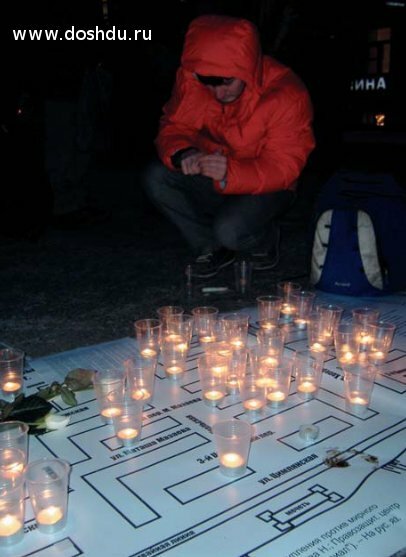
The picket participants lit candles and installed them on the map of the village in the places where the bodies of the inhabitants were discovered. The shares were held as part of the project "With the Good and the World from St. Petersburg."