
Translated material
The end of the hunger strike
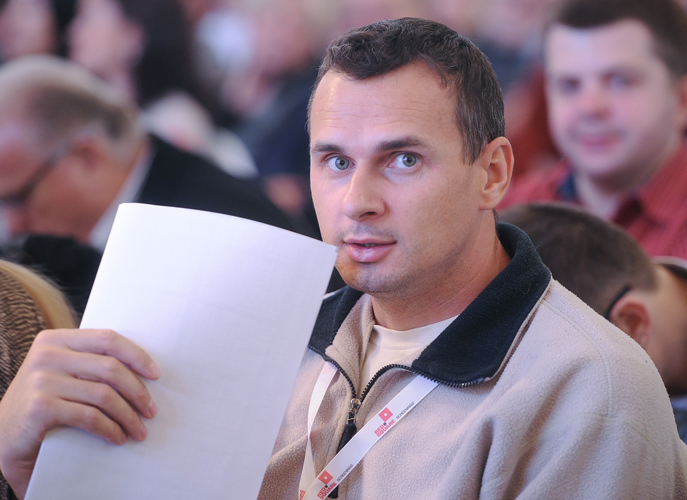
The news of the forced end of the hunger strike Oleg Sentsov was met by almost grave silence. Not only those who demanded the release of the Ukrainian director and release the Ukrainian captives, but also those who, in position or beliefs, at that moment, would have to gloom in silence, were silent. The matter is obviously not of indifference. The point is the inability to describe the situation by setting convenient stamps, the production of which - for further distribution in social networks - is engaged in propaganda and opinion leaders. Social networks, as a primitive musical instrument, are able to broadcast only a small set of emotions in the short range, but three chords are not enough to describe a sharply complicated situation, in which the exhausted hero came from the pedestal ahead of schedule. Joy - “He chose life” - is not suitable, because under the threat of coercive feeding Sentsov did not choose anything. An annoyance - “he surrendered” - is not suitable either, because the duration and intensity of the struggle, the number of people involved in it, the damage inflicted on the body, as well as the questions raised to the surface about the Crimea and the Donbass do not allow the hunger strike at once.
Today, the Russian language itself, tormented by propaganda and chancellery, turned into an instrument of violence assigned by a resentim and not setting the task of developing determining changing reality, less suitable for describing complex phenomena. Hypercompensation of this powerlessness of the language is the constant speaking of the “speaking” layer, waterfalls of the text, which in three days wash any, even the most significant, event in three days. But at the time of the cessation of the hunger strike, the collective speech apparatus was paralyzed.
And in this formed silence, it suddenly became much more understandable what it is and why such an internal protest causes: Sentsov’s business is another triumph of biopolitics, a rare example of a complete reinforcement of the state over a person. When a state car takes a foreign citizen, assigns it completely and marks it with its citizenship, uses it for its propaganda purposes or for reporting and, finally, exercises the right of Soveren described by Michel Foucault "to force to live and allow to die." “I’m not a serf to transmit me to the ground,” Sentsov said on the process, indicating in advance that the battlefield will be the last territory to which a person in a duel with the state can retreat, “his own body.
Some speech constructions in the headings and texts of the news ring in silence, giving out (as in cases with torture in the colonies) the presence of “permanent Auschwitz” is not a place in history or on a map, but forever and manifesting itself in different forms of strong violence over the weak. In a totalitarian system, death means not only getting rid of earthly suffering: it "personifies the moment when the individual eludes all power, turns to himself and retreats in a particular region." In today's Russia, the authorities are not totalitarian and not total, it, as a symbiote in Venom , jumps only on the one whom she can grab - but she still has a resource to restore the “right to death”, and has stopped the Sentsov’s hunger strike either alive or dead into the “private area”. Today, the “best nutritionists of Moscow” (a city where biopolitics also makes enormous successes ) will exercise the right of Soverene “forced to live”. To turn a person “into a vegetable” means to leave him only autonomic functions. Like "goner" in the Gulag or the "Muslim" in Auschwitz; The very one described by Giorgio Agamben, the only true witness who has gone all the way to the end and therefore cannot indicate. So far, at the moment, the rejection of the hunger strike and the refusal to turn “into vegetables” means that a person still retains the opportunity to survive and testify.
In the public field, Sentsov is marked as a director, and one of the most frequently asked questions about him - is he, the author of one full -length film, the director actually. The inertia of perception is understandable, but with all its residual prestigious, the director is an old -fashioned profession from the totalitarian 20th century: a demiurge commanding the masses (Lars von Trier, thinking his whole creative life on this topic, in the new film brings the idea of an absurdity - this is a maniac building a house from the people killed by him). But a small control machine will always lose a large car. Belief in the possibility of modernist gesture, the desire to direct reality at least within the framework of their own body cost Oleg Sentsov dearly, but, watching Game of Power in the open spaces of "permanent Auschwitz" should always be on the side of the loser.
For this long warm summer, slightly blown by a draft from Labytnangi, another event occurred-three Russians were killed in the Central African Republic, including Alexander Rastorguev, who was seriously a hunger strike, he himself looked for creative survival strategies and painfully investigated the director’s relationship with reality. We were preparing to bury one director, and buried another. Even when we are silent, the abyss finds a way to talk to us.