
Translated material
How to be invisible in the city?
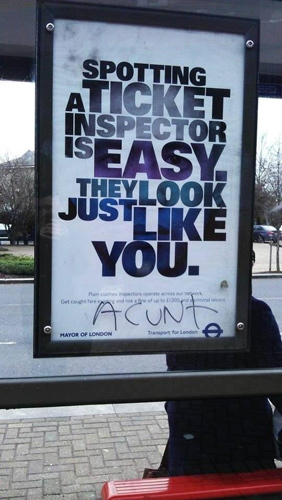
Writer Debbie Kent and artist Alisa Oleva, living in London, talk about the origins of their artistic practice of strange walks in cities - and at the end of the text you will find a booklet with instructions on how to join them.
In the story of Edgar Allan, the hero (1840), the hero, watching people in the crowd, notices a very strange person whom he decides to follow.
In the film Fritz Lang "M" (1931) Berlin beggars create an unofficial observation network to monitor the killer of children.
In the film Alfred Hitchcock "Window to the Dvor" (1954) A person who does not leave the rooms due to an injury begins to observe his New York neighbors in their own apartments.
In the project of Francis Alus, the “Doppelganger” , from 1999 to the present), the artist comes to a new city and watches the crowd until he finds a person who looks like him (this can be understood in different ways), and then follows him.
In the film of Michael Hankee "Hidden" (2005) The bourgeois Parisian family receives a video made by anonymous, conducting observing their apartment.
In a series of photographs of Olga Chernysheva, called “at the post” (2007), employees of the Moscow metro observe passengers on escalators.
The act of observation of people is woven into the narrative of the modern city; The above is only some of the hundreds of examples. Even more stories are associated with the observation of the state behind individual people and the crowd: starting with the project of the ideal prison proposed by the philosopher by the philosopher-panopticon to a huge number of science fiction works about authoritarian societies, which are built according to the model set by the novel by Evgeny Zamyatin “We” (1920).
When the observation is carried out by the state, then its main goal, as a rule, is to track criminals, dissidents and terrorists, that is, in other words, to identify enemies; In the case when the observation is carried out by individuals, their motives may not be so unambiguous. In the "man of the crowd", for example, the narrator begins to observe people from idle, as it seems, curiosity. After 160 years, in the film of Christopher Nolan, the “Pursuit” (1998), a young writer will begin to pursue people along London streets in the hope of overcoming a creative crisis. In both cases, the observation process gradually becomes something frightening for the observer himself. In the film, the hero turns out to be drawn into a crime and violence: they are committed by a person he is following. In the story, the city plunges the observer into a severe obsessive state, forcing him to walk the streets for a day long no sleep. The city is represented as a place in an anonymous others, as a crowd, which first seems to be a playing platform for an idle observer, and then becomes a trap.
How to become invisible in the city: do not catch the eye of others and at the same time observe and evaluate their behavior in the crowd.
Researchers-psychologists find that paranoia and paranoid schizophrenia are much more often manifested in urban residents. Today - for the first time in the history of mankind - half of humanity lives in urban landscapes, which seems to lead to an increase in cases of pronounced paranoia and persecution mania. The pace of urban life, the number of unfamiliar others, whom we have to avoid or meet daily, clashes and conflicts are seemed to be a source of huge psychological pressure. The city crowd is full of strangers who may be enemies. Is the enemy an observer or observed?
The Demolition Project , our joint (Russian artist Alice Oleva and British writer Debbie Kent), uses the city simultaneously as a workshop and as a working material. It is designed to explore the underwater currents and stress points arising between the lonely passers -by and the crowd. Inspired by the work of Alus, “surveillance” of Vito Akkonchi (where Akkonchi followed the random strangers along the streets of New York), “Venetian surveillance” Sophia Cal (the artist documented monitoring a man in Venice) and her “detective” (Cala hired a detective so that he followed her in Paris), we also began to follow in Paris). strangers from the crowd. Based on these “walks”, two works arose: the audio priest “Follow me” ( “Follow Me” ) and the collective work “Shadow” ( “Shadow” ). In addition, participation in various workshops and events in London and Berlin brought us many other considerations about who and who is watching in our time.
At the same time, while we were busy with our project, announcements began to appear everywhere in London transport, which seemed to urge ordinary citizens to establish observation one after another. In the dosage, but with persistent regularity of the media, warnings calling for citizens to be “vigilant” in relation to “suspicious behavior”, no matter what it is.
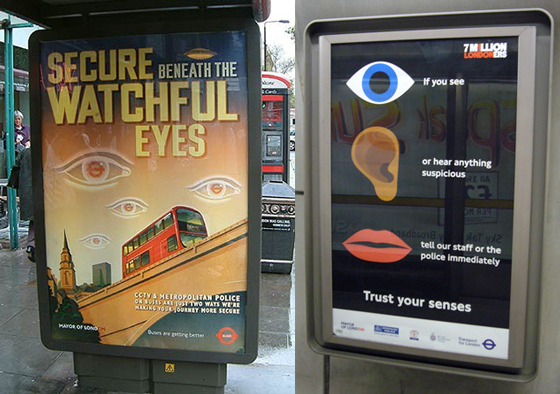 Posters in London: “Safe under close supervision” (at the bus stop); “If you see or hear something suspicious, immediately inform our employees. Trust your feelings "(in the subway)
We tend to think that observing the crowd in the 21st century is something associated with technologically indirect tracking of the masses: surveillance cameras, drones, programs that allow you to recognize faces, algorithms that apply suspicious schemes of movement ... Of course, all this could not but interest artists - for example, Manu Lux, which in 2007 presented the film without the film “Without 2007 faces "( " Faceless " ), based on material from surveillance chambers ; Emily Yasir, the author of the Linz Diary project ( Linz Diary , 2003), presented by pictures from the webcam ; or Brumberg and Shanarin, which used the images obtained from the person recognition system to create the work “Spirit Is a Bone” (2014) ; As well as others whose work offer surveillance protection as “Facial Weaponi Z Ation Suite” (2011-2014) Zak Blaz . But this is only one of the areas of our interest. The state order to follow each other has a hidden force that gives rise to fear and a suspicious attitude to life in public places. It was this phenomenon that we wanted to explore.
We found a response in the instructions of the security services of the police of London, Los Angeles, the CIA and other sources.
Our friend, the artist Simon Farid, suggested that we find places where we could hide from both the surveillance cameras and from the eyes of passers -by, and we realized how unattainable it was in a city like London. We wondered how to become invisible in the city: not to catch the eye of others and at the same time observe and evaluate their behavior in the crowd. We found the answer in the instructions of the security services of the police of London, Los Angeles, the CIA and other sources. We began to develop our ideas related to the city video surveillance system in the so -called walking workshops ( Walkshops ), which take place on the streets in various areas of East and Central London. Including, we created a “walk” for the Calvert 22 gallery, where the season dedicated to the authorities and architecture, Power and Architecture .
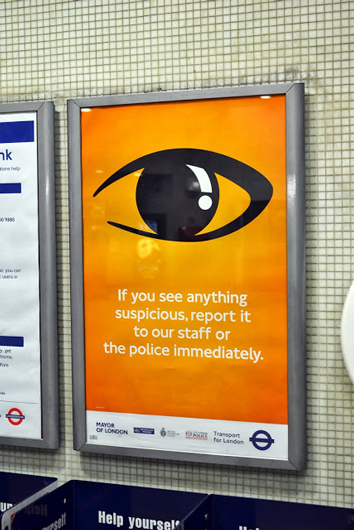 Poster in the London metro: "If you see something suspicious, immediately inform police officers or metro staff"
Our attempts to observe the suspicious behavior of the crowd forced us to feel ourselves with strange and suspicious people. We took pictures, shot video surveillance cameras on video, made notes, allowed ourselves to perform “unusual actions” and “strange movements”, that is, we were ideally suited under a police description of potential terrorists. And this experience was not necessarily unpleasant. Our studies show how London looks like a panoptic, where your eyes are watching you everywhere - both digital and human. Are we developing strategies to protect ourselves from this view, or do we accept the suspicion of our behavior? Such ambivalence is laid down in the most inherited practice of walking around the city from other authors . In the Passage Passage project ( “Passagenwerk” ) Walter Benyamin, which is a collage from notes, quotes and observations about the roots of modernism in Paris of the 19th century, the author writes about a flainer who wanders around the streets, observing the life of the city: “On the one hand, a person who feels that everything and everything sees in him a true suspect, and with a true suspect, and with him with a true suspect, and with him Another, a person who is completely impossible to find, a hidden person. ”
We also want to offer something that would be available to everyone who walks around the city-at the place where suspicious behavior is produced, observed and created under the influence of the fear of the observer. We decided to generate and study the urban paranoia through an audio producer or the applications that we are currently working on. It seems to us that soon people will use this instrument everywhere: a voice that will broadcast them directly into their ears, how to track suspicious behavior, including their own.
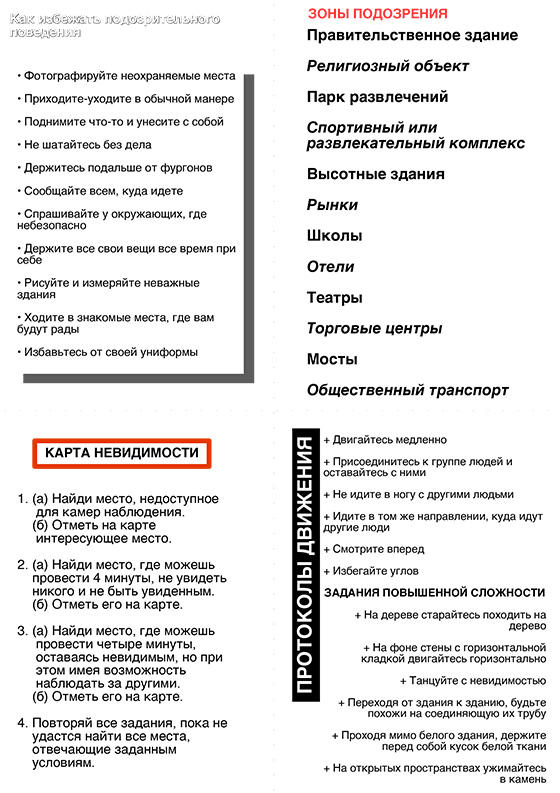
And for those who want to try to explore suspicious behavior before our audio project is implemented, we offer some tasks placed on a page that you can print and put in a booklet, and a booklet can be worn with you.
Download the entire issue of the magazine "Disagreements" (No. 9) "Go out on the street. Back to yourself the city ": PDF , Mobi , Epub