
Translated material
Glasnice-1908-1988
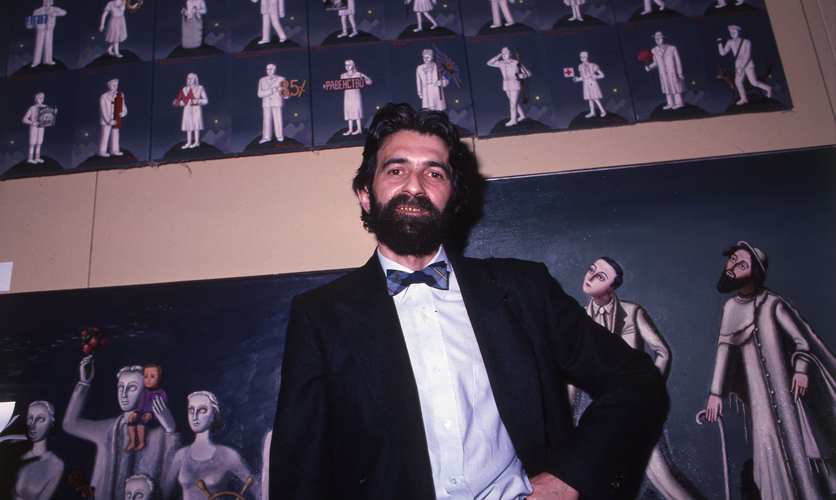
On January 23, the exhibition “Stations on Glaserness” was opened in the Museum of Contemporary Art “Garage”. Auction "Sotbis" in Moscow, 1988. " At the request of the Garage, Denis Boyarinov prepared a special thematic playlist for this exhibition.
On July 7, 1988, in Moscow, at the Sovintin Center (Center for International Trade), the historical auction "Sotbis" was held, which first introduced Western collectors to modern Russian art. Together with the works of the classics of the Russian avant -garde, Alexander Rodchenko, Varvara Stepanova, Nadezhda Udaltsova and Alexander Drevin, the Western guests, among whom were agents of David Bowie and Elton John, saw the unofficial Soviet art - the work of Ilya Kabakov, Dmitry Krasnopevtsev, Ivan Chuykov, Sergey Shutov, Vladimir Yankilovsky and others. The top lots of the auction were the abstraction of Alexander Rodchenko, who had gone over 330 thousand pounds, and the large -scale Soviet iconostasis Grisha Bruskin “Fundamental Lexicon” (1986), sold for 242 thousand pounds (about 500 thousand dollars). This auction instantly made modern Russian participants with art-world stars, desired in the West, but not for long.
Following the example of the organizer and ideologist of the auction of Simon de Puri, in the playlist dedicated to this historical event, I compared the famous musical works of the avant -garde era and the most interesting manifestations of perestroika Russian rock. Having escaped from the information blockade of the early 80s, the Russian rock then experienced his most interesting period-the heyday of ideas and, like the Russian avant-garde artists of the 1910s-1920s, boldly went to the experiment, sometimes unconsciously repeating the finds of artists who created more than half a century before its appearance. The Russian rock was opened by the West at about the same moment as the unofficial Soviet art-in 1986, the collection “ Red, which was produced in the United States, was published in the United States Wave ” , which initiated a wave of interest in underground music from the USSR.
This playlist is composed so that sound parallels and musical rhymes draw between the visangonies of the Russian avant-garde and the heroes of Russian rock: between the steel lumber of the symphonism of Alexander Mosolov and the antipandist-Dadaist SKA “strange games”, between the radical rhymes of Alexei Krusheni in the futuristic opera “Victory over the Sun” and meaningful The laconicism of Victor Tsoi’s priests, between the revolutionary movements of the “mechanical dancing” of Nikolai Foregger, ignored by the Soviet government, and the plastic of the “sounds of mu”, between the romanticus for Termenovs Joseph Schillinger and the naive electronic experiments of the “center”, between anticipating Musical Concr è TE Documentary audiopius of Jigi Vertov and the first samples in the post -industrial music of the Night Avenue, between the refiner, ignoring the spirit of time by the sound of Gabriel Popov and the strange romance of the Aquarium. The main rhyme here, perhaps, is what: Russian avant -garde artists and Soviet rockers lived at the dawn of the eras, beckoning them in a different, delightful future, and, as it should be artists, recorded their insights about the impending reality of the present. The era did not last long, the voices were deceived, but this is a completely different story.