
Translated material
Coffee, sir!
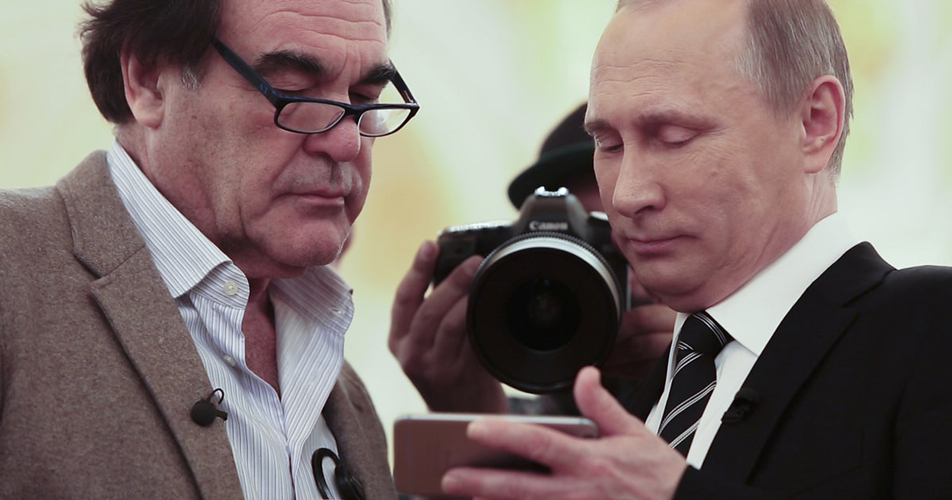
Putin should enter the director’s team room, but Stone commands: “Action, action!” - But Putin does not appear. Stone is angry: “Action! How will there be “action” in Russian? ” - And the translator, strangely bending the whole figure, translates: "We are starting shooting, Vladimir Vladimirovich."
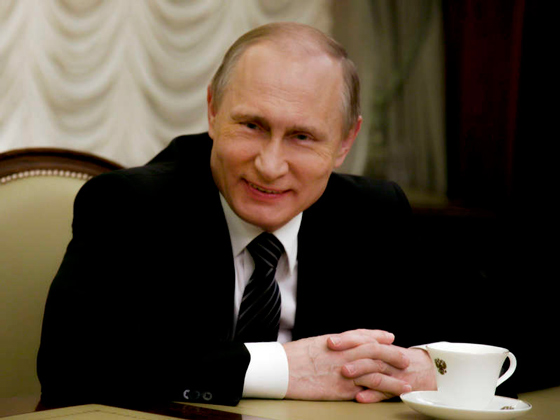
The difficulties of translation - yes, of course, and of course that this translation is not from English into Russian, but from human to Kremlin. Actually, the main property of the film is that for the first time in history, two of these great cultures directly interact with each other. One is Hollywood, who also formed Putin himself in the eighties-nine, and the other-the Kremlin, which is also called the Byzantine and in the language of which (it would hardly have come to the head) Putin speaks with Stone: after responding to the director’s call, the leading role appears with two coffee coffee cups in his hands-“Coffee,“ Coffee. sir!" “And this, of course, is the classical royal self -irony, the one with which one legendary hero signed letters to the daughter“ poor I. Stalin ”, and the other (and this in the modern Russian world remembers everyone, albeit not according to Eisenstein), turning to the subjects, wrote that“ the king and the Grand Duke Bezing Beat ”. Putin clearly likes to play it; When, at the next meeting, Stone asks: "Have you missed me?" - Putin willingly picks up: "Yes, he burst into tears a couple of times, but waited." And Putin’s “I played hockey, and you are tired” - the case when the joke becomes funny at all for the reason that the joker had in mind.
This is a movie in which there are two heroes, and not one: on the stowed in the frame there is no less than in Putin.
Do not take away - this is a beautiful and quite spectacular movie; Anyone, but not a hackist, and if it can be reproached for this in relation to this movie, the four-episode content seems excessive; Stoneov’s material would have been enough for an excellent full meter that could even earn something, at least at the Russian box office, but, apparently, the syndrome of journalist Azar, the author of many dimensionless interviews, is international and invincible.
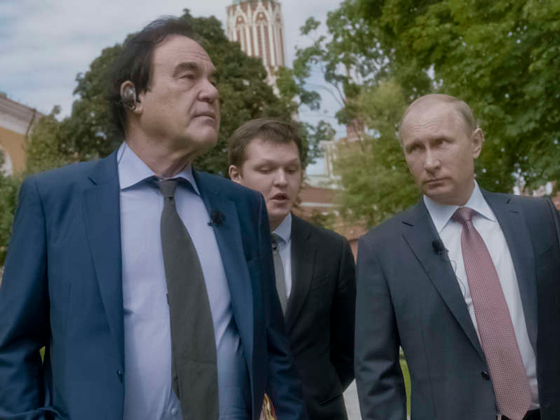
This is a movie in which there are two heroes, and not one: on the stowed in the frame there is no less than in Putin. Wandering around the Bolshevik cemetery near the Kremlin wall, where, to his surprise, there is no Trotsky grave, Stone hangs over the grave of John Read - it is clear that he sees his heir, but it is clear that it is easier to see the heir to completely different authors who regularly came to the Kremlin. The famous “I want to raise the question of the legal status of the pederasts” Andre, the Jew Stone reproduces literally-raises this question, for some reason, going through the shower on the submarine; Putin’s answer was quoted by the agencies even before the premiere, but what do you not quote in the news report that you need to see and hear - an embarrassed giggling and (in the news the continuation of the phrase was not quoted) after the jest of the official “I can’t say that in our public consciousness it is welcome”. Stone's comment is in installation. Putin’s words are illustrated by the shots of the chronicle, which can be approximately called the acceleration of gay parades: the famous scene with a red-haired guy on Palace Square on the Airborne Forces Day, and then in the frame a half-naked Putin in the gym-yes, we can say that in Russia it is welcome or not welcome, but bodily is often expressive than verbal.
 © Showtime
Jew and Feikhtwanger, as well as Barbus, Rollan, Show and other partners of the Voks, who searched the alternative to the Western world to the alternative to the Self -deceased in the Stalinist Kremlin; Putin instead of them-movie stars of twenty to three years ago in the range from Pamela Anderson to Stephen Sigal, and interestingly, of course, what would happen if at one time Putin read Western intellectuals, and did not look at the militants; Who would he bring coffee, who would explain about gays?
The second scene replicated in advance in advance-in the Novo-Ogarevsky house church, a conversation about son-in-law and grandchildren, and in it, too, that you can’t convey with news text: very embarrassed and, it seems, even blushing Putin, overcoming himself, and God would be with them, with their grandchildren, this is the main thing-you will not go to the impression on the expensive (even high) guest. This is precisely the real "coffee, sir." And - but there is already easier, there Putin does no effort, acting according to the usual algorithm for working with subordinates - an episode in the situational center. Deep at night, the president demonstrates the director his general talents: on the large screen, some kind of frail imported analogue of Skype or Feima is launched on the large screen, and at the other end of the line, some General Khristoforov, dressed from the Ministry of Emergencies to the idiotic white polo, is frightenedly reports that “activities for the development of success in the data will be continued in the established time directions ". The main thing here is precisely this - General Khristoforov as a consumable material necessary only to please Stone. Further - the same episode with an iPhone, over which everyone has already laughed.
 © Showtime
Stone on Red Square is watching a parade in honor of Victory Day, and the parade frames are mixed, 2016 and 1945, in the stands of Putin or Stalin. The most powerful impression on Stone makes a female battalion - Putin is pleased that Stone liked, this is the latest innovation - and Gorbachev sitting on the guest rostrum. Stone asks Putin about Gorbachev, he answers indifferently - well, yes, the protocol invites him - and Stone does not understand this indifference: "But you stopped, greeted him?" “I didn't even notice him,” Putin replies. Stone seems to understand. In general, the theme of predecessors, which is more likely to Stone than Putin (this is the beginning and the end in our coordinate system, the Western viewer of Yeltsin and especially Gorbachev still remembers), is touched as rudely when all obvious home preparations (“I do not consider myself entitled to give serious assessments of Gorbachev’s activities and the personality of Yeltsin”), Putin is breaking through-the present gestures of the hand that melts the hand gestures that mimic “Bla-blah blah”: “Gorbachev talked and decided that everything, but things were not done.” And when Stone asked about Yeltsin's drunkenness - "What you said - to hide a sin, it was also." Putin, it seems, really thinks about the past than many: “They say that Russia carries the birthmarks of Stalinism. We all carry some birthday spots on ourselves, so what? "
Now it is clear that in the past and the year before last, Putin rehearsed, prepared for Stone, having starred several times in domestic cinema about himself. Stone also uses the scenes from Andrei Kondrashov’s film about the Crimea “The Way to his homeland” , when the Bastion missile system is scared away by the American destroyer Donald Cook, and from the film “President” with Vladimir Solovyov - obviously, Putin himself is very valuable with the episode from 1999, when in a warring Dagestan during a headquarters in a headquarters in a headquarters The prime minister, as everyone thinks, begins to pronounce a toast, but puts an unexpected glass on the table and says that we will drink after the victory.
It is funny that Putin still considers the argument to be disarming that if NATO is expanding, it is not clear who is against whom - but what is incomprehensible, against you, damn it!
And from the same 1999 - the two most mysterious episodes. Putin recalls that his father, who died two months before his appointment, shortly before his death (that is, this is the spring-summer 1999, the prime minister-Stepashin or even Primakov), already in the hospital, meeting his son, said: "My president arrived." Not a very obvious family joke, albeit for a high -ranking official, and what can it mean? Putin was already warned that he would be a successor? Until now, he has not spoken about it. And the second mysterious moment is Putin's memories of the prime minister’s appointment: “Then I thought about only one thing - where to hide the children.” He now, after almost twenty years, continues to hide them, but, damn what it was for an injury in 1999 and what was the premiere candidate should be afraid to respond to his appointment? Putin further explains that he did not know what Yeltsin had plans for him, and if there was a resignation instead of succession - “there is no protection, there is nothing, how to live, how to ensure family safety?” Such a formulation of the question seems far -fetched: well, in fact, as other retirees survived - Chernomyrdin, Kiriyenko, Primakov, the same Stepashin? It's not about the risk of resignation, but what then? What was Putin really afraid of? How can one not recall the main (still main thing) suspicion of him - Kashirka and Guryanov Street - or what else could we talk about there?
Modern world policy Putin is clearly more interesting than memories. “Our partners live in some kind of world”-it is clear that Putin was touched by the famous words of Merkel , that it was he who lives in “some kind of world”. At the same time, of course, the foreign policy Putin likes it; When he and Stone go into the office where the TV works, and show Munich’s speech on TV, Putin is clearly not lost and asks someone: “Why do they show it?” The voice from behind the frame explains: “Today is ten years,” and Putin brightens his face: “Ah, ten years, yes.” All that he talks about Ukraine, about NATO, about the Middle East and the USA, we have heard a million times, and this digest of the Time program is probably interesting, only by a variety of operator angles.
 © Showtime
And it’s also funny that Putin still considers the argument to be disarming that if NATO is expanding, it is not clear who is against whom - but what is incomprehensible, against you, damn it! Of course, Stone does not say this, but Putin for some reason embarks on comic and subtracting explanations: “It will soon become clear to everyone that Russia does not threaten either the Baltic states, or Eastern Europe, or all the more remote countries,” yeah, it will soon become clear to everyone, but we’ll finish with Donbass.
But the more hackneyed a set of Putin’s words related to foreign policy, the more impressive the unexpectedly rude and, it seems, honest summarizing wording: “We are better than the States, because we do not have such opportunities as in the States. There would be - maybe we would be the same as you. " In fact, this is the Stone replica “Oh, it is very Russian, very in Russian, very in Dostoevsky”, but Stone left her with an answer to the Putin’s duty officer “there is always hope until we are carried in white slippers at the cemetery.” Putin likes that Stone likes when Putin talks about the cemetery, and when it comes to Putin’s wealth, he pleases Stone again: “There is no pockets in the coffin, you won’t take it away with him.” He seems to regret it.
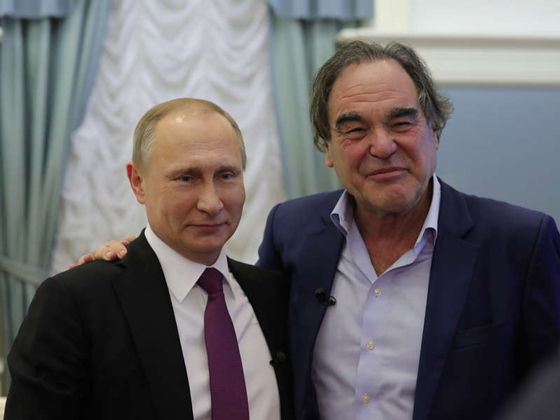
At the end of the last conversation, one of the interlocutors thanks the other for the time spent on him. All the logic, the director should be thanked who managed to achieve a large and frank interview with the inaccessible world leader. But no, “thank you for your time” Putin says to Stone, and this turns out to be his most accurate characteristic, overturning everything that was said in four episodes. I achieved the highest power. For what? To star at Stone.