
Translated material
Dawn is soon, there is no way out
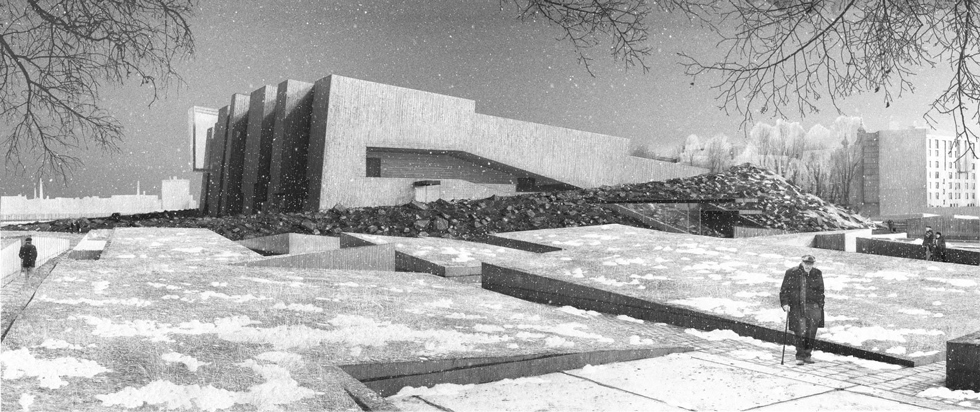
The large-scale complex “Defense and blockade of Leningrad” should appear in the city center in 2019, to the 75th anniversary of the relief of the blockade. Smolny announced a competition for the project and received 39 proposals, from which the jury chose nine, leaving the townspeople to choose which project is prettier. The most open and democratic vote (at an exhibition of projects and on the network) aroused unexpected interest. Finally they are interested in our opinion! The nine leaders included Norwegian, Finnish, German architects, which flattered the emphasized Europeanized Petersburgers, provoked good -neighborly sympathy for the Finns and antipathy to the Moscow Arena (it really resists of the Olympic). Thousands of people found time to go to the play of the stable department, even more voted on the website of the Committee on Urban Planning and Architecture .
Journalists, architects and those who were not aware that the exhibition was closed, and came to vote, pile at the entrance to the stable department. The jury sits in the side wing, we are about to find out which project is approved. We praise and regret foreigners in advance, believing that their proposals are powerless against the tandem of local authorities and local architects. However, they delay. Ten minutes, fifteen, hour. Someone notices that the museum works until seven in the evening-they probably just want to get rid of us quickly. Finnish architects, deprived of instinct to stand in line, communicate lively behind our backs.
I begin to understand why Mikhail Piotrovsky with his unmistakable ethical instinct is not present here.
Energetic domestic architects organized a “interest circle”, and from there comes: “The winner will have two paths - prison or heart attack.” A colleague nearby sadly states that, probably, there is another third option - a psychiatric hospital. Then the journalists will tell you that this evening grandmother-blocker went to the closed doors of the arena. She wanted to vote, but did not know that there was a “closed event”. Of course, she was not on the lists, and did not want to let it go - only after the intervention of media representatives, the pensioner opened the door. Finally let us go. Neither Governor Georgy Poltavchenko, nor vice-governor Igor Albin, nor Mikhail Piotrovsky, who were members of the jury, was not at the table. For everyone, the head of the KGA and the chief architect of the city Vladimir Grigoryev was puffed. The hall was stuffy and gloomy, acoustics multiplied the speedy speaker of translators. Withstanding pauses, we were informed with a heavy stationery, we were informed that the “living” voting and the rating on the KGA website have different but close results. “We have no moral right to make the final opinion without taking into account the opinions of those few people who lived in a blockade city,” the architect finally issued. Rustle of translators. I begin to understand why Mikhail Piotrovsky with his unmistakable ethical instinct is not present here.
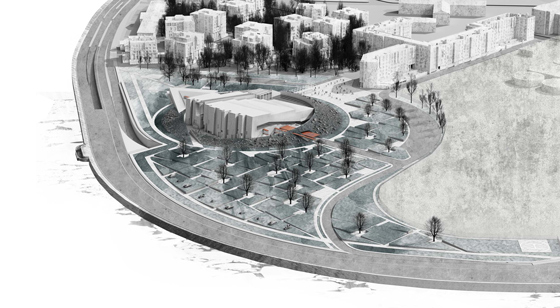 Project of the Museum of the Blockade of the Studio "Zemtsov, Condiane and Partners" (St. Petersburg)
“We have decided to choose four projects that we recommend. But the final choice should be made by residents of the blockade city, ”continued Grigoryev. The tall jury chose from nine-four projects-“finalist”. These are the work of the studio "Zemtsov, Condiane and partners", "Studio 44" by Nikita Yavein, Bureau of Mikhail Mamoshin and Lahdelma & Mahlamäki . The city intelligentsia advocates for the Finnish project. Scandinavian conciseness, lack of references to Stalinist architecture, symbolism, as well as non -interference in the trepidly beloved “heavenly line” of St. Petersburg and really captivate. On the other hand, this same “Scandinavianness” in Imperial Petersburg looks frank import. The project is beautiful, but who will say that it is about the history of Russia? In this sense, the project of Studio 44 - the ethical antagonist of the Finns, in forms and ideas offering the usual harsh monumentalism - we are much closer to us. The thinking public, as always, cannot decide how to do more in the Petersburg: to vote for the Finnish project or sign a petition with a demand to refuse to build a complex and place a museum in the buildings of blockade bakeries, Levashovsky and Kushelevsky. After all, they are in the minds of Petersburgers associated with tragedy, and billionths will not be needed. However, some vote both there and there.
- It’s easier to drink with a local architect, Finns have much higher requirements for the quality of technical implementation.
“The future appearance of the blockade museum will be little different from the architecture of shopping and entertainment centers. The blasphemous comparison! Gloomy communities, offered as a blockade memorial, cannot convey either true sorrow or pride in people who have withstood the most difficult tests. A similar building, and it will be in the immediate vicinity of the Smolny Monastery, will only mutilate the face of the city and devastate the budget. And this despite the fact that in St. Petersburg there were 2 blockade bakery, which, being witnesses of historical events, could become a wonderful platform for the museum. The museum in the historical buildings of bakeries will become a living memory, and not an emasculated memorial, ” the petition said, which was signed by almost 4,000 people. Mass antipathy was caused by Mikhail Mamoshin. The bureau made a clear PR problem, arranging a release of release with arguments in favor of its project and, most unpleasant, with the comments of the blockade in the same tone.
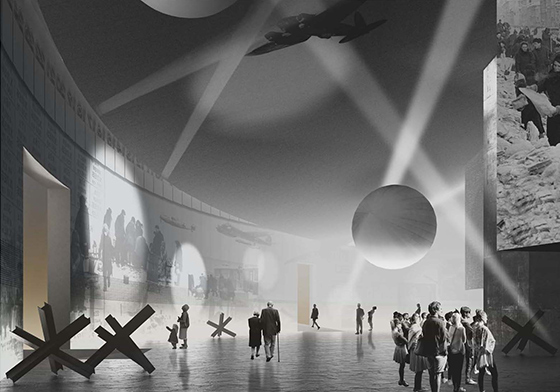 Project of the Blockade Museum "Studio 44" (St. Petersburg)
It is difficult to say what officials will solve, coupled with veteran organizations. The idea with bakeries was expectedly not met at the top. So we will discuss the success of the Finns and the prospects of the St. Petersburg three “finalists”. “There are very few chances to win this project,” comments Lahdelma & Mahlamäki Architectural critic Maria Elkin. - “No” I will not say, because in life there is always a place for a miracle. It is pretty for obvious reasons-this is the only sentence where there is no severe pathos, from which everyone is generally very tired. The Finnish project is not outstanding, it would be much better, but it is timely and light. The spiral does not clutter up the landscape, it is still elegant. Feelings of hope and despair here are naturally read due to the rise and sudden cliff. It would be honest that there is simply no vulgarity in the Finnish project - and this is already a huge achievement in the current competition. ”
- There is still an opinion that they are realizing the one on which it is easier to “drink”. Do you think there are obviously more expensive and cheaper projects?
- He should be expensive, honestly. It’s easier to drink with a local architect, Finns have much higher requirements for the quality of technical implementation.
“Finns look better outside, yes,” notes the architect Oleg Manov. - Spectacular, tragic. The conversation at the level “fits - does not fit” in this case is inappropriate. This is not about the building that should be like something similar, someone's beautiful addition or to harmoniously combine with the environment. We are talking about memory, about the symbol of the tragic events taking place in Leningrad during the Second World War, the heroic struggle of the inhabitants of the besieged Leningrad with death. The value of the museum is in the confrontation of war and peace, love and hatred, life and death. What inscription in the city landscape can we talk about if we are not talking about a concrete box, windows and facades, but about the loss of hundreds of thousands of Leningraders? To personify this struggle the museum will be best in the city center, contrasting itself with the environment. This contrast is very important precisely in the historical center, which has suffered the most.
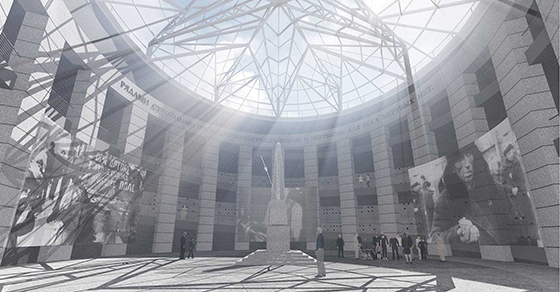 Project of the Blockade Museum of the Mamoshin architectural workshop (St. Petersburg)
The museum, of course, should contrast with the environment by silhouette, forms and materials. St. Petersburg developed as a European city with clear lines of avenues, embankments and urban planning accents. Some of these accents were demolished and destroyed in Soviet times. Today it is necessary to create not only the new fabric of the city, which would fit well and complement historical development, but also new urban planning accents, because the city should develop! From the point of view of the volumetric solution, the Finns project is most sympathetic to me, although it does not 100% meet the general topic. The “Studio 44” project is interesting inside the saturation of the exposition and the complexity of the spaces. Perhaps he is the most promising. ”
They noticed that, worrying about the ethics and silhouette of St. Petersburg, we still have not touched on the main question: for whom is the city the city is involved in the next road (at least 2 billion rubles) long -term construction? It is assumed that the new museum is a “message to descendants”, a multimedia center, designed to use existing and organic implementation of future technologies. Why does the jury, having in hand the results of the folk “elections” and fifteen votes in the basket, shifts responsibility to blockade? Starting with a democratic gesture, leaves for a vulgar subservation? Indeed, after a few generations, the same bakery will hardly be associated with the blockade, and from this position a new, stuffed with interactive attractions and equipped with a VIP input of the Museum is relevant. What is there, you can still sell magnets and launch a couple of quests. In the end, Leningrad lived for a long time without this museum. Even before the removal of the blockade, the Heroic and Patriotic Museum of Defense worked, where the exhibits were brought directly from the front. And he was clearly not about the "loss of hundreds of thousands of Leningraders."
Why does the jury, having in hand the results of the folk “elections” and fifteen votes in the basket, shifts responsibility to blockade?
Later, the exposition occupied the entire salt town, but soon at the end of the war it was recognized as ideologically erroneous and destroyed (photographs and documents were burned, the remaining assets were transferred to other museums). The question of restoration was raised only in the late eighties - again, the intelligentsia and veterans. It was assumed that the city would not appear heroic-patriotic, but a household, humanistic exposition. As a result, we have an old -fashioned, but extremely powerful emotionally museum in Solianaya Lane. It is difficult and difficult to keep the concepts of “museum” and “blockade” in one semantic bundle, but this city is so necessary. And the current museum has no area to show a huge collection (more than 20,000 items), which probably will take the space of the new complex.
I managed to get through to one of the district branches of the organization "Residents of the Blockade Leningrad." Surprisingly, the catch is not yet felt - all the board of the cell is going to collectively go to vote to the exhibition, the organization did not receive any “recommendations”, except to hurry. “True, I don’t know if they will tell us there about each project in more detail or only they will allow us to see it,” said my elderly interlocutor. - I was at the exhibition on September 7, then there were architects themselves, they told. I liked the project of Yuri Zemtsov-perhaps because he, like me, is from Fox (now St. Petersburg Architectural and Construction University.- A.S .). Well, I want the author to be a Leningrad. Finns have a beautiful project, this is interesting, but, we were told that he may have a problem with the roof. When we go to vote (and there are twelve people), we will need to walk from the metro on the Griboedov channel, but nothing, we can still come! ”
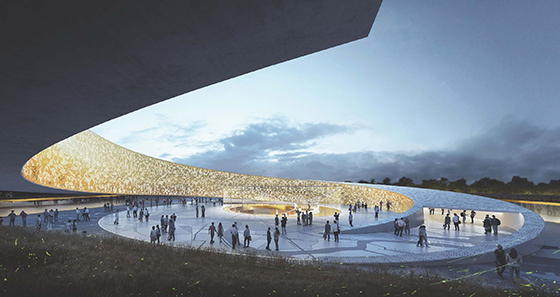 Project of the Blockade Museum Lahdelma & Mahlamäki (Finland)
One gets the impression that there are two St. Petersburg-Leningrad. One - where the budgets are “sawn”, they are manipulated by the opinion of the respected, civilian and historically significant part of society, and the small town intrigues nullify the declared priorities. Another - where the townspeople are overturned, forgetting that reflection is an internal business, which does not affect the next grandiose construction, regardless of how many billions will go to this “black hole”. And, it seems, there is the third-where for some reason the bureaucratic apparatus decided to interact with this reflective intelligentsia and, by strange inertia, continues to look back at its tastes. Not understanding that, firstly, this is not such a large and terrible layer (less than ten thousand people voted from the five millionth city), and secondly, it is impossible to achieve their approval. At the same press conference, my colleagues asked the question: “Why do you even have a vote, ask the townspeople? Should the projects choose non -professional? " Of course, if the Petersburgers were not asked, there would be even more indignation.
- You can not cover Petersburg with a glass dome and watch how it is destroyed. And then blow off the ruins of dust from the ruins. The city is alive, it must develop. And let the museum be built in the center than to get something else to slap, ”I tell a colleague at the stable.
- Certainly. But name at least one example when we succeeded! Okay, Mariinka-2 , and Gazpromovskaya "corn"? So it turns out that it is better not to touch anything and leave it as it is.
It seems that a familiar series awaits us again: construction, billions, another billions, change of contractors, invisible attacks of officials. As the song “Spleet” is sung in the city beloved by the city: “Soon the dawn, there is no way out.”