
Translated material
In understanding God
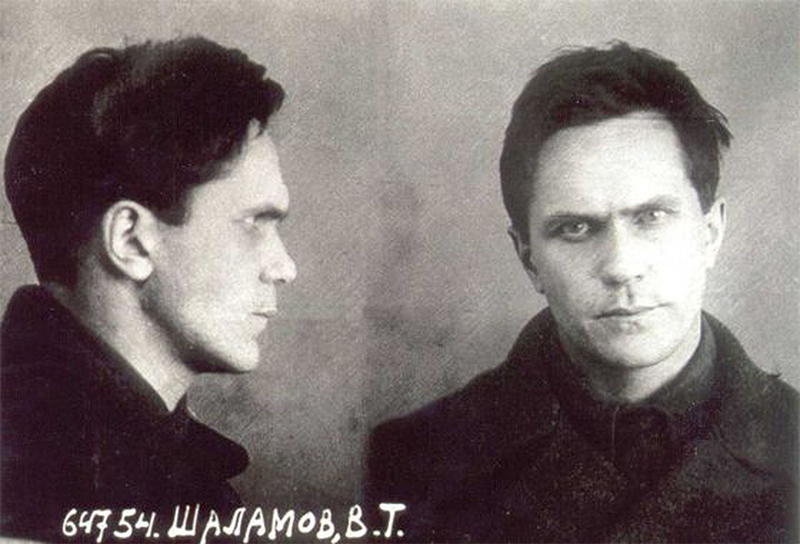
The other day, a conversation came about Shalamov, about his vision of poetry as a way of understanding and memory, about the mysterious energy contained in his outwardly traditional short verses.
And I remembered how in the spring of 2012 Robert Chandler translated Shalamov for the anthology of Russian poetry compiled by us [1] , and Boris Draluk and I assisted him. In general, five years of work on anthology are thousands of letters and notes, but some poems are in this sense apart. Such is the poem “Memory hid so much evil ...”: the conversation arising around the last two lines - and therefore the whole poem - lasted several days until the volitional order was decided to stop it. But this unnecessary mystery still also surfaced in our correspondence.
This is the poem:
Memory hid so much evil
Without a number and measure.
All my life was lying, lied.
There is no more faith for her.
Maybe there are no cities
Not green gardens
And only the force of ice is alive
And seas of salty.
Maybe the world is only snow
Star road.
Maybe the world is one taiga
In understanding God.
1952?
When Chandler first sent an option among several sketches of Shalamov’s transfers and this text, it became clear that my perception of the final lines is sharply excellent from the perception of my co -appropriations and, as I now see, most readers and researchers of Shalamov’s poetry. Obviously reading for others: God, who understands the taiga, the eye, converted down. My intuitive (and the only thing, until I saw the one, the first, the option of translation), understanding was mirrored opposite: the taiga was turned up by her whole dark immunity up - in her contemplation - understanding - God.
Trying to justify this in my own and , I frantically brought the first arguments that came across. For example, that the last stanza is a clear (and accurate , using Shalamov’s beloved word) the continuation of the tradition: not only the obvious Lermontov is the “star road”, the siliceous path in the sky and on the ground, and, of course, the desert heeds to God (“understanding” is “heeding”, taken in a tone higher), but also Lomonosov and even hardly known J.M. Hopkins - After all, osmosis in poetry occurs in addition to our acquaintance with texts, including foreign language ones. The repeated “maybe”, the structural axis of the last stanza, its rhythm and breathing were sent to the Pasternak “wedding” (written in 1953 , that is, a year later than the poem by Shalamov, presumably dated to 1952 )-a poem, absolutely opposite Shalamovsky in human experience and a feeling of the world, but precisely this polar opposite, without saying, without saying. About the role of Pasternak in the work of Shalamov, paradoxically connected with him: "... only a song, only a dream, / only a blue blue." I also cited other arguments, including rather shaky grammatical (ending -ie ) , but reading my, which was sure, was primarily intuitive.
Shalamov’s attitude to rhyme as an instrument of memory and understanding is known (“Guardian of blind feelings, / stick, sticking into darkness ...”). Then I did not notice, and now I drew attention to, apparently spontaneous, empirical rapprochement “without measure” and (without) “faith”. Without faith, but in the lasting effort (from the world, its immense taiga ) of understanding.
Taiga is a homogeneous existence, nature and man, a homogeneous mess, where evil and good, tormentors and martyrs, are indistinguishable and merged, according to Shalamov, “for all one” [2] . The world depicted in the poem, the place where (as in the thickness and darkness of the ocean) does not penetrate sunlight, but only the cold star (“snow a ”, “ice”) - one and therefore at least does not require any adjectives when translating: the ice as it is.
But the words-images arising in the reader's mind also participate in the construction of a poem. The very word "existing", which is implicitly present in the context of this poem, conveys confusion and impassivity of the taiga, chaos and inaudation of indistinguishable branches. “Contemplation” is also a word already in the fields of the text, but, of course, adjacent to it, and in it and brilliance (“-rotz”) , and mirror/tsal of ice, star-earth mirror reflections.
So I saw and heard the finale of this short poem.
On the other hand, the almost anthropomorphic image of God, leaning over the experience of the Taiga world, human and natural experience of lawlessness; The one in an attempt to understand the existing one, that is, that by definition is less than him, the taiga , which in this case is not as a thinking person, but as conceivable - such a reading seemed to me not only unjustified, but also less interesting and precisely less exciting than “mine”: the poem unfolding before that suddenly collapsed, formed like an unnecessary telescope.
My colleagues were surprised, but accepted my reading at least as an opportunity. For some time, we balanced the three on this region, assuming that ambivalence could be embedded by Shalamov consciously (and most likely subconsciously, as is the case in any living verses). For some time, the last line has been held, duplicating the duality of the subjective and objective genitive case and leaving the reader the same freedom as the original: in contemplation of God . They consulted with colleagues, and they also allowed the ambivalence of meaning: the more obvious “Schopenhauer” (God makes understanding) and “mine” natural philosophical (nature makes understanding). The first seemed to them more obvious [3] .
Thinking now about this discussion, I come to the conclusion that my intuitive understanding - “at first glance”, which is the recognition between people - was dictated not only by the perception of the world, the closest natural -philosophical, but also my sensation of the personality of Shalamov, standing behind the text, his human experience, as I understood it. I do not think that my reading would change, I do not know the name of the author, his texts and his fate. But this would be an incorrect mental experiment in this case.
In the end, the idea of duality was discarded, and a choice was made in favor of the first version, that is, the God-subject and the object of the object :
Just Northern Forest
In the Mind of God.
Bowing today to his initial and not as confident as nine years ago, I think that this was right and the choice should have been made: a person like Shalamov, can only be like a taiga: one . I, as a reader, is free to occupy any position; It is free to join any judgment, except for absurd, contrary to logic.
A poem about memory, which is not more than faith, immeasurably more than these two amazing lines, but I deliberately limit myself only by them. This is not an analysis of one of the most important poems in the work of Shalamov. This is just another attempt to understand how we read living verses. And, of course, another offering to Shalamov. There cannot be too many of these offerings.
My understanding of the art of poetry and, accordingly, the art of reading - with regard to “big meanings” - comes down to the following: every poem, its text is not only creation, creature (Creature) , but also the Creator (Creator) . It creates its own universe and its own philosophy from zero, that is, out of nothing . The temptation is always strong to turn to the ways of understanding the world that already created before us - in this case, not only to Schopenhauer, but, of course, to the dam and in general neoplatonists or, on the other hand (and not only according to the association with Pasternak), to the neo -Kauguens and his ethics; Or appeal to natural philosophers, which I did, trying to justify my primary intuitive image. But the reader and, therefore, the translator - like the poem itself, as the poet himself - are just as free to start from scratch, with nothing , they are free not to take into account the experience of philosophy and its history that they learned by them.
“The poet is pursuing sensations, not the topic,” wrote Shalamov. Such is the reader, who gives the text, without hesitation, and it is at this moment of “non-understanding” that combines with the meaning of the poem. This is the first intuitive, preanalytic reading freely, in a sense-erotic. In the first moment of contact, that is, this non -orientation , the reader gives himself to the poem, of course, guided only by intuition and his underlying undeveloped, unheated experience, as an ocean or taiga.
[1] Penguin Book of Russian Poetry. Edited by Robert Chandler, Boris Dralyuk, and Irina Mashinski. - London: Penguin Classics , 2015.
[2] About the Shalamov taiga as a place of lawlessness and the indifference of evil and good, see I. Sandomirskaya’s article “Seismic poetry, collecting man and Kolyma as a historical foresight: the experience of multiple reading.” In: Susanne Frank / Franziska Thun-Hohenstein (HRSG). Körper, gedächtnis, Literatur in (post-) Totalitären Kulturen. Wiener Slawistischer Almanach . BD . 85. - Berlin : peter Lang , 2020. SS . 247–268.
[3] In the article by Leona Toker on the translations of Robert Chandler from Shalamov, the author compares the possible duality of the “subject-object” in this poem with the Latin Amor Matris -the mother of the mother for the child or the child for the mother ( Leona Toker. On Robert Chanslations of Varlam Shalamov's Poetry / Toronto Slavic Quarterly. I will also send those interested in these translations to the article by Robert Chandler “Poetry of Varlam Shalamov (1907–1982) ” .