
Translated material
Web 2.0 for physicists
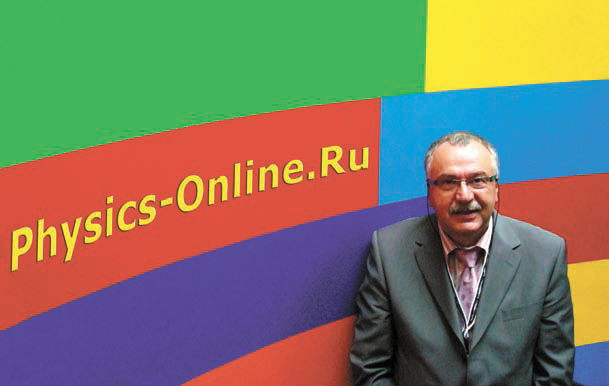
Recently, a new project has appeared on the Web - Physics - Online . ru . Its creator is the Publishing House of Turpion LTD . Turpion publishes English versions of Russian scientific journals (“Success of Physical Sciences”, “Quantum Electronics”, etc.). Lev Malov, General answers Sergei Popov questions Manager Turpion Ltd.
- PHYSICS - Online project . Ru Created by the publishing house. How unusual is this situation? How often do publishers go to the network not only for posting electronic versions of magazines and publishing news about their work, but also for creating forums, blogs, etc.?
 - You asked a key question to understand the problem: what is the role of the scientific publisher today, and whether it will change in the near future. No matter how trivial sounds, but there is no more universal approach to predict the future than understanding the past. Over the centuries, the concept of publication of the scientific journal remained unchanged - first the selection (review), then the publication (seal). This was influenced not only by the causes of an academic nature, but also by purely economic factors: the process of publishing a magazine in paper format and its distribution is quite expensive. In the 90s of the last century, the first electronic magazines appeared. Publishers of scientific societies were pioneers in this field: Institute of Physics Publishing in the UK and the American Physical Society in the United States. By the way, Turpion began to provide subscribers with electronic versions of his magazines since 1997. The functionality of those electronic products of the end of the last century was very primitive, in fact they were only a cheap, convenient and quick way to spread the publication in digital code, usually in HTML or PDF format. Since the beginning of our century, the scientific publishing process has been developing rapidly and mainly in two main directions. The first is functionality: full -text search; various methods of cross-references that allow the reader-user it is easy to move from one source of information to another, often belonging to various publishers; RSS subscriptions to new articles; The possibility of generating a list of articles (documents) referring to this published article, etc. The second, and, in my opinion, the most significant is the actual gradual change in the concept of the scientific publishing process. The Internet has ceased to be only a convenient tool for downloading electronic resources. The network users themselves can communicate with each other, organize “Online Communities”, create electronic resources on the network (“Web 2.0”), and, ultimately, take on the function of “filter” - first publishing Online, then selection. We know well that the main authors and readers of the scientific journal, especially in areas such as physics and mathematics, are the same people. Thus, Web-2.0 gives a unique possibility of an open and possibly more objective review of a particular scientific product. I can fully imagine that in the near future the scientific citation index will calculate not only and not so much according to publications in scientific journals, say indexed in Web of Science , and as a result of active participation in various Online Communities. Actually, the concept of a scientific publication began to change with the creation of the first preprint servers like ARXIV . Org . This is the largest free archive of electronic preprints of scientific articles in physics, mathematics, astronomy, computer science and biology laid out directly by their authors without prior review. By mid -2009, it contained more than 540,000 publications, and each month 3000–4000 articles were added. Upon admission to the archive, publication is automatically added to the Citebase citation database . Org . This allows you to evaluate the citation index, i.e. A formal sign of the significance of the article. It is important that all these changes take place in an evolutionary way, without “revolutionary” shocks (it is always easier to destroy than to build) and were sent by professionals, which are scientific publishers.
Now, returning to your question, I can say that those scientific publishers who monitor today's trends and the number of which I can safely include Turpion and our partner Institute of Physics Publishing can not only, but should also take an active part in the creation of forums, blogs, objectively oriented web portals. Correctly organizing the work of such portals and delicately directing the discussions leading to them, the publisher attracts new authors generating fresh ideas, and scientific editors receive invaluable information about what trends in a particular scientific field and what is most interesting today for publication in a scientific journal. And the result of such activities is a significantly greater quoting of articles and, as a result, the growth of the impact factor of the magazine and its prestige.
- And how did it all begin? Whether the Turpion project appears First in Russia?
-I can be mistaken, but, it seems to me, the first among scientific publishers who began to experiment with Web-2.0, were Nature Publing Group. As they say to themselves, Nature is not a publisher of magazines, it is a Web company that exchange scientific information. Today they provide such well -known services in the world as: Connotea -online manager of links of researchers and scientists around the world; Nature BLOG - a wide selection of blogs in many scientific fields; Nature ProCEEDINGS -Preprint server, allowing researchers to exchange scientific results at the very early stage, to the official publication; and a number of others.
Today, many Western scientific publishers create scientific communities on the Internet. Our partner IOP Publishing has created several thematic forums in various areas of physics on the basis of his portal ( http://pubinging.iop.org/communites/ ).
We wanted to offer a certain set of service functions for our Russian researchers, students and graduate students, who are authors (including potential) and readers of our magazines, so that they can communicate through our portal in a more familiar language - Russian, to discuss both published and unpublished materials. If we consider our project in such a context, then we, as far as I know, are the first in Russia.
- Publishing house Turpion He is engaged in the publication and distribution of famous Russian magazines in English. Why did you choose the Russian language for the site? Will this serve as some brake? After all, 90% of science is made by scientists who do not speak Russian, for them the discussions will not be available.
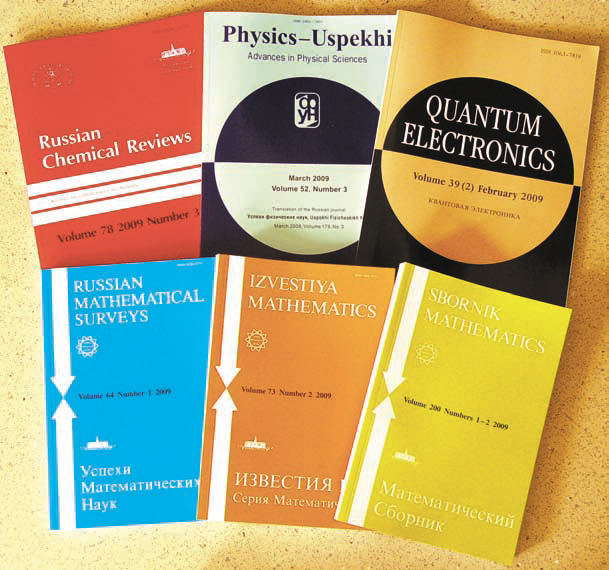 -Then let me again look at at least a little bit into history. The initiator of the creation of Turpion in 1990 (next year we will celebrate the 20th anniversary) was Adam Gelbtuch, a successful British publisher, owner of Pion Ltd. Adam Gelbtuh is a physicist in education, who is fluent in five languages, including Russian, in the 50s of the last century was one of the first translators of L.D. Landau's works in English. In the late 50s, Adam and his company Pion Ltd participated in a large project to translate Soviet magazines in mathematics, chemistry and physics into English together with the British Library, the Royal Society of Chemistry, the London Mathematical Society Mathematical Society). Therefore, for Turpion, one of the directors of which is Adam Gelbtuh, it was quite natural to continue the traditions of popularizing the work of Russian scientists in the world, for this English was chosen-and, importantly, to support the publishing process of Russian magazines that experienced difficult time in the 90s, to translate the publication of magazines to completely new technologies and at the same time propose new business models that are effective in the conditions of the market economy.
The Russian language for our portal was chosen because the Russian thinks in this language, which means that we offer a more natural communication environment for a huge number of people whose native language is Russian. However, already in early September S.G. The English interface of the portal will appear, and the forum itself will be bilingual. We leave the choice of the language of publication/ commentary for authors/ readers, and now they can write both in Russian and in English. Information content, all publications and comments are laid out in the original language. So, for example, the famous preprint server Arxiv works . Org .
- The main idea of the Physics - Online project . ru - Create an environment for communication between scientists. However, the site, of course, is filled with various information. What are the main sections now, and what were you guided by selecting them?
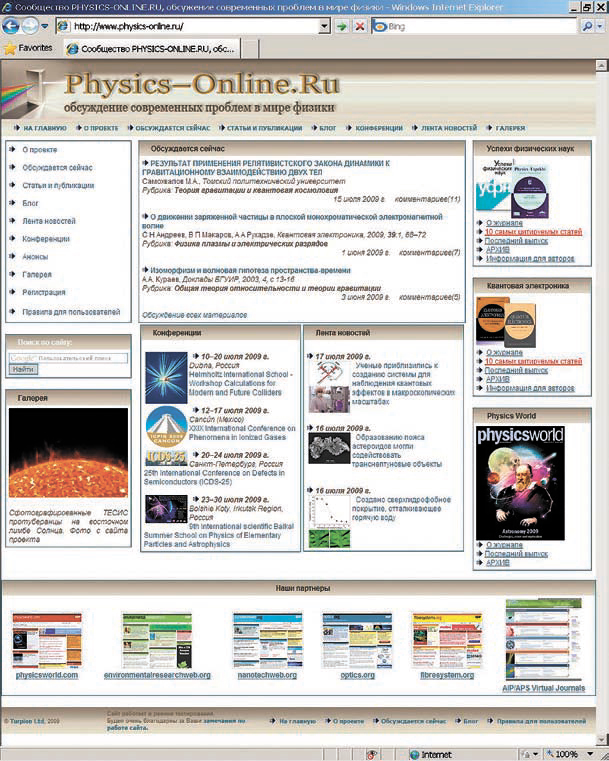 - The principle of selection is quite simple and quite obvious:
1) provide as much diverse and interesting information for the user as possible;
2) moderate a discussion of the most relevant topics and significant materials posted on the site;
3) to initiate users to generate new ideas and publish them on the site, a kind of “brainstorming”. The main headings are “discussed now” and “blog”, the publications themselves and comments on them, which cause the interest of our users. There are headings “News tape” and “Conferences”, which are replenished daily by materials from various sources, including from the sections “Science and Technique” of the news portals “Lenta.ru” and “Computer”, various foreign sources. In the "Gallery" we select the most interesting, in our opinion, illustrations from articles, as well as photographs. By agreement with our foreign partners, we will gradually add links to their electronic resources. Already today , our users can have free access to many articles published in Physics World ” , or to participate in the discussions on the website of the UK Physics Institute, as well as track the most interesting publications in virtual magazines published jointly by the American Institute of Physics and American Physical Society.
We provide open and free access to all resources of the portal to any user, and in order to leave his comments or put his materials on the site, the user must pass a simple registration and get the login and password by e -mail - the usual approach in such things.
I want to make a reservation right away. This is still a pilot project launched in April of this year, and we already see that some structural changes are needed to make the portal more convenient, and the interface is more “friendly” for users. Our experts, Irina Kravchenko and Dmitry Chebukov, who are direct executors of the project, are now working on this.
-Does any of the very famous scientists lead the blogs on the site now?
- No, our concept is different. The idea under discussion is important for us, not a name. In addition, any scientist, including very famous, can participate in discussions or create his own blog under a fictional name, if he wants it. Once again I want to emphasize: we invite everyone - from a student to an academician - to upload interesting materials on the court of readers and actively participate in discussions.
-Have you used the experience of any projects in Russia or abroad, developing the concept of your project?
- Undoubtedly. We have viewed many sites of domestic forums on physical topics. For example, we really like the site of the Nanamometer Internet community, created by the team of enthusiasts of the faculty of sciences about Materials of Moscow State University. Of course, we discussed the idea of a project with our colleagues from Institute of Physics Publing, on the website of which ten portals have been created in various fields of physics and its applications today. In my opinion, we have advanced a little further in conceptual terms, and at present we are discussing various opportunities for cooperation with the iP Publishing and to some extent the possibility of integrating our portals.
- How will the network communication of scientists be able to replace personal communication in the future? Will video conferences crowd out conferences and seminars in Real Madrid?
- I think that network communication is already playing an extremely important role today. The Internet and especially Web 2.0 provide amazing opportunities for communication between people, especially geographically far from each other. Therefore, holding conferences on the Internet certainly facilitates the possibility of participating in them for many young scientists, especially in today's difficult conditions of the economic crisis. But just as the cinema will never replace the theater and the energy exchange that occurs each time between the viewer and the stage action, in my opinion, the personal communication of people will never disappear. And at the same time, it does not matter at all what common hobby unites them - the study of puppies or poetry of Pushkin.
- Publishing house Turpion engaged not only in physics magazines. Are you planning to create projects in other areas of science? Or, perhaps, Physics - Online will expand . ru ?
- Remember: “If you want to laugh God, tell him about your plans”? We have really published translated versions of magazines in physics, mathematics and chemistry for almost 20 years. And we would like to see the further development of our project both horizontally (new areas of science) and vertically (deeper coating in the framework of a separate area). But, indeed, after all, the portal was launched only a few months ago, let's talk about it at least a year later.
- What new services and headings do you plan to offer visitors to the site in the near future?
- In the near future we have to rethink the structure of the portal as a whole. We received responses and suggestions from visitors to the portal, as well as from our colleague publishers, and the priority task for us is to present the already posted information more understandable and accessible. The most important here is the thematic collection of materials. We plan to add a new section “Reviews of new books” with the possibility of discussing them on the site. In the near future we will make it possible for the user to add his own news, information about conferences.
Preparation of an article for publication in a scientific journal requires the author of significant time costs. We want to facilitate the author’s work and provide him with a service package that includes a number of useful functions, such as templates (TEMPLATES) for entering a list of literature (bibliography) in a structured form (say, in XML format).
- How do you see the project in 2018, when the UFN is 100 years old?
- According to Thomson Reuters Journal Citation Reports , the journal "Success of Physical Sciences" ( Physics - Uspekhi In English translation) is included in the ten best physics magazines and has the highest impact factor among all magazines of the Russian Academy of Sciences. UFN is the history and encyclopedia of physics of the twentieth century. It was extremely important for us that the editorial board and editors of the magazine supported us and actively participate in the implementation of our project. We hope that the authors and readers of the UFN will also become regular authors and readers of our portal. Last year, the magazine celebrated its 90th anniversary, and our joint efforts developed a special website dedicated to this wonderful event, http://ufn.ru/ru/ufn90.html .
Let's dream. After 10 years, I would like to see our portal as a starting platform with unlimited access to the critical mass of domestic and world resources in physics, mathematics, chemistry and other natural sciences. I can assume that today's business models in the publication of scientific journals (subscription, consortiums, the sale of individual articles, etc.) will undergo significant changes. Most likely, the resources themselves will be provided for users for free, but participation in the creation and discussion of these resources or membership in a particular Internet community will require a very moderate fee from the user himself, which, however, will more than cover all the costs of creating and supporting the Online Communities themselves.
But in any case, I am sure that the UFN will celebrate a lot of anniversaries in its history, and the centenary of the magazine in 2018 is only one of the closest dates.