
Translated material
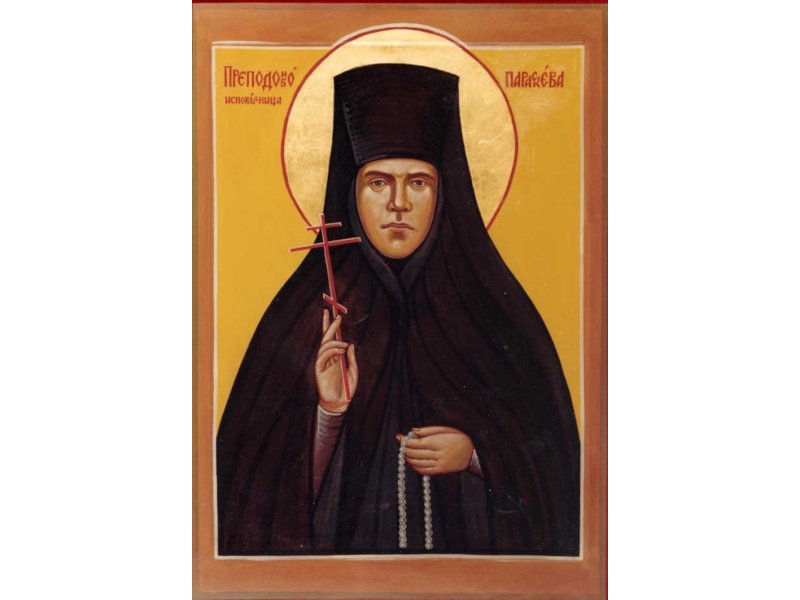
Confessor Paraskeva Mathyshin
The persecution of Soviet power to the Russian Church was such that it was not to say about their faith, but even silently follow it as a feat. The new martyrs and confessors, glorified in the face of the saints did not come: believed, prayed and meekly went to their Calvarys.
“Polit.ru” recalls those who gave their lives for faith and by whose prayers the Russian Church is alive - even if almost nothing came to us besides the name.
Publications were prepared by Kirill Kharatyan (included by the Russian authorities in the register of foreign agents).
 Confessor Paraskeva Mathyshin
Paraskeva-a peasant daughter from the village of Peschanoy Kamenetz-Podolsky district of the Podolsk province. In 1896, when Paraskev was eight years old, her mother died, her grandfather and a younger sister. After his father, Paraskev became the main employee in the house.
The lad out had a desire to go to the monastery early. Grandma did not allow her to think about it. There was a groom. But Paraskeva affectionately explained to the young man that she would not marry, because she was going to the monastery. The young man followed her example, left for Athos and took monastic tonsure. Grandmother told Paraskev that she could not bear the difficulties of monastic life. The girl began to fast and work on herself to prepare herself for hardships. Finally, her grandmother allowed her to go to the monastery.
In 1907, Paraskeva received an obedience to the Theolinsky Transfiguration Monastery of the August County of the Suvalka province.
A few years later, Paraskeva asked for a visit home. On the way, I drove into the Turkovichi monastery of the Diocese. Due to illness, she had to stay in the monastery, and then she decided in the Turkovichi monastery. In 1912, she was adopted among the sisters.
In 1914, during the Germans of Poland, the monastery was evacuated to Moscow, then to Dmitrov. In 1918, after the end of the war, the monastery returned to Turkovichi, and the novice of Paraskeva was left to send monastic property after those who left. However, the Turkovichi monastery soon ceased to exist, and Paraskeva remained in Dmitrov, rented an apartment on the outskirts of the city in the village of Podlipichye and served in the local church of the Kazan Icon of the Mother of God.
One peasant asked Paraskev to teach his daughter to church singing. Others joined her. The choir of girls began to grow rapidly, its number reached 60 people, and there were two choirs. Paraskeva not only taught singing, but instructed the students in the Law of God. She was outwardly somewhat harsh towards her students, but loved them as her own daughters.
In 1920, Paraskeva met with Dmitrovsky Bishop Serafim (Zvezdinsky) and became his spiritual daughter. Vladyka severely led her in spiritual life, but he spoke to others with respect.
Bishop Serafim in 1921 tonsured Paraskev to the Ralesofor, without changing her name, and determined the monastery in the Spaso-Vlaherny monastery.
Soon, the name of the Vladyka received a petition of parishioners of the Kazan Church of the village of Podlipichye to return to the monk Paraskev to Dmitrov to continue the teaching of children to the arrival of their arrival and singing. They promised to provide her with an apartment and food. On July 25, 1921, Bishop Serafim called the toki Paraskev from the monastery “for missionary work in the village”, leaving her among the sisters of the Spaso-Vlahern monastery.
On November 27, 1921, the nun Paraskeva was dedicated to the Lord in the ancient rank in deaconissa, for altar ministry. Since that time, she began to serve in the Kazan Church in the village of Podlipichye, in which Bishop Seraphim very often served and near which he lived.
In 1924, mother Paraskeva was called to the OGPU, where she was ordered to stop classes. But even after that, not having the opportunity to teach girls, she did not leave the care of them and the leadership of the choir.
In 1928, the Spaso-Vlahernic monastery was closed. Mother continued to serve in the Kazan Church. On May 27, 1931, the nun Paraskeva was arrested. She answered the questions of the investigator: “I am deprived of electoral rights as a nun. I entered the monastery in 1912 in the Kholm province ... I stayed until 1914, then we were transported to Moscow, where we were until 1918. In 1918, I arrived in Dmitrov. She rented an apartment in the Podlipetskaya settlement and served in the church. She participated in the choir, taught children church singing. In 1924, I was called to the OGPU and was forbidden to train girls with church singing. Since then, I finished classes with girls and have been a choir as a leader. I do not find myself guilty of anti -Soviet activity. ”
On June 28, 1931, the Troika of the OGPU sentenced the toki Paraskev to 5 years in Kazakhstan. Paraskev was first brought to Alma-Ata, and then determined to work near the city: she was a cook in a large working artel, which consisted of exiles. For the care and compassion she shown to workers, they called her sister. After some time, the monkey was transferred to Alma-Ata. I did not set up on state work, because for several months spent in the artel, I was exhausted - I ate what I had to.
In Alma-Ata, mother suddenly met with her spiritual father, Bishop Seraphim, sent there to exile in August 1932. He lived in the city for three months, and mother could at that time be comforted by joint prayers and spiritual advice of his Abva.
Soon she was transferred to the city of Barabinsk. She ate mostly with cakes, which exiles were baked from her own grinding flour made of spikelet grains selected in the field after harvesting.
The link ended in 1935, and the mother, very weakened and sick, settled in Astrakhan, and then moved to the city of Kirsanov of the Tambov region. Upon learning of the diseases of the nun Paraskeva, the pupils called her to Dmitrov, closer to their native places. Here she was found by the war and hunger associated with her. Mother fell ill with an abscess of the lungs and suffered heavily. Medicines did not help, her condition was considered hopeless. She was already preparing for death, but one night on the second time the visions of the holy apostles of Peter and Paul were given. The apostle Peter promised her recovery and, giving the keys that were in his hands, said: "You will still open these keys to open church doors in the gravy." From this day, contrary to the expectations of doctors, mother began to recover. Having strengthened, she went to Ukraine to her relatives, who accepted her very cordially. Having recovered, she returned to Dmitrov, where she began to work again in the Kazan Church, unlock her in the morning, read, sang and controlled her choir. At first she was found a room near the church. But soon I had to find another housing, further from the temple. Mother every day had to climb the mountain on the way to church. Over time, it became more and more difficult for her.
Over time, mother’s health shaved again. The lung abscess resumed. Arthritis, furunculosis added. She tried to be treated with humility. It became easier for her for a while, but the disease did not pass. It was possible to go to church less and less. She lost an apartment in the city, and had to move to the village of Birlovo. The patient needed care that no one could provide her there. She had paralysis, and she became completely helpless. Mother's suffering was very large, especially from abscesses and pressure sores. Feeling great pains chained to bed, mother Paraskeva not only patiently endured them herself, prayed, but encouraged all her visits and called for prayer.
The nun Paraskeva died on December 4, 1953 and was buried in the cemetery of the city of Dmitrov.