
Translated material
Hell is calculated
At first glance, everything is clear. The young Russian director, whose surname became known in Germany three years ago thanks to numerous publications about the Tangiazer case , chose the Gulag theme for his dramatic debut in Europe. What is called, with a guarantee - if not success, then quite obvious interest. And although Timofey Kulyabin loves to emphasize his indifference to the journalistic theater, it is impossible even to try to imagine that the director and his staged team could not notice the straightforward journalism of this application. This context was calculated by Kulyabin - but a rather complicated and risky way. Because the play “On the Pole of the Cold” staged on the stage of Cuvilli é s Munich residenztheater , the most persistent and even unfriendly way shows not the proximity of Shalamov’s prose to the modern reader, but its almost insurmountable remoteness from him.
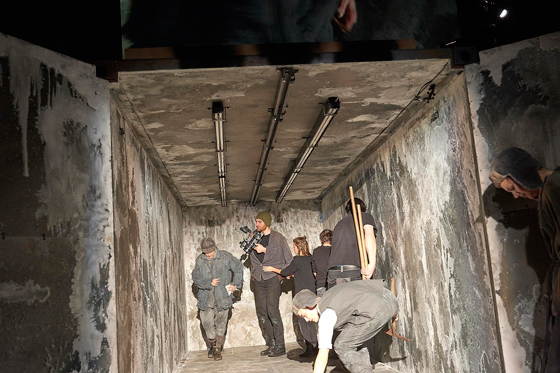
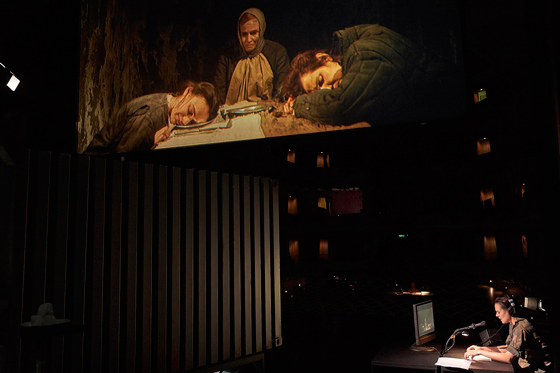
The small and cozy space of the auditorium Cuvilli é s is a rocker museum bonbonniere, which is in every possible way to execute the operas of Persella and Vivaldi in historical costumes and decorations. However, on the dark and empty scene of the Munich viewer, a large, slightly rusted old refrigerator container, created by the artist of the play Oleg Golovko, is waiting for a large, slightly rusted. Near it there are a small table with a lamp and a microphone and a chair. Above the container is a large screen. No significant changes in this mise -en -scene throughout the performance occur - except that in the midst of the halt, figures of mounters and requisitions are busy, and at the table one reading replaces the other.
The camera is an equal narrator in the performance of the Kulyabin, offering its own, very dense, far from always a direct video commentary on the text that is sounding from the stage.
There are no male faces and votes in this performance. Six actresses are employed in it - Nora Buzalka, Sibilla Canon, Paulina Fusban, Anna Grenzer, Hannah Shaibe, Charlotte Swab alternately sit down at the table and read one story in a confusing impassive, almost technical way. Before the eyes of the reading not only sheets of paper with text, but also a computer screen. Even the rhythm in which they pronounce the Shalamov text obeys not only the logic of the phrase, but also the speed of events on the screen.
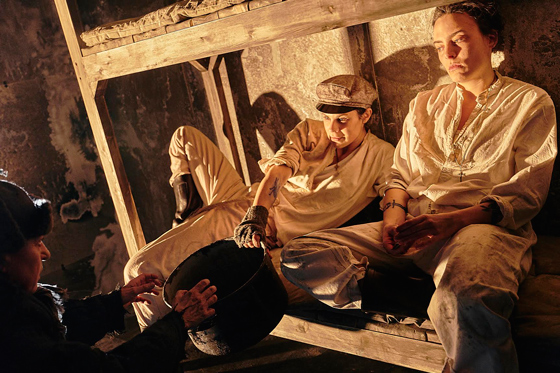
On the monitor of the reader’s computer is the same picture that the viewer sees on the big screen. The inside of the container, covered with frost, and in it - deprived of the floor and voices of the creature in characteristic quilted jackets or Vertukha form (costume designer - Galya Solodovnikov). Together with them in the container is the only operator David Müller: at his disposal, one manual and two stationary cameras, which he also manipulates as a director of installation. The camera is an equal narrator in the Kulyabin play, offering its own, very dense, far from always a direct video commentary on the text of the stories that sounds from the stage.
 © Matthias Horn
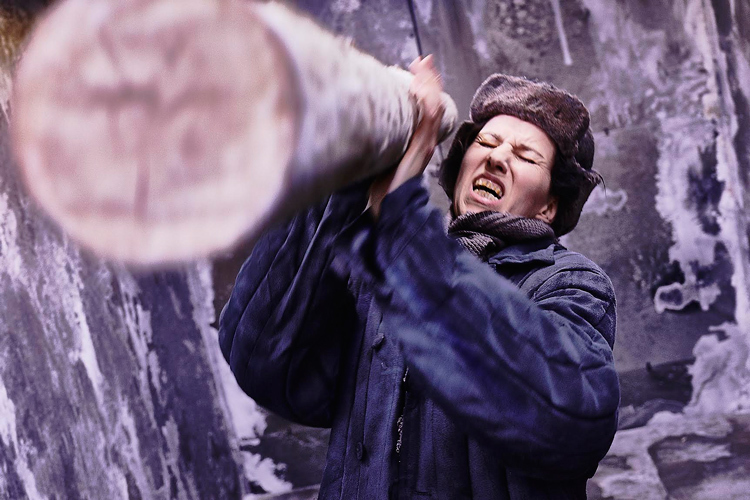
Here it is probably necessary to clarify that Residenztheater with all its status is still a very acting theater, that for Germany as a country of winning active directing is no longer very characteristic, and therefore very valuable in its own way. In Resi , as Munich’s affectionately called it, despite the abundance of large directorial names in the poster, and the audience and the troupe still value the moment of direct communication between the actor and the hall-with the notorious “energy”, which directly whips into the hall during lengthy monologues. Kulyabin ruthlessly took away all his actresses with his voice, Gender (since they play men) and the very opportunity to see and “break through” the auditorium. However, it is this amazing in acting tools that incredibly enlarges every micro -jest in the frame, a turn of the head, suddenly limp back in a tattered quilted jacket, half -frozen knuckles of the fingers that knock and slip off the log on the shoulder. Of course, there are large plans - and quite outstanding in acting (not least because there are few of them). But most of the time of the actress is spent in a container in the roles of boots, sleeves, a spin or even a poorly blurry flashlight jumping through the faces. The flashlight, obviously, is also a role - he takes on the functions of selecting what to show the viewer, which means, like the operator, is also a narrator.
All numerous rearrangements are carried out in front of the public. Large, those between the stories, were shot in black and white and slightly darkened version, so that the viewer can read the poems of Shalamov, which are displayed on top of the picture. Inside the stories, the permutation does not lose color and brightness, so that the audience is clearly visible the coordinated and fast work of the requisition and installation workshops of Residenztheater . This process is fascinating, but inevitably pulls out the viewer from the story of the story, so that in twenty to thirty seconds to immerse it there again.
 © Matthias Horn
It seems that in this performance, Kulyabin wants to freeze not only the stage action, but also the audience in the hall, building a tripled alienation system from what he actually tells and shows. This most complicated directorial move, of course, overturns all obvious poster expectations. Kulyabin consistently passes past all the possibilities of not very expensive, but guaranteed success. But he manages to catch the most important property of the poetics of the Kolyma Stories: in the Shalamovsky method of writing, an empathy is almost completely absent. Neither Shalamov himself nor his heroes demand from the reader either sympathy or justice. The only thing that this text insists on is that he demands to read himself.
In his preface in the booklet, the playwright of the performance Olga Fedyanin puts Shalamov’s Kolyma Stories on one regiment not so much with Solzhenitsyn’s “Gulag Archipelago”, but, first of all, with Dante's “hell”. The consideration about the book shelf is important - this is an indirect indication of the fact that the Shalamov text and its relationship with the modern reader were the central topic of the performance for its creators. The refrigerator container here is not so much a sign of a closed camp space as a book that is closed and chilling, which is difficult to read is even more difficult to read. Such a directorial optics is related “at the pole of the cold” with two other recent Kulyabinsk works in the drama theater - the Chekhov “three sisters” and the “process” of Kafka, where the text itself was a full -fledged hero of the performance.
 © Matthias Horn
This is the local German context that Timofei Kulyabin seeks to get into. The stories used in the play - “Parcel”, “At night”, “Vaska Denisov, the Pigorator of the pigs”, “Berries”, “Housing day” and “dry ration” - sound in Gabriele Luipold, laureate of several bonuses, translator Platonov, Mandelstam, Prigov. Varlam Shalamov was translated earlier, back in 1967, long before the first publications in Russia. But these transfers could not claim either completeness or even copyright permission.
New translations of Loypold were published in the Berlin Publishing House of Mathes & Seitz in a multi-volume Shalamov meeting, which has been published since 2008, edited by the famous Slavist philologist Franciska von Tun-Hoenstein. Seven volumes have already been published, including prose, poems, memories, letters - and this is not the end. Each of this meeting is in its own way that ice container to which Kulyabina is trying to choose the keys. Perhaps the most convincing and expensive success of this performance is not even applause and laudatory reviews, but a fair number of inspired and trained spectators who want to become also readers.