
Translated material
"Night of Science" in Hamburg
In the free Hanseatic city of Hamburg, the tradition of various evening and night cultural events is very diverse: “nights” of museums and theaters are held annually and very popular. The recent innovation - “Night of Science” - replenished the collection of night entertainment. This cognitive action is carried out in Hamburg for the third time, but with such a scale as November 7, 2009, for the first time.
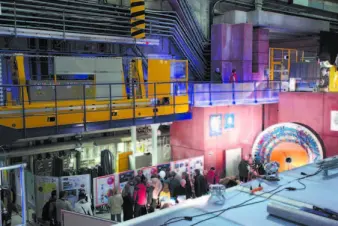
More than 60 scientific organizations opened their doors to visitors, preparing about 650 experiments, exhibitions and reports. Thousands of people visited various institutions of the city. Access was free everywhere, including travel on special buses, plying between the “scientific points of the city”.
At the University of Climata (Clima Campus), inquisitive Hamburgers were able to find out how the weather in the world changes and what would happen to the city if all the ice on the planet suddenly melt. And at the Institute of Experimental virology and immunology. Henrich-Pette-In-Institt Fy Experimentelle Virologie und Immunologie) Visitors gained access to chemical laboratories and learned about dangerous infections and combating them. Employees of the Higher School of Music and Theater talked about visual effects in modern and ancient theaters, about the predecessors of the piano and dismantled the clavier to the components of the details to show how it is arranged. And at the Technical University of Hamburg Harburg (Technische Universitat Hamburg-Harburg), they explained the nuances of flight techniques, held a master class on paper ships and provided aircraft controllers, which immediately gathered a crowd of curious little visitors.
The Deutsches Electronen Synchotron (Desy) program was the longest: “Night” at the Institute of Experimental (mainly) physics began at 12 hours. day, and ended at 12 o’clock. nights. In a vast territory belonging to the institute, four special bus routes operated, with the help of which it was possible to reach the western and northern halls of the hera accelerator (Hera), to the experimental site of Peter (Petra), as well as to the parking place. We have already visited the historical tunnel of Hera-not so long ago, studies turned off, and during the years of his work it was the only lepton-proton collider with a circle of 6.3 km. Amazing sensations! We walked along long tubes, metal boxes, wires, along magnets and traders, and mysterious music sounded nearby, which simultaneously resembled a soundtrack from a thriller and space Odyssey. At equal intervals, bright yellow phones with an emergency number were found, and at the end of the path there were a stretcher of ambulances-the work of the experimenter physics is interesting and unpredictable.
Many Hamburgers visited the more modern accelerator of Peter. Previously, he was a preliminary ring of Hera, now he is rebuilt into a source of synchrotron radiation. The huge hall was dedicated to the future experiment - a linear laser on XFEL free electrons, the construction of which is in full swing. And the information technology department presented a collection of computers on which they conducted and conduct calculations to Dezi - from antique IBM PC 5150 to new sophisticated laptops.
In total, Dezi on this day was visited by more than 13 thousand people.
The long “night of science” in Hamburg turned out to be very short - after all, it was physically impossible to see all the scientific venues in 12 hours. But there will be more opportunities.
Elena Shcherbakova
Photo by Ekaterina Solovyova