
Translated material
The time of fate
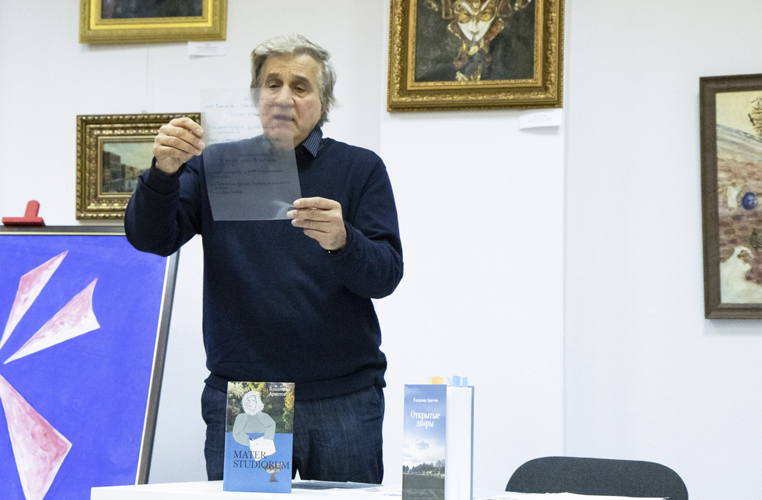
Talking about the new novel by Vladimir Aristov “Mater Studiorum” (“UFO”, 2019), presented at the end of 2019 at several Moscow sites at once, is impossible in isolation from his large poetic book “Open Courts”, published in the same publishing house three years earlier and, perhaps, best representing Aristov as a poet. Aristov is the author of diversified literary gifted: he is a poet, a prose writer, an essay, and a playwright. It is important to note that the prosaic and poetic in his work do not compensate each other, but are the phenomenon of self -sufficient activities. But between them there are mutual currents, the fields of attraction, in a word, a special relationship, which I would like to talk about.
Svuggestia and duration, length and depth, in a word, understanding the spatio-temporal continuum and the search for the most adequate, equal to the present time of forms-this is what both the poet and the prose writer are concerned. Romanic long form, i.e. A wide textual linen, allows Vladimir to simulate or reinvent entire worlds. He consciously works with the switching of the temporite, freely weaving fragments of travetes, philosophical treatises, poetry into the tissue of the story, but this polysemantic saturation does not distract us from the course of the novel and its main topics.
Speaking about Aristov’s poetic works, mainly about small poetic texts collected in the book “Open Yard”, it is impossible not to say about the search and creation of paradoxical connections between objects and phenomena. Without losing their aura, they testify to the continuous interaction of the external and internal, their/alien, articulate the concept of the border as such.
The topic of movement, movement and ultimately travel, for decades exciting the author and in sufficient details he developed in his poetic books, becomes one of the main in the novel “Mater Studiorum” . In the “Other River” (2002, “Comments”, Moscow- St. Petersburg ), Aristists have already made this ambitious attempt to describe the internal landscapes of a person, his worlds through the continuously changing decorations of the external world, through a landscape, sometimes broken, discrete, sometimes continuous, opened and re-discovered by the hero at a state of physical and geographical movement.
What goal is the hero of the novel “ Mater Studiorum ” , a single in three faces - a professor, student, observer - crossing the globe in an vague attempt to catch up with his student, elusive lover and“ mother of teaching ” IRU ? À propos : The recording of the name of the main character by transliteration hints at its difference from the rest, foreignness, and the association recalls the name of the rare element of cosmic origin of Iridia ( Iridium ), designated by the sign IR . We get the answer almost at the very end of the novel from IRI itself: “You decided to travel ... by the time of your life to recognize yourself ... to recognize yourself, which you no longer recognized ... but without space ... without wanderings in space ... without another ... you will never find and will not recognize yourself.” Searching yourself different, yourself in another or two-and subsequent acquisition. By the way, gender self -identification, belonging, or gender as such, uncertain, unsteady, bothers heroes and poetry, and Aristov's prose.
Admired, no, admired
In reflection
And under the spoon a delicate burning
And everywhere on the walls in a swelling
And they and she, and it
("Open yards")
The image of femininity, so attractive to the mystics of various teachings and schools, is in the research focus of Aristov for many years, and as an essyist, publicist. In his article “Soviet“ Matriarchy ”, published in the collection“ Woman and Visual Signs ”(edited by Anna Alchuk, 2000, “ Idea-Press ” ), reflecting on gender identification today, he writes:“ A growing interest in the “Yungg” mixed parameters of a person (without strict separation into feminine-maskulinnaya), in which There is a significantly new understanding of androgynia. Our experience of “overcoming the floor” and then “its acquisition” does not mean entering the “same point” of historical development; We returned impoverished and in some ways enriched by him. By virtue of this, it may not be so difficult for us to perceive the experimental meaning of the gender that is happening now in the world. ”
The spatial-turning experiments, so characteristic of Aristov Poet,-“On the Lane of the Night / Three-Prudy, where it is divided / into Ermolaevsky and Blagoveshchensky / you stood then and now” (“Open Yard”); “In many places we are not identified - here and now” (“open courtyards”) - are carried out, for example, through sharp changes in angles (“a triangular package of milk. / If you cut the angle, / then white praises melancholy. / How a letter is unread / disappears in the night. / Silent. Silent” (“Open courtyards”) and consistently discover themselves in the novel “Mater Studiorum” . The reality of the overflow contains, as a sheet of mobius with its flowing surfaces, the continuity of time and time and their ability to contract to the point, to the point. This becomes the hope of a modern person, his expanding universe. “It seemed to him that all the air in the audience was not that stale, but filled with some kind of barely perceptible fog ... It was, as he later determined for himself, the nostalgic smell-almost unnecessary smoke-the smoke of a distant fire, far from space, but in time-the smoke that he heard when it was from the evening river” ( “Mater” (Mater Studiorum " ). How clearly it has something out from “from the depths, from the inside we saw / we saw / shining day / retreated as if we were not believing our eyes / because the window was opened like light / in the world huge” (“open yards”).
At the time of a special connection with the event, the psyche acquires a healing ability to return to an expensive lost past, lively spathing mental injuries and fractures of the protagonist, healing his life and fate: “... and he extended his hand to feel the fabric that was perceived in the dark, and recalled their last winter night. Actually, he continuously returned to her, he was so constantly in this repetition that he did not even notice, and all his wandering around the world in pursuit were weak, as if behind the ghost of that night - to return it, but he himself was woven from it, and now, when all this was returned in a unique and unclear instinct, he feels that the world was returning again that there was no more world that there was no more peace chase. Now it was as if his name has returned with the history of his family and himself ”( “ Mater Studiorum ” ).
The integrity, fullness of being, a continuum, in which there is no more discreteness, but only the acquired trinity of the times, through the elusive, slipping and - located again next to him, at his eyes and hands IRU - this is the centripetal power of the novel, its thrust, that the time of the fate of the protagonist slides and moves.
Poetic speech and, it seems, poetic breathing itself, its tempo, proportionate to human breathing, running, going, crazy, fading; Poetic breathing, proportional to the rattles of glass in the vestibule of a provincial train, and a flickering landscape behind bus windows, and outbursts of a blessed, not always comfortable light that illuminates the path to our hero, uncontrollably appear in the novel, expanding and expanding meanings. Crossing over the boundaries of time and space, through the disparate and fragmentary, reconfiguration of the world in its immature integrity. Aristov’s poetry in her czura-transpans and a sharp difference in intonations rhymes with the street dialogues overheard of the main character in “Mater Studiorum” . “But in the failure, in the error, in a random distortion of the voice, great value may be hidden. In it you can see and grow a new, unforeseen meaning ”( “ Mater Studiorum ” ). “Growing meanings” is what unites both prose and poetry of Vladimir Aristov.
One could still talk about the “poetry of vision”, about irony, about the specially overcome inertia of transgumanism ... And here it is impossible not to say about the image of a lion, the final element of this trinity: after all, the main character and IR A on a new journey beyond the unknown boundaries of the novel come out. It seems that we had known about its existence before, heard his intonations, glimpsed in the collection “Open Yard”. The lion, speaking in the languages of a person, is remembered and legitimized by the hero of “Mater Studiorum” not somewhere, but at the Christmas party-mud. Being in a hidden casket of children's memories, when the wonderful does not seem to us something supernatural, this touching character refers us to the experience of human childhood, to the archaic, to the apocryphrus, where stones, plants and animals are given the gift of speech, the gift of reason, the gift of insight. “He did not think about it later, but precisely because he did not think, but kept in the depths of memories, he was able to perceive everything simply and recognize Leo” ( “Mater Studiorum” ).
The healing power of recalling, recalling and free, free circulation inside itself - all this provokes the emergence of new meanings that are constantly arriving in waves, updated and renewing us. And this is Perpetuum Mobile Roman.
Almost thirty years ago, one poet asked a sacramental question from the category of eternal: "Does time heals everything that it destroys?" I want to answer him with the final lines of the novel “Mater Studiorum” , which, as it seems to me, contains a recipe for the cure: “And he, who remembered his name, and his name was a lion, suddenly stepped, as then in the first school class of the first September in his hands, going, not believing himself and his steps from the happiness of the upcoming knowledge, down the mother -in -law. And the three of them entered the crest of the pass to pass through. ”